
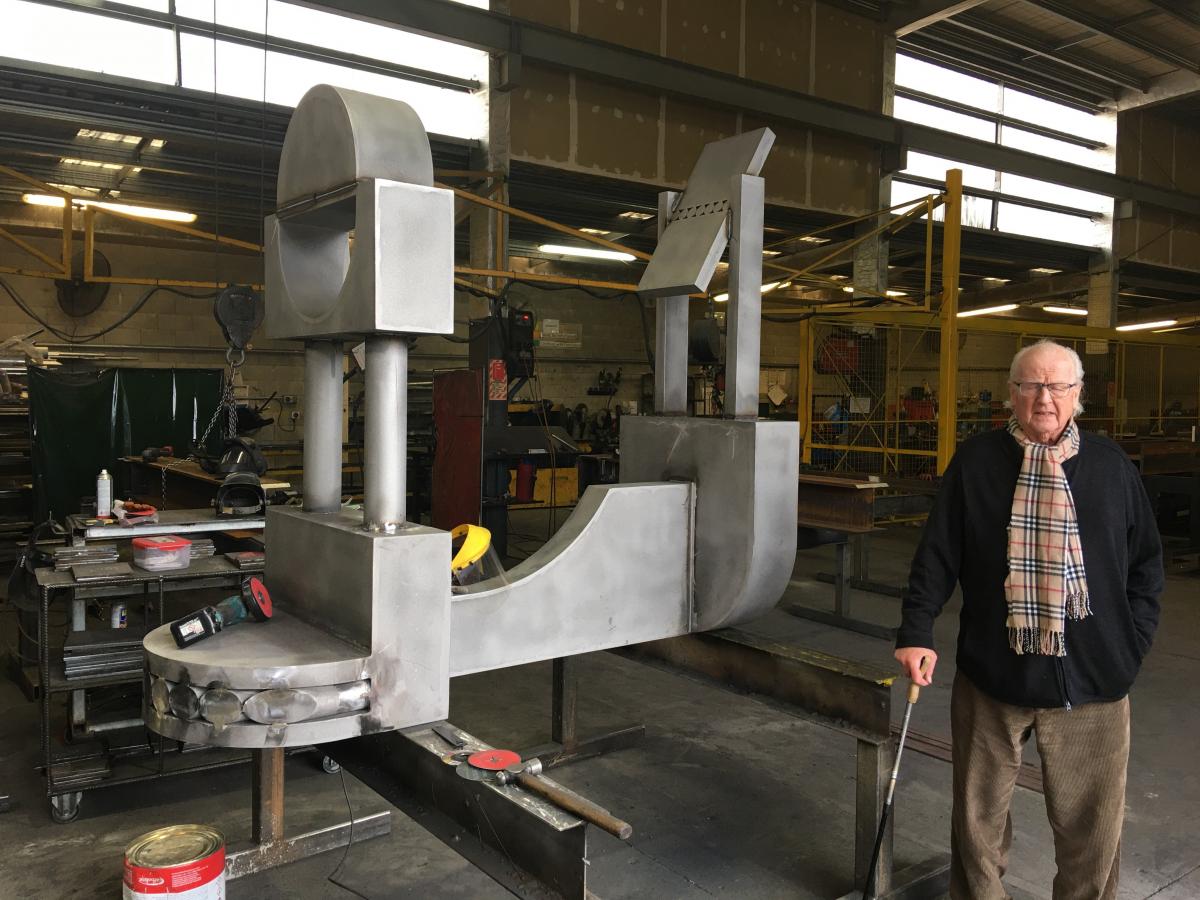
Queenstown sculptor Morgan Jones’ latest exhibition ‘‘Drawings in Space’’ features a range of the artist’s work, from his recent white card wall works to his large metal sculptures at St Clair gallery Fe29. He talks to Rebecca Fox about his drive to sculpt.
At 92 years old Arrow Junction sculptor Morgan Jones may have slowed down but he cannot stop making things.
‘‘I must actually do it. I don’t do it for the money. I have never, ever started a piece of sculpture thinking, ‘oh, I’m going to make some money out of this’. I never think like that. I only make sculpture because I’ve just got the urge to make it. That’s all.’’
A broken leg about five years ago means he cannot work in his studio any more, something he misses greatly, so he has had to think about other ways to make work.
He came up with the idea of making wall pieces or ‘‘reliefs’’ from white card.
‘‘I make them and then paint them white, they are white already but they’re not white enough. No-one’s going to take any notice of these white wall pieces that I’m doing now, but I’ve got satisfaction and that’s what matters to me.’’
The loss of his wife Pat last year has caused Jones to question the point of life, but he still wants to make things. More recently though, his drive has taken a knock due to illness.
When talking about his work, Jones says it is the idea behind a work that is the most important thing, something he realised right at the start of his sculpting career when he was about 26.
‘‘The idea that I struck at that age was the idea of law and order and that’s where, really, all my work comes from.’’
Back then, Jones, who was born in Surrey, England and spent part of his childhood in London during World War 2’s blitz, was working in a bank.
‘‘It was bloody awful. God almighty, never advise anyone to join a bank and work in London.
‘‘Anyway, I broke away from it and joined the Forestry Commission.’’
It was during his time training in Wales that he had the opportunity to carve a piece of wood, although he had no interest in art at that time.
‘‘And I had, suddenly, into my head, I thought I’d like to carve a face, a head, or someone. So I started carving it. And what surprised me was, it actually looked like a head. There was a nose that came out of it, there were eyes. It actually looked as though it was something.
‘‘That’s how it all started.’’
He came out to New Zealand in 1955, aged 21, after accepting a job with the New Zealand Forestry Service and went on to train and work as a teacher in Canterbury.
Jones continued to carve wood right through to the 1970s — one of his works from this time, Rural Machine, is being shown at Aigantighe Art Gallery as part of an exhibition, ‘‘New Vision Gallery’’, until August.
‘‘Back then it was hammer and chisel. I would have considered using a power tool as being a bit of betrayal.’’
But soon after he recognised how limiting wood was and that he needed to ‘‘construct something’’, a realisation that literally came to him one day in 1974 while he was standing in front of a class of children in rural Ashburton.
‘‘It came into my head how I could actually construct something.’’
The previous summer he had made his children a centreboard sailing dinghy out of plywood and fibreglass and he realised the flexibility those products could give him.
‘‘So in that instant, I conceived a piece of sculpture. As soon as school was over that day, I went into Ashburton, I bought the plywood, I bought the fibreglass, as though I was going to make a yacht and made a piece of sculpture.’’
That work, Jaws, won the Hansell’s Sculpture Award in 1975, the only contemporary sculpture award in New Zealand at the time and national recognition for his work.
‘‘And that really, really set me up. The Arts Council started giving me grants to travel to places, take part in things.
‘‘To go to the United States and travel around to all the great galleries.’’
In his artist’s statement for a retrospective of his work, ‘‘Journeys and Decisions’’, at Christchurch Art Gallery in 2004, Jones described the freedom the construction process gave him.
‘‘The means and ability to move outwards from any given theme, unhampered by boundaries or the limitations of a single block of wood, or a given type or amount of material.’’
In the statement, he also says how important it was to him that for any sculpture to be fully realised it had to ‘‘be well made and strong’’.
‘‘Although unseen all my sculptures have an internal structure based on what I learned as a young boy when I made model aeroplanes that would fly and return to Earth without breaking.’’
For that exhibition Jones, who has lived in Arrow Junction for about 30 years, constructed from painted steel Scissor, which stood almost 4m-high outside the art gallery.
By that time Jones had already become known for his large steel sculptures. In 2011 he submitted a photograph of a marquette, a small three-dimensional model of an idea, to Denmark for the ‘‘Sculpture by the Sea’’ exhibition in Arhaus and was accepted.
His idea of a keyhole sculpture that was 5m×3.3m and 1.9m-high was constructed in Dunedin by Zeal Steel before the nearly 3-tonne work was shipped to Denmark.
‘‘We had a wonderful time — there I was with 100 other sculptors from all over the world.’’
That led him to search out other ‘‘Sculpture by the Sea’’ exhibitions and he applied for Sydney’s Bondi exhibition and was accepted. The exhibition attracts about 100 artists from all over the world exhibiting along a 2km coastal walk.
‘‘I’ve found what the key to ‘Sculpture by the Sea’ is that you have to make a very large piece of sculpture that will stand out in the landscape.’’
On his fifth year of exhibiting in 2019, at age 85, his COR-TEN steel work, the 2.5m-high, 4m-long The Sun Also Rises garnered him the Aqualand Sculpture Award and a $70,000 cash prize. It was gifted by Aqualand to be part of the North Sydney Council’s public sculpture collection.
‘‘That’s my brag, I was the first New Zealander to actually be in the ‘‘Sculpture by the Sea’’.
‘‘I was certainly the first New Zealander to win it.’’
TO SEE
Morgan Jones Fe29, April 16-June