
Main PointsUS president Donald Trump has said US forces will remain “in place” until Iran complies with the “real” ceasefire agreementHe said the US will start “shooting” again unless Tehran fully complies with the deal The absence of Strait of Hormuz reopening in any meaningful way has worried markets and oil prices edged higher overnight Trump has said talks with Iran on the 10-point two-week ceasefire plan will be held behind closed doorsIsrael insisted that its fighting in Lebanon, which it says is targeting Iran-backed Hizbullah, must be considered separate from the war on IranSeveral states in the Gulf region accused Iran of breaking the ceasefire and Iran has previously stated that Lebanon must be included in any truceThe United Nations criticised Israel for Wednesday’s attacks on Lebanon which the authority said resulted in ‘significant civilian casualties’ Best Reads
Hugh Dooley – 15 minutes ago
Ceasefire must cover Lebanon says French foreign ministry
The ceasefire agreed by Iran and the United States must also cover military actions in Lebanon, French Foreign Minister Jean-Noel Barrot said on Thursday, adding France condemned “massive” Israeli strikes the previous day.
Barrot added that he expects Iran to make a series of concessions as part of the peace talks due to start in Pakistan.
“Iran must give up to have nuclear weapons and means to obtain them, must give up using its missiles and drones to threaten countries in the region and give up supporting groups like Hezbollah, Hamas and Houthis who destabilize the region,” he said in an interview with Radio Station France Inter.
Iran must also open the traffic in the Strait of Hormuz, he said. – Reuters
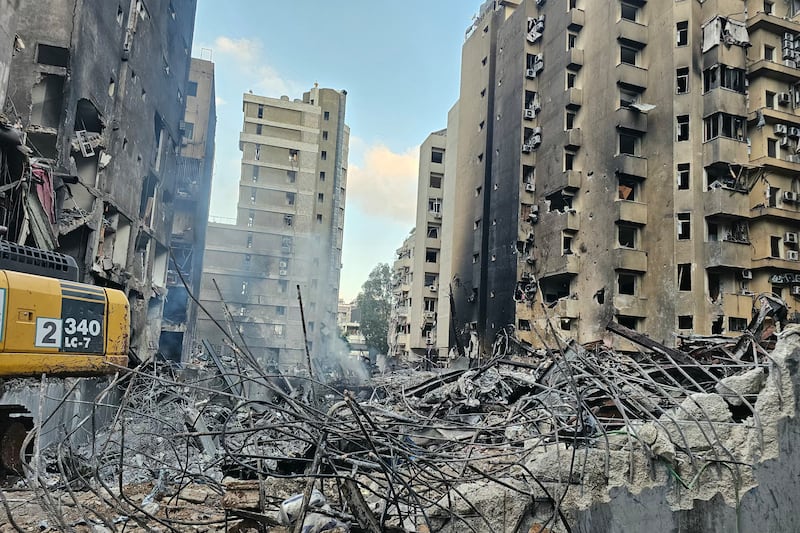 A picture taken on April 9, 2026 shows the aftermath of the previous day’s Israeli airstrikes that targeted southern Beirut’s al-Mazraa neighbourhood. The Israeli military said it struck a Hezbollah commander in Beirut on April 8, after Lebanese state media reported that Israel had targeted a residential neighbourhood in the capital. (Photo by AFP via Getty Images)
Hugh Dooley – 19 minutes ago
Iranian official deletes post about new US talks
After posting to social media that an Iranian delegation is set to arrive in Islamabad tonight for negotiations with the US, Iran’s ambassador to Pakistan, Reza Amiri Moghadam, appears to have deleted the post.
Moghadam had posted: “Despite skepticism of Iranian public opinion due to repeated ceasefire violations by Israeli regime … Iranian delegation arrives tonight in Islamabad for serious talks based on 10 points proposed by Iran.” That post no longer appears on his X account. – The Guardian
Hugh Dooley – 28 minutes ago
IDF claims dozens of Hezbollah killed in ‘expanded’ operations
The Israel Defense Forces (IDF) has claimed to have killed “dozens” of Hezbollah fighters in its “expanded” ground military operation in southern Lebanon over the past week.
In a series of posts on X, the IDF said its forces have operational control of the area and will continue to strike what it described as Hezbollah infrastructure. The Lebanese civil defence service said at least 254 people were killed in the Israeli strikes on southern Lebanon yesterday, and more than 1,100 others were wounded. – Agencies
Hugh Dooley – 36 minutes ago
Israel attempts to restart domestic natural gas production
Israel’s energy ministry said on Thursday that it had instructed Energean to begin resuming operations at the Karish natural gas platform off Israel’s Mediterranean coast following the ceasefire with Iran.
Before the shutdown, oil and gas giant Energean produced 15,000 barrels per day of oil alongside gas. Following facility upgrades, production will hit 20,000 bpd upon restart, helping offset deferred income. – Reuters
Hugh Dooley – 48 minutes ago
Fuel shortages from Gulf threaten food supply in South Asia
The fuel crunch from the Iran war is rippling through Bangladesh’s countryside, leaving tens of thousands of farmers struggling to secure diesel for irrigation at a critical stage of the paddy season.
Rice is a staple food in the South Asian nation of 175 million people and late March is a crucial window for sowing the main summer crop. But diesel shortages, rationed sales and long queues at fuel stations are disrupting irrigation, heightening concerns about plant growth, lower yields and increased losses for farmers.
Bangladesh relies on imports for 80 per cent of its refined fuel needs with much of that coming from the Middle East. Service stations frequently hang banners at the pumps reading ‘No Fuel’, with farmers queueing throughout the day for diesel.
Price volatility and supply disruptions as a result of the war have squeezed supplies, but while the government has introduced measures to conserve energy and find new sources of fuel, farmers say they are struggling.
Pump operators say they are struggling to meet demand. “Farmers need a lot of fuel in this season,” said Abdul Salam, a local pump manager. “We are following government guidelines, but the supply we receive is not enough.” – Reuters
Crude oil could sit at $100 for rest of 2026 – Goldman Sachs
Brent crude is set to average more than $100 a barrel right through 2026 if the Strait of Hormuz were to remain closed for another month, according to Goldman Sachs Group.
“The situation remains fluid,” analysts including Daan Struyven said in a note following the start of a two-week ceasefire between the US and Iran, noting comments from US Vice President JD Vance that the truce was fragile. “We continue to see the risks to our price forecast as skewed to the upside.”
At present, Goldman’s base-case outlook is for energy flows through the strait starting to pick up from this weekend, followed by a gradual, one-month recovery in Persian Gulf exports to pre-war levels. Under that scenario, Brent is seen averaging $82 a barrel in the third quarter, and $80 in the fourth.
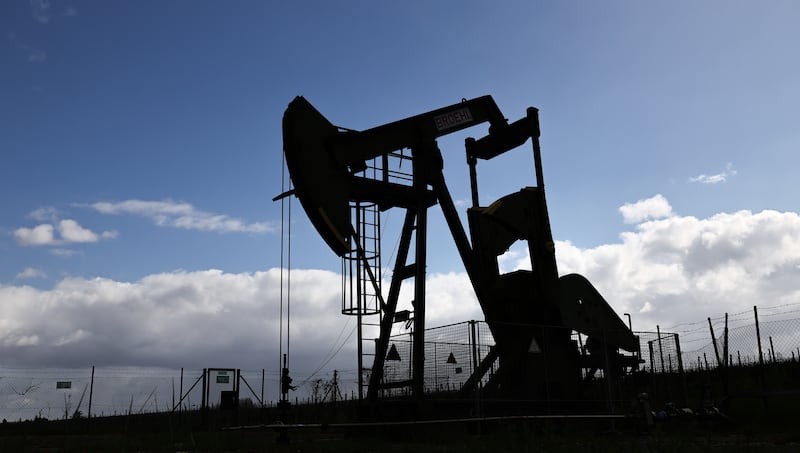 The global oil benchmark, Brent Crude, appeared to be easing on Wednesday amid heightened geopolitical tensions and ongoing supply concerns.
Under the bank’s so-called adverse view, including the reopening being “postponed” for one month, Brent was expected to average above $100 a barrel in the second half, they said.
Another outcome, based on a longer closure and the loss of some regional production, came with even higher forecasts, with Brent seen at $120 a barrel in the third quarter and $115 in the fourth.
The global oil market remains fixated on the strait, which has been largely closed to traffic since the US and Israeli attack on Iran in February that ignited the war. While Tehran and Washington said they paused the fighting in exchange for a reopening of the conduit, there’s little clarity on what was agreed. – Bloomberg
Japan weighing new release from national oil reserves, reports
Japan is considering a new release of about 20 days’ worth of oil reserves as early as May, Japanese news agency Kyodo reported on Thursday, amid uncertainty over the reopening of the Strait of Hormuz.
Japan, dependent on the Middle East for some 95 per cent of its oil supply, began releasing oil from its stockpiles in March in line with other nations and on its own.
In total, Japan is making available about 50 days’ worth of oil consumption and has asked the International Energy Agency to consider a co-ordinated release of a second batch.
It now has enough oil for 230 days in its reserves.
Asked about the report, a top official at the Japanese at the Ministry of Economy, Trade and Industry, Narumi Hosokawa, told reporters the ministry continues to examine the situation.
To help cope with the energy supply crisis, Japan has started searching for non-Middle Eastern barrels, rolled out gasoline subsidies and stepped up coal-fired generation to reduce the need for liquefied natural gas supplies, which have also been cut due to the closure of the Strait of Hormuz. – Reuters
Ceasefire eases fears but LNG sector scarred, says executive
The liquefied natural gas (LNG) sector has been scarred by the conflict in the Middle East, a top gas industry executive has warned.
The disruption has dented confidence in Gulf suppliers and raised doubts among Asian buyers – particularly poorer countries – over the fuel’s reliability and affordability, according to Menelaos Ydreos, secretary general of the International Gas Union (IGU).
IGU has more than 140 members globally and represents more than 90 per cent of the world’s gas market. LNG prices have, as of last week, soared over 80 per cent since the U.S. and Israel launched strikes on Iran on February 28, closing the Strait of Hormuz.
The narrow waterway that normally carries about a fifth of global LNG supplies.
“Where you have choke points and you have geopolitical events that occur, it impacts security of supply,” he said.
Global gas supply remains ample. But LNG depends on complex infrastructure, specialised ships and predictable transit routes. When those are disrupted, cargoes flow to buyers able to pay more, leaving poorer importers exposed, he said.
That dynamic is critical for Asia, where LNG demand growth has relied on the fuel’s reputation as a stable bridge away from coal.
The reputational impact is particularly sensitive for Qatar, the world’s second-largest LNG exporter, whose supply record has long been a cornerstone of Asian energy security. – Reuters
Hugh Dooley – 2 hours ago
Pakistan declares national holiday in advance of talks
Pakistan has suddenly declared two days of local holidays in Islamabad from Thursday, authorities said, in advance of US-Iran talks due to take place in the capital.
No reason was given in the official notification, but authorities in Islamabad have often announced holidays or restrictions for security reasons in advance of high-profile diplomatic events.
Pakistan has been preparing for high-stakes talks involving US and Iranian representatives.
The White House says the vice president, JD Vance, will be leading a team to the negotiations in Islamabad “this weekend”.
Hugh Dooley – 2 hours ago
Oil prices rebound after biggest one-day drop in six years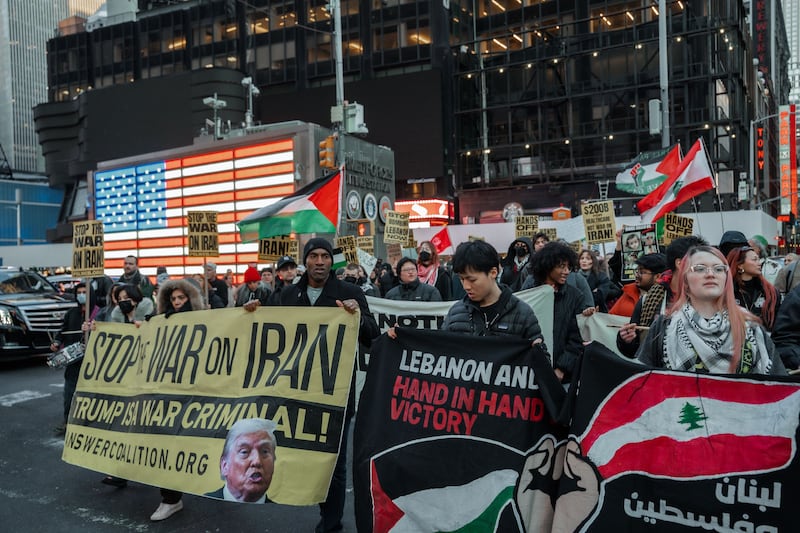 People protest against the war in Iran in New York on Wednesday night. Photograph: Olga Fedorova/EPA
Oil prices rebounded on Thursday after their biggest one-day drop since April 2020, as the Strait of Hormuz remained largely blocked and Israeli attacks on Lebanon threatened to derail the fragile ceasefire in the Middle East.
Brent rose toward $97 a barrel after slumping 13 per cent on Wednesday. West Texas Intermediate was also near $97. Iran’s semi-official Fars news agency reported that passage of tankers through the strait was halted after Israeli strikes, although US vice president JD Vance countered that assertion, saying “we are seeing signs that the straits are starting to reopen.”
On Thursday, two fully laden Chinese oil tankers in the Gulf were approaching the strait, potentially putting them on track to become the first such vessels to cross since the ceasefire was announced. A successful passage is not guaranteed, and there’s been little change in traffic over the past day.
The near-halt of traffic through the waterway – through which about a fifth of the world’s crude and liquefied natural gas flowed before the US and Israel first struck Iran at the end of February – has caused the biggest-ever oil market disruption. Vance will lead a US delegation to Islamabad in Pakistan for direct talks to Tehran on Saturday.
Meanwhile, the Islamic Republic’s Ports and Maritime Organization announced two designated safe routes for vessels entering and exiting the strait, according to state-run Nour News. The passageways were established to avoid possible mines, according to the report.
[ Iran to charge cryptocurrency fees for ships passing Strait of HormuzOpens in new window ]
Even once Hormuz transit picks up, the return of energy supplies won’t be instant. Output has been reduced at oil and gasfields, while refineries have curtailed production or shut down. Some of those will take weeks – or possibly longer – to return to normal.
“This isn’t over just yet,” said Dennis Kissler, senior vice president for trading at BOK Financial Securities Inc. “We will need to see a full opening of the strait with no obstacles before we see crude prices in the low $80s. And I don’t see that in the next two weeks.”
Hugh Dooley – 2 hours ago
Israel kills at least 254 people in Lebanon strikes
Israel carried out its largest attack on Lebanon on Wednesday since its war with Hizbullah began, killing at least 254 people and wounding 837.
Warplanes levelled several buildings in the centre of Beirut, filling the skies with smoke in what Israel’s defence minister said was “a surprise strike” on the pro-Iranian group.
The Lebanese capital was filled with cars crumpled by the blasts and the flaming wreckage of buildings that first responders struggled to extinguish, as Israel bombed more than 100 Hizbullah military sites across Lebanon.
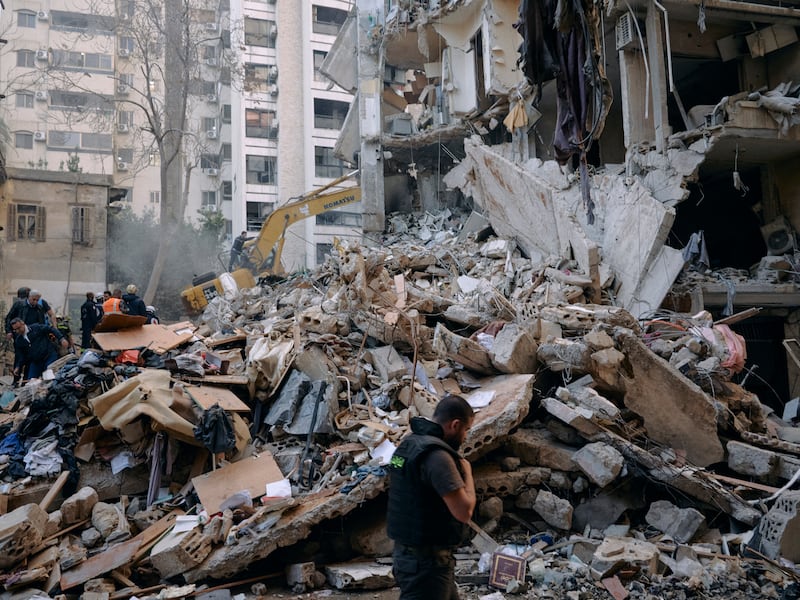 Emergency worker as the site of an Israeli strike in Ain al-Mreisseh, Beirut, on Wednesday. Photograph: Benoit Durand/AFP via Getty Images
The office of Israel’s prime minister Binyamin Netanjayu said the two-week Middle East ceasefire did not include Lebanon, contrary to a statement made by mediator Pakistan – while US president Donald Trump, after initially remaining silent, said Lebanon was “a separate skirmish” and not part of the deal.
Iranian sources told Iran’s Tasnim news agency that the country was ready to exit the ceasefire agreement if Israel “persists in violating the truce in Lebanon”, and the crisis was discussed by Iran’s foreign minister and his Pakistani counterpart.
Israel Katz, the Israeli defence minister, said Iran and Lebanon were separate and that the aim was to “change the reality in Lebanon and remove threats from the residents of the north”.
Katz went on to directly threaten Hizbullah’s leader. “We warned Naim Qassem that Hizbullah will pay a very heavy price for attacking Israel on Iran’s behalf – and Naim Qassem’s personal turn will come too,” he said.
The Red Cross said it was “outraged by the devastating death and destruction” in densely populated areas across Lebanon, adding that the country had been once again plunged into “panic and chaos”. – Reuters
Hugh Dooley – 2 hours ago
UN warns ceasefire at ‘grave risk’ if Israel keeps attacking Lebanon
The UN secretary general Antonio Guterres has warned that ongoing Israeli attacks on Lebanon pose “a grave risk” to the fragile US-Iran truce.
“The ongoing military activity in Lebanon poses a grave risk to the ceasefire and the efforts toward a lasting and comprehensive peace in the region. The secretary general reiterates his call to all parties to immediately cease hostilities,” the spokesman said in a statement on Wednesday.
Hugh Dooley – 2 hours ago
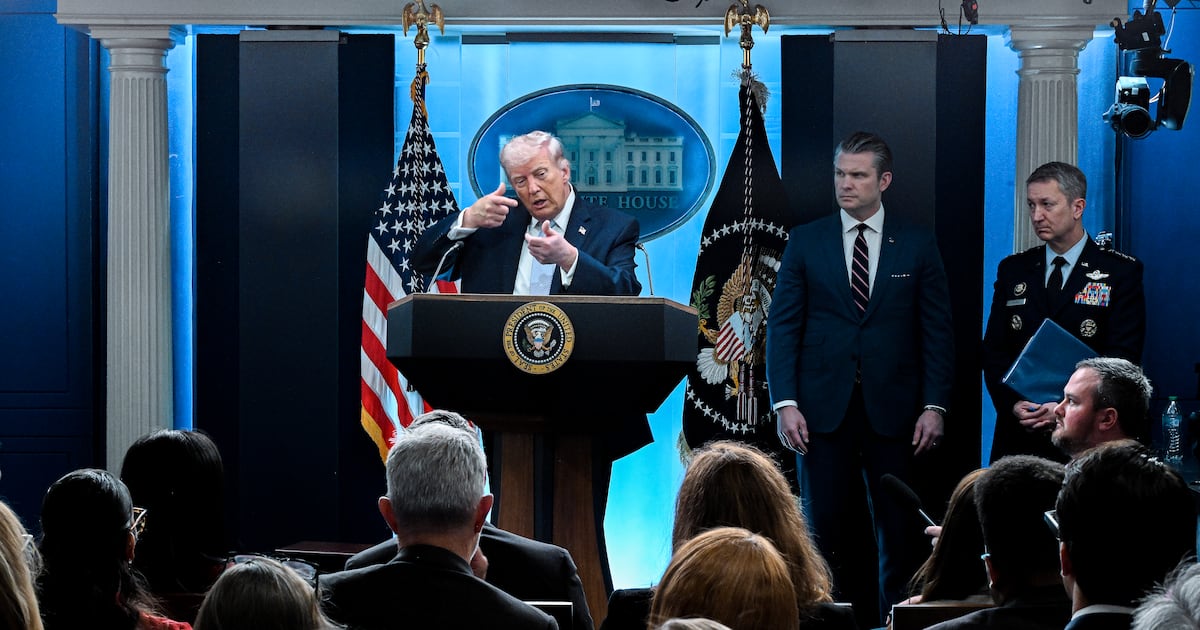
Trump threatens US will start ‘shooting’ again if Iran deal fails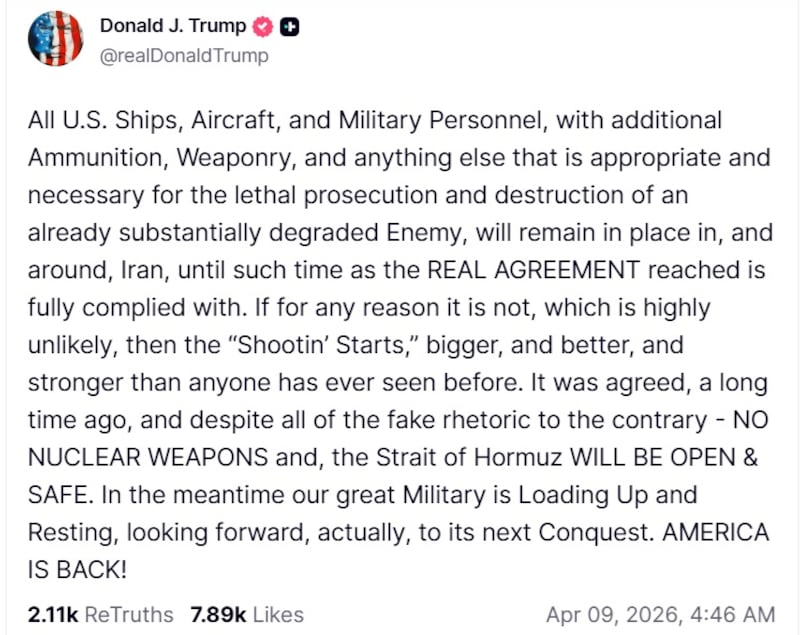 Donald Trump post on his Truth Social platform
Donald Trump has said US military ships and aircraft will remain around Iran and threatened that the US will start “shooting” again unless Tehran fully complies with the deal reached with Washington.
“All US Ships, Aircraft, and Military Personnel, with additional Ammunition, Weaponry … will remain in place in, and around, Iran, until such time as the REAL AGREEMENT reached is fully complied with,” Trump said on his Truth Social platform on Wednesday.
“If for any reason it is not, which is highly unlikely, then the “Shootin’ Starts,” bigger, and better, and stronger than anyone has ever seen before.”
Iran had said earlier on Wednesday that it would be “unreasonable” to proceed with talks to forge a permanent peace deal with the United States after Israel pounded Lebanon with its heaviest strikes yet on Wednesday, killing hundreds of people.
The two sides appeared to be far apart on Iran’s nuclear program, with Trump saying Iran had agreed to stop enriching uranium, and Iran’s parliament speaker Mohammed Bager Qalibaf saying it was allowed to continue enriching uranium under the terms of the ceasefire.
“It was agreed, a long time ago, and despite all of the fake rhetoric to the contrary – NO NUCLEAR WEAPONS and, the Strait of Hormuz WILL BE OPEN & SAFE,” Trump added in his Truth Social post.