
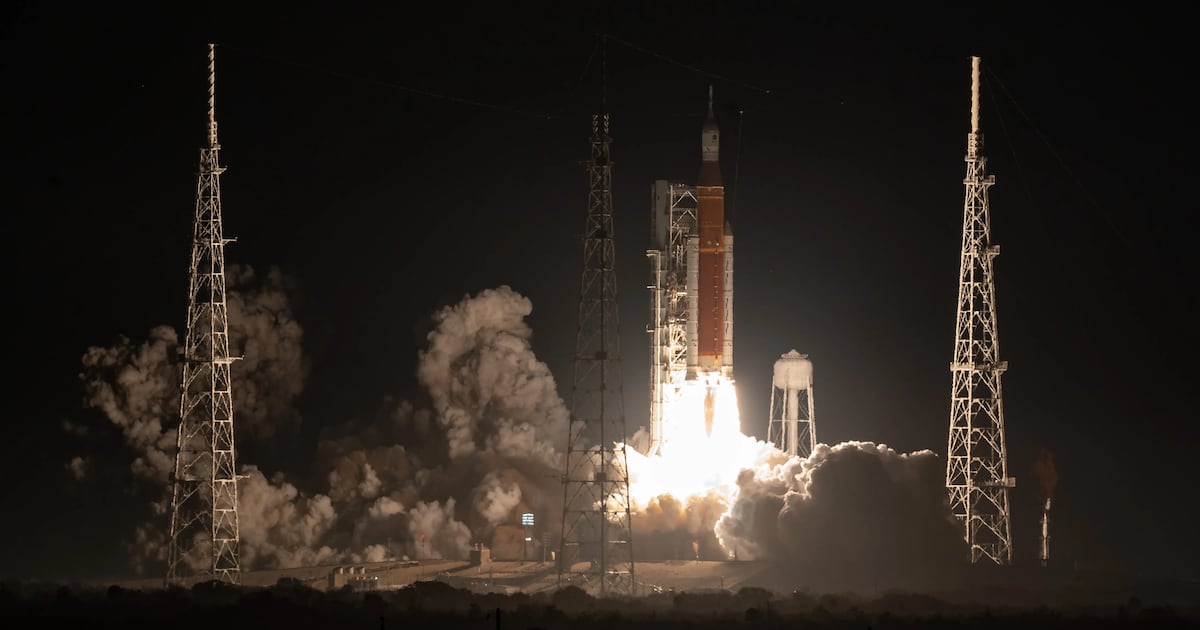
It’s 8am and already my loose-fitting T-shirt and light trousers are sticking to me. At Nasa’s Michoud Assembly Facility, on a hot humid Louisiana morning, rows of folding chairs face a podium where officials wait to mark the roll-out of the first stage of Artemis II.
The rocket emerges slowly from the cavernous building behind us. Without the engineers walking alongside it, you might mistake its four engines for something routine, perhaps akin to the boosters that carry astronauts to the International Space Station (ISS). But they are colossal. This is not a short hop to low Earth orbit. This is a vehicle designed to send humans back to the moon.
There is pride in the air. Nasa administrators mingle with welders and technicians who have spent years shaping alloys into something capable of withstanding deep space. But when the astronauts arrive, the mood shifts. US astronaut Reid Wiseman is quickly surrounded. Jeremy Hansen, Canada’s representative, slips quietly into a seat at the front.
I hesitate, unsure whether to focus on the rocket or the men who will entrust their lives to it. I choose the latter.
“That rocket is going to take you to the moon,” I say.
Hansen smiles, a mix of disbelief and calm. “Yes,” he says, “it will.”
I don’t know what else to add. I only wanted him to know that I see it too; the weight of the moment, the scale of what is coming. This is where Artemis II began for me.
Artemis II was devised as a key step in the long-awaited return to the moon, more than half a century after Apollo 17 left lunar orbit in 1972.
[ Artemis II launch: Crowds gather for glimpse of historic Nasa moon missionOpens in new window ]
Scheduled as a 10-day mission, the plan was to send four astronauts around the moon aboard the Orion spacecraft, launched on Nasa’s Space Launch System (SLS) rocket.
So, why has it taken more than half a century? After Apollo, Nasa redirected its focus to low Earth orbit. Skylab, the Space Shuttle programme and ultimately the ISS, became the centre of gravity for human space flight. For decades, the priority was not going further, but learning how to live and work safely in orbit.
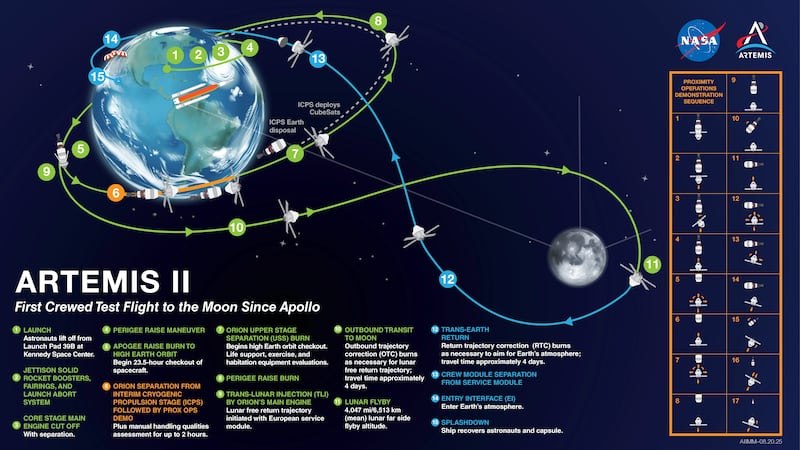 Explaining the Artemis II mission. Photograph: Nasa
Returning to the moon was never simply a question of technical capability. At its peak, Apollo consumed roughly 4 per cent of the US federal budget. Nasa today operates on closer to 0.4 per cent.
Artemis was built in a different era, defined by international partnerships, including the European Space Agency (ESA), and commercial contractors, rather than Cold War urgency. Development of the SLS began in 2011. It took 11 years before Artemis I flew in 2022.
If Apollo was defined by bold countdowns and national spectacle, Artemis was shaped more slowly, under the weight of problems that refuse to co-operate. I saw that first-hand during Artemis I, sitting through multiple launch attempts as engineers struggled to contain liquid hydrogen, a fuel so small it escapes through seals that appear perfectly engineered. Artemis I would not launch until months later, in November 2022.
Artemis II has already experienced its own version of that fragility. Wet dress rehearsals – full simulations of launch day – revealed familiar problems. The first was halted by hydrogen leaks, echoing Artemis I. After those were resolved, a second rehearsal was set back by issues with helium pressurisation, forcing the rocket to be rolled back for further work. With four astronauts on board, there could be no room for error.
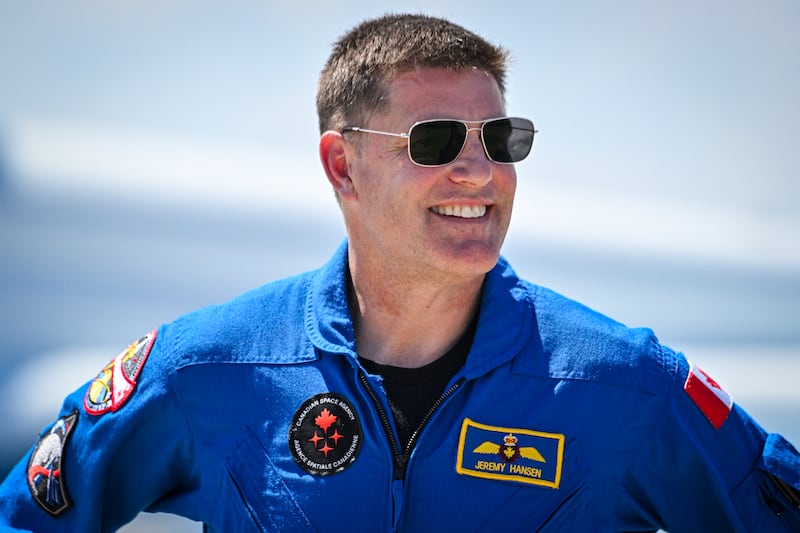 Canadian Space Agency astronaut Artemis II mission specialist Jeremy Hansen looks on during a welcome ceremony ahead of the Artemis II launch. Photograph: Miguel J. Rodriguez Carrillo/ AFP via Getty Images
Lunar missions depend on precise alignment between the Earth, the moon and the spacecraft’s trajectory. The task set for Orion was to perform a critical engine burn at exactly the right moment to intersect with the moon’s position days later. Because both bodies are constantly moving, this alignment occurs only during narrow windows each month.
According to the carefully crafted script for the mission, the powerful engine burn would place Orion on a trajectory towards the moon. Over several days, the crew would test life-support systems, navigation, communications and radiation monitoring in deep space, a far harsher environment than lower Earth orbit.
[ Why are humans returning to the moon?Opens in new window ]
Rather than entering lunar orbit, the mission would follow a free-return trajectory, swinging around the moon and using its gravity to redirect the spacecraft back towards Earth. Even in the event of propulsion failure, the crew would still return home.
The four astronauts selected for Artemis II represent both continuity and change in human space flight: commander Reid Wiseman brings experience from a long-duration mission aboard the ISS and pilot Victor Glover flew on SpaceX’s first operational Crew Dragon mission in 2020.
Christina Koch would become the first woman to travel to lunar distance and Jeremy Hansen, the first Canadian to journey to the moon. Together, they are a crew of firsts, but also a test crew tasked with proving that humans can once again travel safely into deep space.
A free-return trajectory requires precise geometry to ensure a safe return and abort scenarios must be possible at every stage. Timing is everything with Orion’s solar arrays needing to avoid prolonged darkness, and re-entry scheduled so that splashdown occurs in daylight. Together, these factors reduce each opportunity to a window of just a few hours.
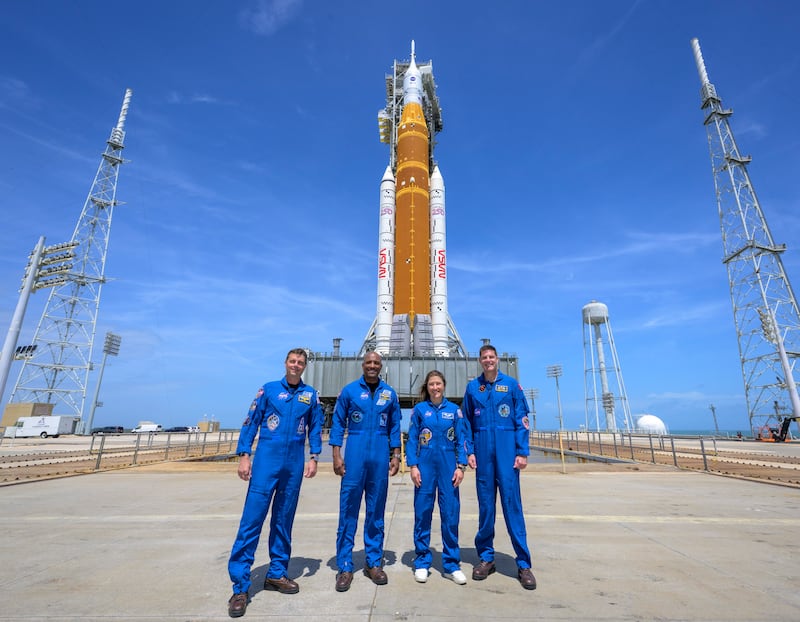 Nasa astronauts Reid Wiseman, Victor Glover, Christina Koch and Canadian Space Agency astronaut Jeremy Hansen. Photograph: Bill Ingalls/NASA/Getty Images
The plan to return to the moon has evolved. Recently, Nasa inserted an additional step into the sequence. Artemis III, originally intended to deliver astronauts to the surface, is now expected to focus on testing how multiple spacecraft systems work together in orbit. A crewed landing is now more likely to take place on Artemis IV.
The reason is simple: complexity. Returning humans to the Moon today depends on capabilities that have never been demonstrated at this scale. SpaceX’s Starship must first be refuelled in orbit – requiring multiple launches and precise co-ordination – before it can travel to the moon and meet Orion. Blue Origin’s Blue Moon lander represents an additional system that must be integrated.
Nasa’s target was to have Artemis III under way in 2027, with Artemis IV – the mission intended to deliver “footprints and flags” – potentially following in 2028.
What emerges is a programme less direct than Apollo, but more ambitious. Artemis is not a single return, but the gradual construction of a system designed to sustain a long-term human presence beyond Earth.
In that sense, Artemis follows a pattern as old as exploration itself. Long before rockets, expeditions established the template: small teams moving ahead, laying down supplies and reducing risk step by step. Apollo followed that logic. Artemis does too.
If Apollo proved that humans could reach the moon, it also hinted at what might follow. Harrison “Jack” Schmitt, the geologist on Apollo 17, was sent not simply to visit, but to study. That shift is central to Artemis.
Across Europe, that question is already being explored. At ESA’s astronaut centre in Cologne, the Luna facility, led by Irish scientist Dr Aidan Cowley, recreates the lunar surface using manufactured regolith. Its purpose is practical: to test how astronauts might operate, build and survive using local materials. This field, known as in situ resource utilisation, focuses on extracting water, oxygen and building materials directly from the lunar environment.
Seen in this light, Artemis begins to look less like a return and more like the early stages of settlement planning.
A successful Artemis mission will mark not just a return to deep space, but the result of years of incremental effort. It has always felt worth the wait, not for the spectacle, but for what it makes possible: a deeper understanding of how humans can travel further, and do so safely, knowing they can come home.
Dr Niamh Shaw is an engineer, scientist and writer