
9 April 2026
Welcome to the Teagasc April Tillage Advisory Newsletter. In this edition, Teagasc Crops Specialist, Shay Phelan brings us key agronomy advice for winter crops such as barley, wheat, oats and oilseed rape and shares management tips for spring crop establishments.
Winter barley
April will be a critical month for winter barley crops to maximise yield, the 5-year average of 8.66 t/ha is below what many would expect, so timing of key agronomic inputs is crucial.
Nutrition:
Complete the main split of nitrogen, total N at Index 1 = 180 kg/ha (144 u/ac). If you plan to go higher than this, consider a third split before growth stage (GS) 32, as barley does not use late nitrogen efficiently and needs its nitrogen working before you see the flag leaf.
Manganese deficiency has been reported again this year and needs attention.
Fungicide:
Teagasc suggest a three-spray program where disease levels are moderate or high. However, many of the newer varieties have relatively good disease resistance, many growers will hope to get away with two applications.
First spray – GS 30/31
Second spray – GS 39/49
Options include: Macfare Xpro 0.8 L/ha, Siltra 0.6 L/ha, Navura 0.8-1.0 l/ha, Elatus Era 0.8 L/ha or Proline 0.4 L/ha + SDHI (e.g. Imtrex)/strob (e.g. Comet).
Where mildew is evident, include a mildewicide.
Plant Growth Regulator:
Aim to apply a plant growth regulator (PGR) on two row varieties between GS 32-37 for effective shortening, e.g. Terpal 1.2-1.5 L/ha, Cerone 0.5-0.7 L/ha, Meddax max 0.3-0.5 kg/ha etc.
For six row varieties or two row varieties on very fertile sites, two applications are generally required, consider Moddus 0.2 L/ha + CCC 1.0 L/ha at GS 30/31 followed the normal timing at GS 32-37.
Watch the weather when applying PGRs, as frost will lessen the effect of the products while also increasing the possibility of scorching. Also, avoid complicated mixes as crops can easily be damaged where there are large swings between day and night temperatures.
Winter wheat
Winter wheat will also need a lot of attention as we try to build a big and disease-free canopy in the crop to catch as much light as possible. 75% of varieties planted in 2025 are susceptible to yellow rust, so this will need to be watched.
Nitrogen:
Complete the main nitrogen application now (before GS 32). This generally equates to half the total amount of nitrogen for the crop if a three split programme is being used and is typically in the range of 100-125 kg/ha (80-100 units/ac).
Apply the third split at flag leaf.
PGR:
Apply PGR by first node (GS 31).
Options include CCC 75% 2.0 L/ha + Adjuvant, K2 1.8 L/ha, CCC 1 L/ha + Moddus 0.2 L/ha or Meddax Max 0.2 kg/ha.
Fungicide:
Leaf 4 spray (T0):
Despite the wet weather, there have been reports of yellow rust already in Champion mainly but also in some of the other susceptible varieties.
Options include Tebuconazole + Pyraclostrobin
Leaf 3 spray (T1)
Apply when 3rd last leaf is fully emerged.
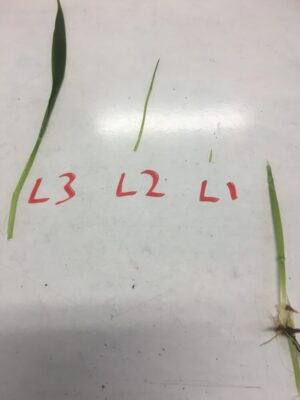
Growth stage may not be an accurate indicator of the actual leaves present in the crop so dissecting plants and identifying the correct leaf to apply the first fungicide is critical for optimum septoria control. (See photo)
In many crops this could still be very late April or early May before the timing is correct even after the mild spring.
Options: Folpet 1.5 L/ha or Sulphur e.g Thiopron +
(Revystar XL, Univoq, Jessico One, Ascra Xpro, etc.)
Winter oats
Winter oats have progressed reasonably well given the weather with most crops around GS 30 by the first of April. Disease levels, especially mildew, are relatively low, but as usual include a fungicide that will control mildew.
Nitrogen:
All crops should receive their full nitrogen by first node. Do not apply more than 150 kg/ha as this will increase lodging pressure and trials from Oak Park also indicate that it will reduce yield and quality.
PGR:
Best growth regulation is achieved when crop is at second node (GS 32-33)
Options include of CCC 75% 2.0 L/ha or Ceraide 1.4 L/ha or CCC 1 L/ha + Moddus 0.2 L/ha or Meddax Max 0.2 kg/ha etc.
Fungicides:
Disease control should start early with the first signs of mildew, and the first two applications generally coincide with PGR applications. Options include;
Talius 0.2 L/ha +/- Proline 0.5 L/ha
Fezan 0.5 L/ha + Midas 0.25 L/ha or 0.3 L/ha or Tern 0.25 L/ha (15m Buffer)
Winter oilseed rape
Most crops have started flowering in late March but again there is some variation in crops depending on the level of pigeon grazing and when fertiliser was applied.
Fungicide:
Sclerotinia is best treated preventively in fields at risk (where rape was grown previously or nearby).
Apply Filan, Proline + strob etc. at the start of petal fall (this is the most effective time for Sclerotinia control as later infection only affects lesser yielding side branches).
Nitrogen:
Apply 40-70 kg N/ha as near as practically possible to flowering, this is to prolong green-leaf area during pod-fill.
Spring crops
Complete the sowing of wheat, oats and beans as soon as possible, spring barley remains to be drilled in many areas but can be drilled well into April. Increase barley seed rate as you drill into April; aim to sow approximately 350 seeds to establish 300 plants.
Fertiliser key points for spring cereals:
Select a suitable fertiliser to deliver sufficient seedbed N for early establishment and sufficient P and K for crop yield.
P trials in spring barley indicate the benefits of placing P fertiliser on P Index 1 soils in terms of rapid root and tiller development.
Recent work in spring barley has also shown that higher rates of K (80-100 kg/ha) can also help to reduce brackling in barley.
Reduce the chemical fertiliser rates where organic manures have been applied.
Apply ~ 30% of the crop’s N requirements at sowing.
Apply remaining N at mid tillering or alternatively split the reaming crop N as follows ⅔ at early tillering and the remaining ⅓ by GS 31 / 32 to reduce the risk of N loss in feeding barley. For malting, apply all the top dressing as soon as tramlines are visible.
Watch crops closely for signs of manganese deficiency and treat as soon as symptoms appear. Tillers can be lost very quickly, and the crops will not have time to recover.
Aphids:
March sown crops usually do not need an aphicide, except in areas with a history of BYDV or near the coast.
April/May sown crops should receive an aphicide at the 3-4 leaf stage for optimum effect.
Use full label rates to get best control but monitor after spraying to assess for resistant aphids.
Weed control:
Early application (4-5 leaf stage of crop) using reduced rates will save money.
Best results when the weed and crop are growing actively.
Weather before spraying will influence how well the weed takes up the chemical.
Table 1: Popular weed control options for spring cereal crops
Suggested rates and products
Sulfonylurea e.g. Ally Max or Cameo Max or Harmony Max etc. ¾ to full rate
+
Fluroxpyr 0.75 l/ha or Galaxy 0.75 l/ha or Pixxaro 0.375 l/ha
Or
Zypar 0.75-1.0 l/ha can be considered almost as a one can solutions for most spring germinating weeds. Check weed spectrum.
Wild oats
Pinoxaden (Axial Pro 0.6L/ha) or Fenoxaprop (Foxtrot) can be applied with certain herbicides on different crop so check each label for restrictions.
Where wild oat sprays are applied separately, obey intervals to maximise the efficacy of the wild oat herbicide.
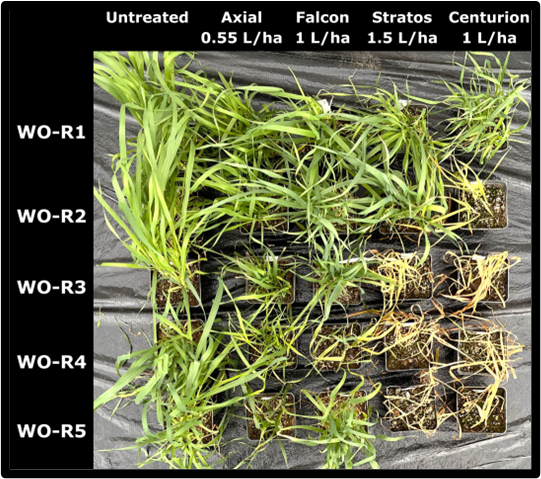
We are seeing increasingly issues with wild oat control so make sure that the herbicides are applied in the best conditions possible. (See photo of some resistant and poor control)
Teagasc Tillage Edge Podcast
For all the latest tillage news the Teagasc tillage podcast is available on the Teagasc website, Apple Podcasts or Spotify. Listen to some recent episodes below:
Keep up to date with Teagasc
Teagasc offers a suite of digital products – ranging from insightful podcasts, trusted eNewsletters, social media, website and mobile app channels – to provide you with the latest news, information and knowledge.