
Newly released documents in the Nuclear Regulatory Commission (NRC) public ADAMS database show that DISA Technologies is seeking federal approval to classify uranium mine waste processed through its HPSA system as “equivalent feed” without a new license application, environmental review or public comment. If approved, that material could be sold to the White Mesa Mill and processed into yellowcake for nuclear fuel, fundamentally changing the scope of the original NRC license granted for cleanup of abandoned uranium mines.
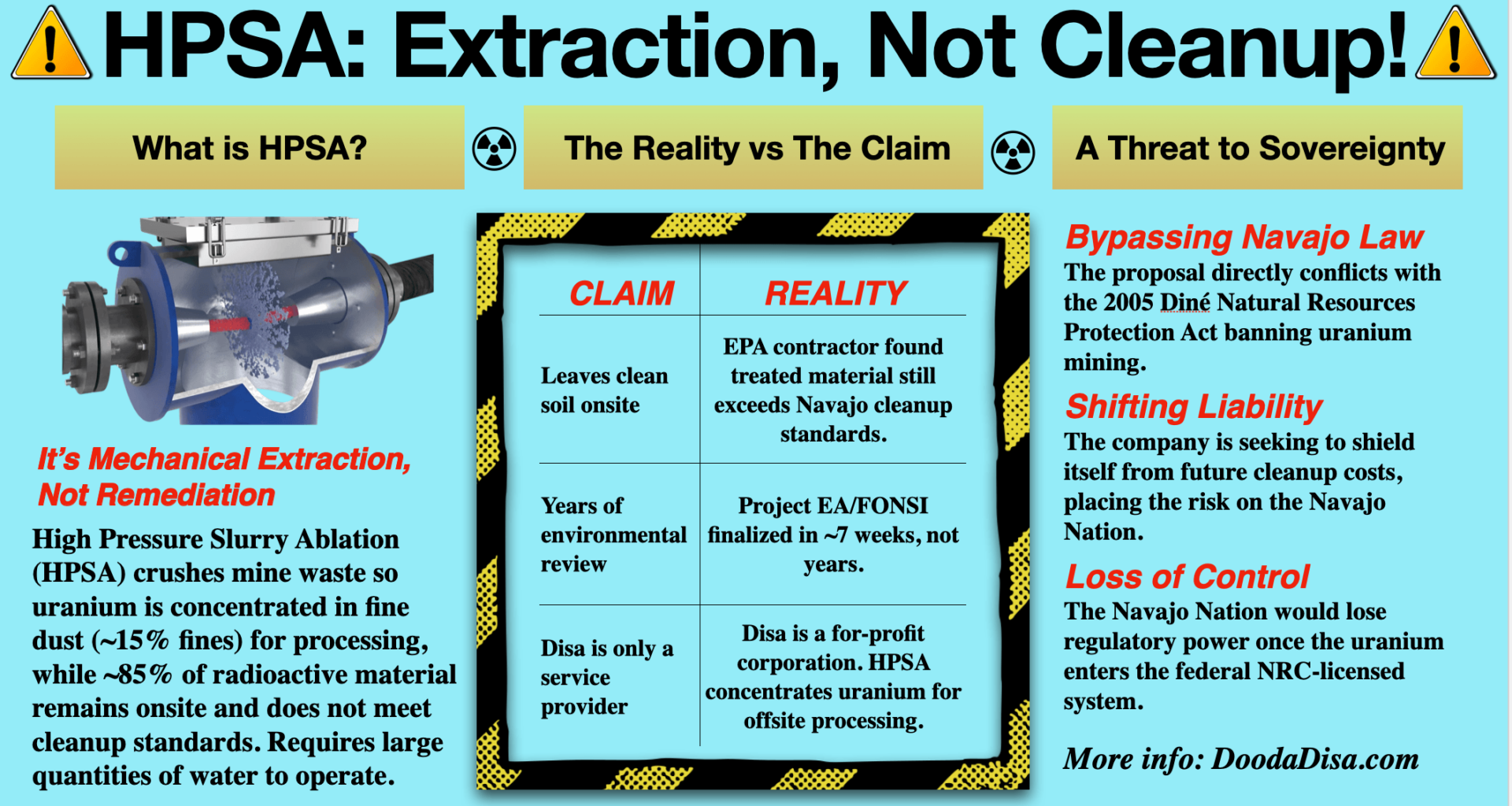
DISA’s High-Pressure Slurry Ablation (HPSA) system uses high-pressure water to break apart contaminated waste rock, separating it into a uranium-rich fraction—”fines”—while the majority of the bulk waste remains on site. An EPA-commissioned study by Tetra Tech was limited, running the system in short-duration cycles—minutes, not continuous operation—and at relatively small scale. The study showed that the remaining coarse material left onsite did not meet Navajo Nation cleanup standards.
Opponents argue that since HPSA cannot meet Navajo Nation cleanup standards, it constitutes uranium extraction — and therefore violates the Diné Natural Resources Protection Act of 2005, which prohibits uranium mining on Navajo land. Nevertheless, Navajo Nation EPA Executive Director Stephen Etsitty, who has been promoting the project, told the Gallup Independent on November 29, 2025: “You just need to scoop it up, you don’t need to mine it. It’s not mining. It’s all remediation.”
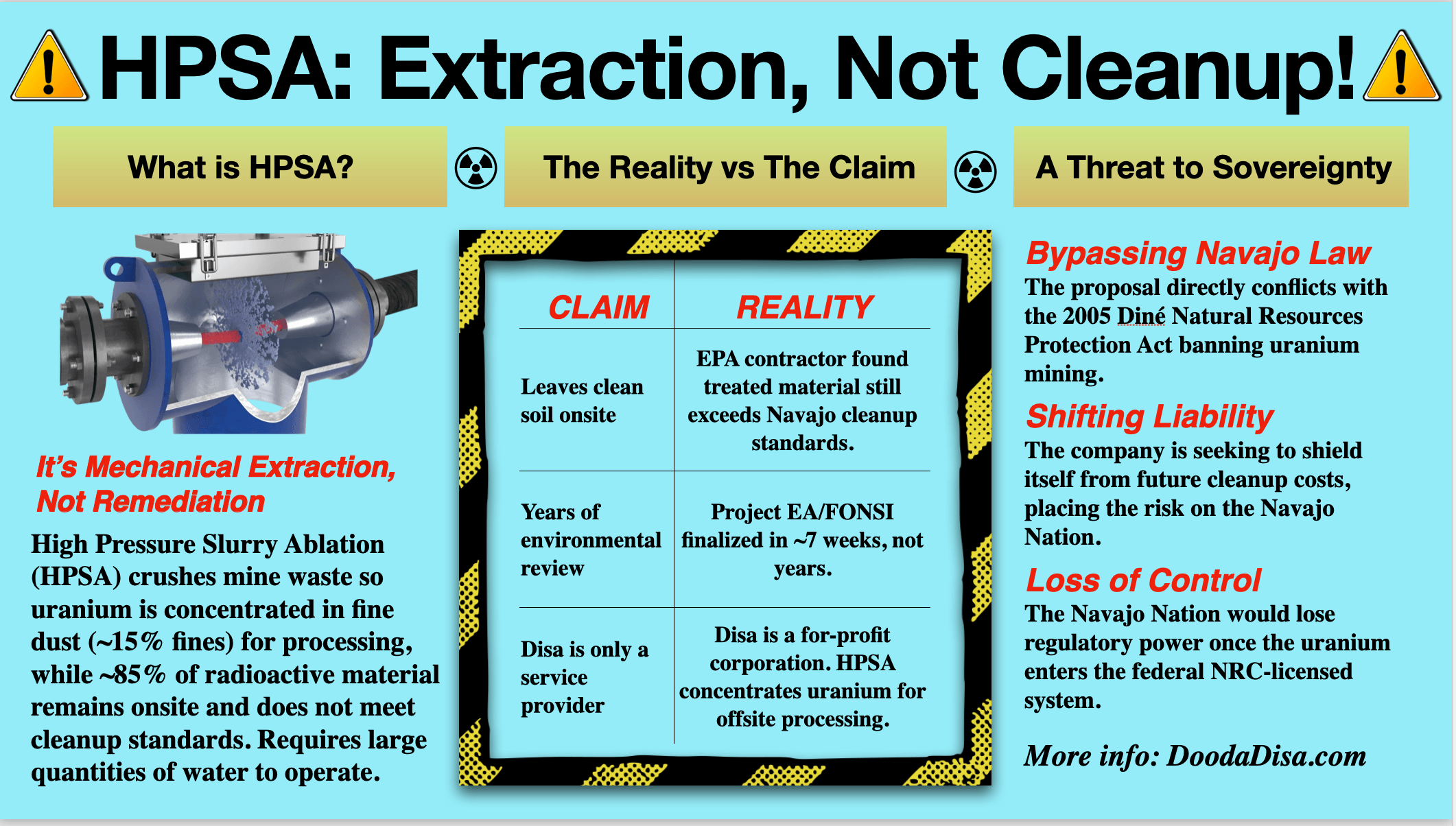
Infographic courtesy of Dooda Disa.
The NRC record tells a different story.
In 2025, the NRC published an Environmental Assessment and within weeks issued a Finding of No Significant Impact, allowing the agency to avoid preparing a full Environmental Impact Statement. Shortly afterward, the NRC approved a generic, multi-state license authorizing use of the system as a remediation technology, not for commercial uranium production, with site-specific verification required before operation.
On February 12, 2026, DISA’s Chief Regulatory Affairs Officer Stephen Cohen asked the NRC to classify HPSA fines as “equivalent feed,” which would allow them to be sold to the White Mesa Mill and processed into yellowcake for nuclear fuel. On March 19, NRC project manager Priya Yadav responded in the same NRC correspondence that DISA would need to demonstrate that the material contains no chemical additives and is essentially identical to natural ore.
In its March 23 filing, DISA states that HPSA uses “no chemicals to accomplish the separation,” but then discloses two industrial additives: a surfactant (DUSTREAT DC6109) applied to ore before processing and a polyacrylamide flocculant (Superfloc A-100) added to process water to settle uranium-bearing fines. Both carry safety warnings for hazardous components linked to cancer risk—including formaldehyde and acrylamide—and both safety data sheets explicitly caution against release into the environment. The filing describes the process generating contaminated process water planned to be sprayed back onto the mine site—conditions not evaluated in the original environmental review.
The same NRC filing includes a letter from Buu Nygren, President of the Navajo Nation, urging the NRC to act quickly so that “the verification test at Church Rock can proceed in 2026,” referring to the Old Church Rock Mine. The letter reveals that the Navajo Nation EPA has already entered into a formal agreement with DISA to conduct a Time Critical Removal Action (TCRA) at the site. Nygren describes the equivalent feed classification as “critical to my Safer, Sooner strategy,” warning that without it “our verification study cannot proceed” and recoverable uranium will be “lost to the fuel cycle.” The terms of the agreement between the Navajo Nation EPA and DISA — including who receives revenue from the sale of uranium-rich fines to the White Mesa Mill — have not been made public. If the NRC denies the classification, DISA would not be able to sell the fines for milling and would instead have to dispose of them at a licensed waste facility or leave the material on site and cap it.
On April 1, the NRC responded again in its correspondence, requiring DISA to provide data from operation of the full HPSA process—including the use of additives—to determine whether chemical residues remain in the final material. The NRC stated that DISA must: “demonstrate that the material resulting from the HPSA process is essentially the same as natural uranium ore and does not contain residual chemicals or contaminants that would affect its acceptability as mill feed.”
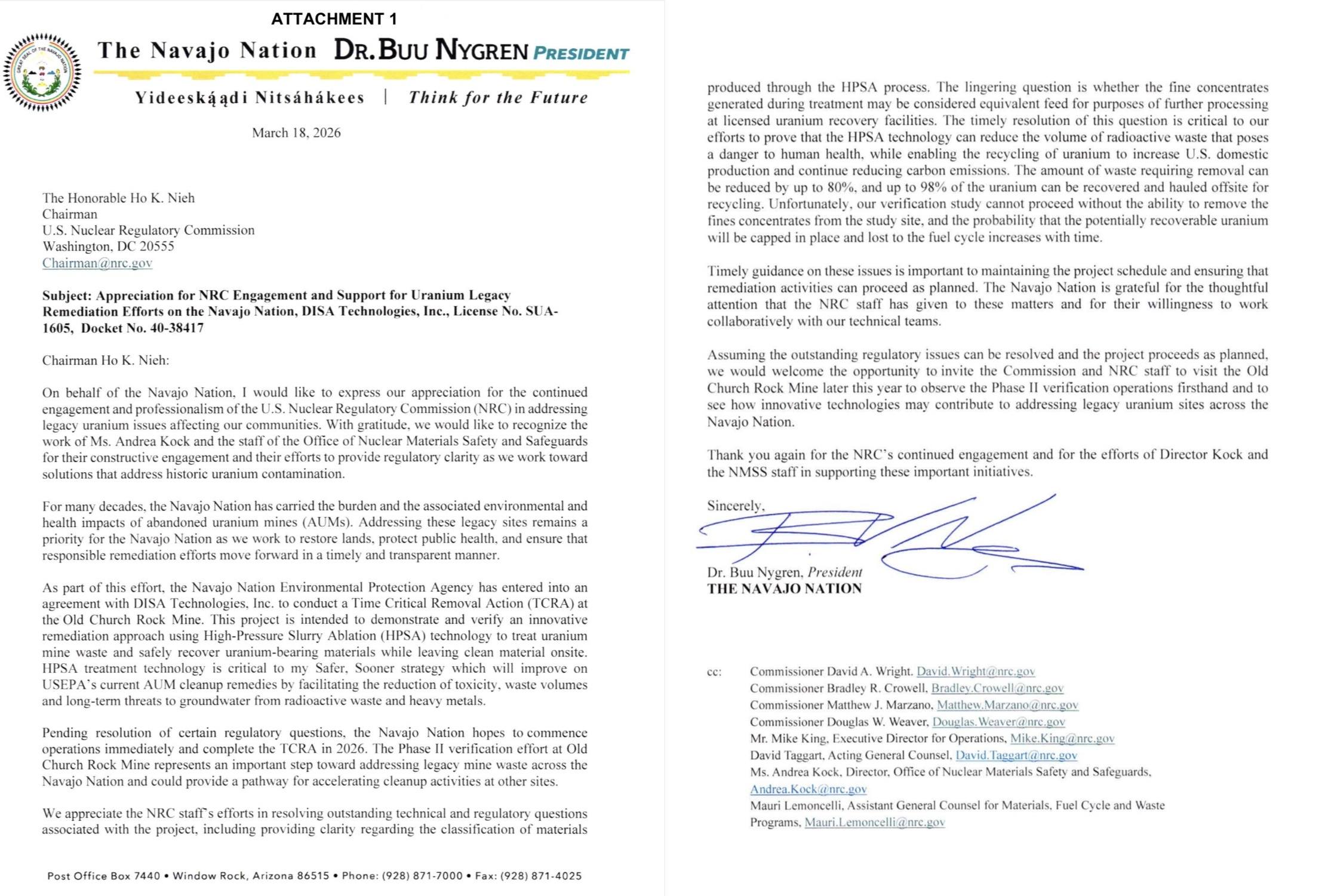
Letter from Navajo Nation President Dr. Buu Nygren to NRC Chairman Ho K. Nieh, March 18, 2026, included in DISA’s NRC filing.
If approved, uranium concentrated from mine waste under a license issued for remediation would be treated as natural ore and enter commercial nuclear fuel production without public environmental or license review.
Located near Blanding, Utah, adjacent to the White Mesa Ute tribe, the White Mesa Mill is the only operating uranium mill in the United States and is owned by Energy Fuels, a Canadian mining company. Energy Fuels also owns and operates the Pinyon Plains Uranium Mine in Arizona and is currently pursuing permits for the Roca Honda Uranium Mine in New Mexico. If the NRC approves the equivalent feed classification, it would set a precedent that could allow HPSA technology to be deployed at future mine sites, processing waste rock on-site and extracting every last ounce of uranium before leaving the radioactive waste behind.