
A few years ago, we had one word that was both very good and very bad for VR: the metaverse. During the hype, the metaverse helped XR in getting a lot of attention, but at the same time, it created so much confusion in our field that we all started hating it, and a few people, me included, started calling it the M-word, since we were all tired of hearing that shit. But lately, I was thinking that there is another M-word that was potentially good, but turned out to have bad outcomes for us all, and I want to share with you some thoughts about it.
What is “mainstream”?
Every time we speak about XR, at a certain point, we all start discussing when it will become “mainstream”. But what the hell does mainstream mean? We all want XR to become mainstream (exactly as we all want to have the XR metaverse), but at the same time, no one can exactly define what it means. We all only have a personal vague idea (more or less like the metaverse).
Mainstream may mean many things: it may be about awareness, like the fact that everyone knows about it. In this case, AR/VR are kinda mainstream, because almost all people in the richest countries have tried at least one headset somewhere, or have at least heard about VR somehow. We have had ads about VR, TV commercials showing headsets, musical videos with headsets… even Jessica Fletcher wore a VR headset in an episode of her famous TV series!
 … and her headset 30 years ago was even as small as the last-generation ones!
Mainstream may instead be about how many people own an object. In this case, XR is not that mainstream because it is still mostly owned by a minority of people.
But there are many nuances to this question. For instance, when can an element be considered mainstream? How many units should be sold? We all consider VR a niche and consoles as mainstream, but the Quest is selling better than many consoles on Amazon US. So, which one is mainstream?
Or even more: how often should an object be used to be mainstream? I guess we all consider the plunger to be a mainstream gadget, even if it is rarely used in houses (unless you have a problem with your pipes, but that’s another problem). I have used more VR headsets than plungers in the last two years, so which one is mainstream, again?
Should we consider the whole market or only a segment of it when considering if something is mainstream? The SteamDeck is considered a huge success because “it dominates the PC console market”. But it has sold until now something like 6M units, which is far less than the sales of Quest 2! So, should we consider it mainstream only because it is so popular in its specific niche?
I could go on and on mentioning my doubts, with other questions (e.g., should we consider all countries or only the most developed countries?). But at this point, I think I made it clear that there is no unique definition for mainstream: it is more of a sensation.
Big companies and the mainstream
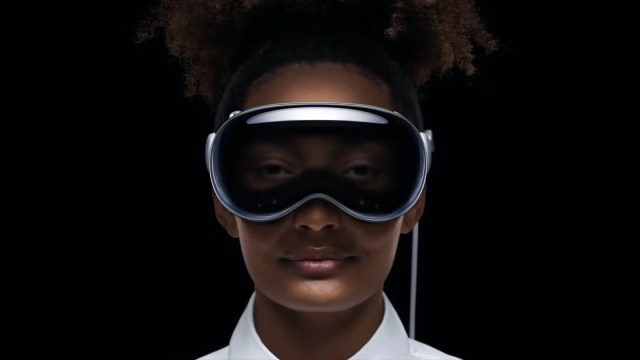 The Apple Vision Pro (Image by Apple)
Years ago, I read someone stating that the mobile phone ruined the perception of “mainstream” for all the other technologies. And I totally agree with this statement. Because now it seems that everything that didn’t reach billions of sales, it is used every day, and has reached every corner of the world, is not a successful technology. The problem is that disruptive technologies like the phone come once every 20-30 years, maybe: recently we had the phones, and then AI. In the middle, we had a lot of interesting things coming to life, but that didn’t reach this level of scale.
Big tech companies are so huge that everything that doesn’t reach enormous sales is not relevant to them. Having a $200M revenues is a dream for almost all startups, but $200M revenues is a rounding error for Meta, which made $200B of revenues in 2025 alone. A $200M project is so very successful for a standard company, and a huge failure for a company like Meta, Google, or Apple.
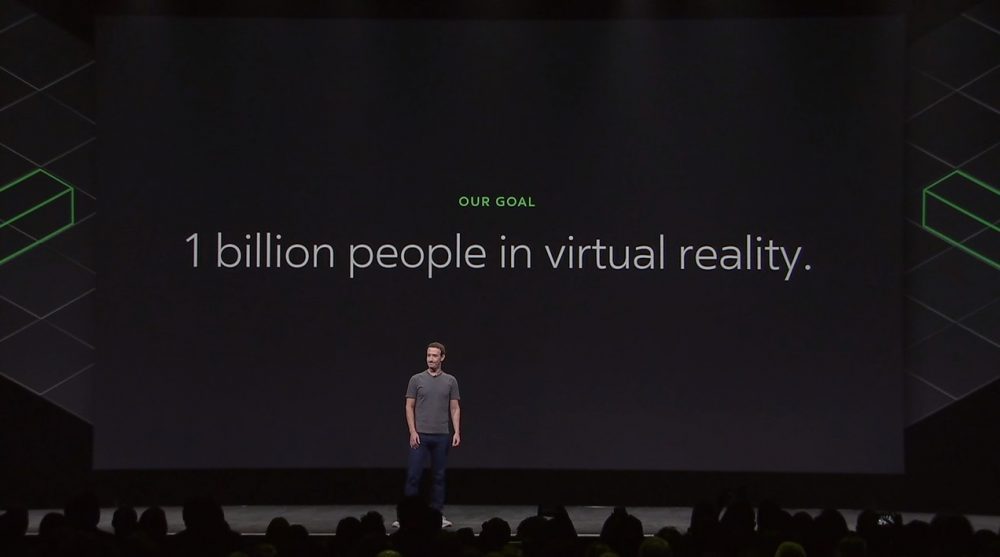
And this is where the craving for mainstream adoption becomes a problem: every project should go big or go home. Mark Zuckerberg claimed a few years ago that he wanted 1B people in virtual reality, but thinking about it in hindsight, that statement simply made no sense. What should 1B people have done in VR? And how should this number have been reached? No one knows.
But Meta needed to speak about these big numbers because they are the only numbers that matter to it. And it entered VR only hoping to have these big numbers, and it spent the famous $80B because it wanted to have that famous “mainstream adoption”. And the same reasoning holds for Horizon Worlds: it had decent numbers to be a product of a startup, but horrible numbers for a company like Meta. And so it enshittified all the UI of the Quest, trying to reach its Horizon World business goals, until it realized that with this behaviour, it destroyed two products instead of just one.
But VR/AR are probably just not ready for those big numbers, yet. I’m a big believer in the technology, but there are many factors we all already know (price, content, comfort, etc) that prevent it from becoming “mainstream” today. And so big companies are now all looking at what for sure is already mainstream, that is, AI, and deinvesting in what is too little for them. And even if that “little for them” could be a sustainable environment for many of us, they don’t care, because they just operate at another scale.
I personally don’t agree with the people saying that VR is destined to be a niche for nerds forever. Yesterday, I wrote a LinkedIn post about me playing again inside PCVR just to feel that “presence” that made me fall in love with the technology, because when you enter Half-Life: Alyx with a powerful graphics card, you can only be in awe. I demoed VR to many people, and almost everyone loved it. So it is not a matter of potential: it is there, and I can’t imagine that in the future people would prefer a 2D screen over a VR one. And the fact that many kids are using Quest shows it is not just a nerd gadget anymore, already today. It is just that we are not ready yet for the jump.
The California roll and the known use cases
Sometimes you just need a bridge to connect people to something new and make it mainstream. Sushi today is mainstream in Western countries, but it was not like that in the beginning. That’s why the California roll was created:
“The California roll, featuring imitation crab, avocado, and cucumber, was created in the 1970s to bridge the gap for Western diners hesitant to eat raw fish or seaweed. By turning the roll inside-out (uramaki) and using creamy, familiar ingredients, it popularized sushi in North America and facilitated the adoption of Japanese cuisine” [source Gemini+Wikipedia]
Sometimes you just need to give something familiar to people to adapt to something new. And a technology becomes adopted much faster if it can relate to a use case of the past. iPhones were successful because people already needed a phone to call people and send messages. Steve Jobs didn’t have to explain to them why they needed a phone, or what the phone’s killer application was. He just needed to show them they could have a phone that was also a pocket PC.
And this is why Ray-Ban Meta smartglasses are succeeding so well. People enter into a Ray-Ban store to buy sunglasses, and they see that with a little more, they can have the glasses they need, but with the extra features of shooting photos and speaking with AI. So they buy them. I’ve always praised Luxottica’s distribution network and the cool design of the glasses, but I think the best thing about these glasses is that they are… glasses. When I reviewed the Reebok Octane smartglasses, I mentioned how it was cool for me to run with them and that even without using any smart feature, I would probably have worn them the same as running glasses. This is a big key for adoption.
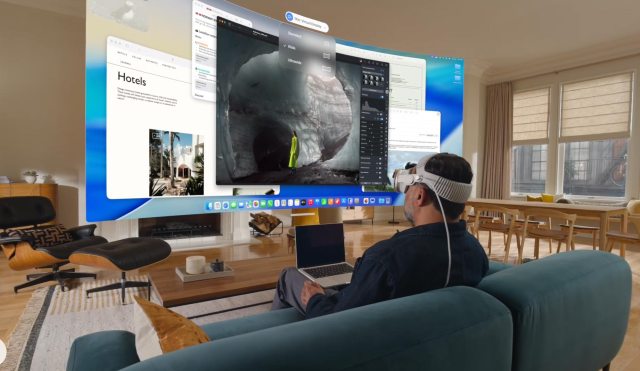 The favorite MR use case for Apple is Big Virtual Screens (Image by Apple)
I think Apple tried to do something similar with the Apple Vision Pro. During the launch, it showed people the device could be used to watch “big screens” in mixed reality. We XR enthusiasts were a bit puzzled: why show this lame use case if XR can do so much more? The reason is that they tried to show people a use case they could understand: instead of buying a big TV, you can buy a Vision Pro and have a better result. It was a smart strategy, and it probably would have paid off more if the device had not been so expensive.
Having a known use case helps, and if you don’t have it, you need to explain to people why they need that new technology. In the case of VR, as we know, there is nothing already existing that translates well to it. So there is a lot of work to be done to show people why it can be useful for them.
The “mainstream usage.”
Let me return to the definition of mainstream and how it relates to our field.
Meta smartglasses are selling very well, and Luxottica plans to manufacture 20-30M per year. These are huge numbers… but I don’t know if for you, these are “mainstream numbers”. Also, one other factor that we should take into account is what these glasses are used for:
Can we consider them as mainstream XR devices if people just use them as sunglasses, ignoring the smart parts?
Can we consider them as mainstream XR devices if people use them just to shoot photos and videos and ignore the other smart features?
I really don’t know. Meta talks about “high retention” of the glasses, but it never clarified what this retention is about. My guess is mostly photos and videos (which again is another known use case)… which does not prove that these glasses have a future as AR devices.
Talking about Virtual Reality, I personally believe that sooner or later it will become mainstream, but I don’t imagine VR becoming mainstream as the phone, but more like PCs. People may use a headset for virtual traveling, or playing, or porn (a friend told me)… but it makes no sense for people to be in VR the whole day. Even the concept of the metaverse that Zuck tried to explain for one hour before launching Meta was never about VR alone, but many of the concept videos were actually about AR. It was the dull mainstream media that conflated together metaverse, VR, and Horizon Worlds (And they keep doing it now when they say that Meta spent $80B for Horizon Worlds alone). Wearing VR the whole day will happen maybe in 100 years, when we’ll have the Nervegear and will live in the Zuck-Matrix the whole time.
 This meme says it all
But, again, is VR mainstream for you all if it is not used the whole day?
Crossing the Chasm
In the startup world, the problem of “Crossing The Chasm” is that it is “easy” to succeed with early adopters if you have a decent product, but then it becomes incredibly harder to enter into the “mainstream”, that is, when you target more average users. It is like there is a chasm to jump to get to the other side.
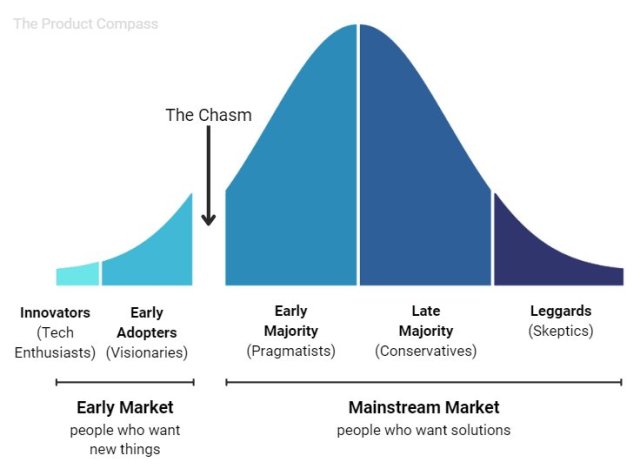 Many products die in the Chasm (Image by The Product Compass)
Currently, VR has fallen into the chasm, and for smartglasses, I think companies are ready to take the jump. We saw that more tech-savvy people are interested in wearing them, but the big question is whether everyone will start wearing them, and what use they will make of them (whether they’ll use them in a smart way or not).
The truth is, no one knows, as usual. The glasses are showing potential, but people are also getting increasingly disturbed by cameras pointed at them. And the recent report about people’s images being sent in Nigeria for human review is not going to help…
Final considerations
I just wanted to share with you these random thoughts I had about the relationship between VR and the other M-word that impacted its destiny: mainstream.
I don’t have a clear conclusion to share with you, but in my opinion, we should start reducing the use of this term, because it is not clear what it means, and it is forcing everyone to think that either VR goes as big as smartphones, or it is a failed technology. And I also think we should all stop obsessing about replicating the success of other technologies like smartphones, which have a totally different history and also start from an already clear use case (the telephone).
But I don’t want you to give up and think that we should never aim at making VR (and XR in general) more widespread. This should still be the mission of everyone, and we should all push for it, also because the more people in the field, the more money for all of us. And if VR won’t become as widespread as the phone, it’s ok as well, as long as it finds its segments of the market where its use is popular.
Probably everyone, big tech companies included, should be a bit more realistic about the timing, without trying to push to have immediate “mainstream adoption”. I remember a few years ago, Michael Abrash speaking about AR glasses becoming “mainstream” in 2035-2040. It’s like 14 years from now. It’s better to grow organically with a distant timeframe than having the continuous hysteria of “VR is getting mainstream” and the day after “VR is dead”. Or at least, this is what I think.
(Header image by Meta, Upload VR)
Disclaimer: this blog contains advertisement and affiliate links to sustain itself. If you click on an affiliate link, I’ll be very happy because I’ll earn a small commission on your purchase. You can find my boring full disclosure here.
Share this with other innovators
Related