
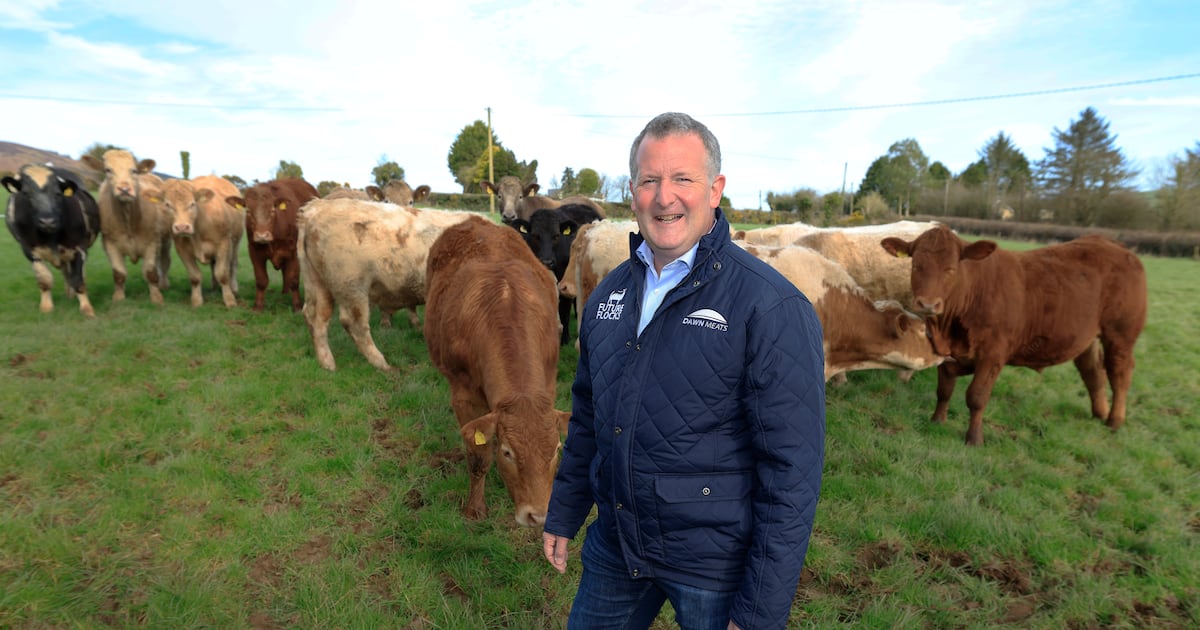
“We put the happy in happy meal,” declares a large poster of a child munching on a McDonald’s burger from a wall at the Dawn Meats site in Co Waterford.
In my experience it’s probably the plastic toys that please children in McDonald’s more than the food. But what’s not up for debate is the fact that Dawn Meats supplies the beef for every burger sold at the fast-food-restaurant chain’s outlets on the island of Ireland.
The plant at Carroll’s Cross produces roughly 12 million burgers a week for McDonald’s, some of which go to Britain and France. “That’s a lot of happy meals,” says Dawn Meats chief executive Niall Browne.
Between 2015 and the end of last year, some five billion patties were produced for the US fast food giant. It’s a head-spinning figure.
Browne leads me into a changing room where we don white coats, fashionable hair nets, and suitable footwear for a visit to the facility’s kitchen lab, where the beef is put through its paces.
The biggest surprise for me is that the days of flipping burgers are gone. McDonald’s now uses a grill machine with a lid that cooks the burgers to order, depending on their size and thickness.
Pop it on the grill, close the lid, set the timer, stand back and wait for the finished product. All that’s left to do is to insert them in their buns, with their dressings and packaging, and pop them into the queue to be served to customers. It’s a finely tuned operation.
“They are a very good customer,” Browne says of McDonald’s, as we await some burgers to taste. “It’s all about attention to detail for them. Every little thing is managed minutely. We don’t give them any problems and they love that. It’s all about consistency; everything has to be the same.
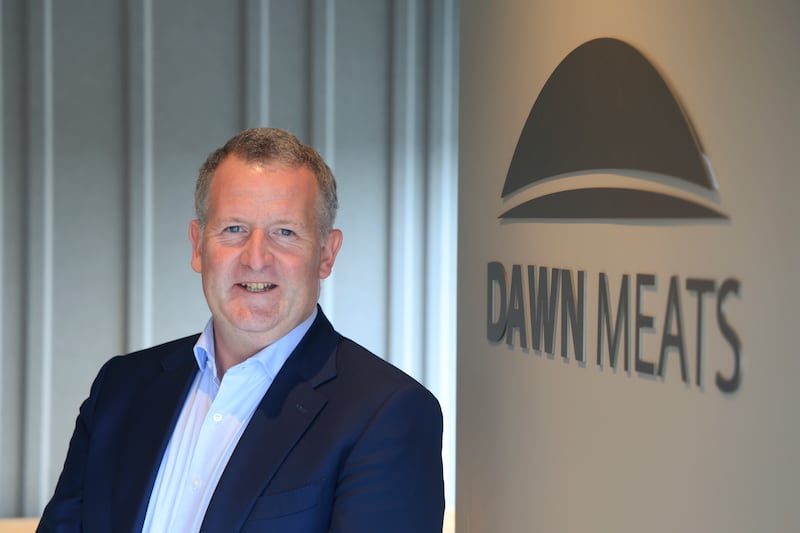 Niall Browne, Dawn Meats chief executive, at the group head office in Grannagh. ‘When you look at all the essential amino acids and vitamins and minerals in red meat it’s actually very good for human health.’ Photograph: Nick Bradshaw
“McDonald’s is one of a number of very big customers that we have that is very important to us. But so are other customers,” he says, adding that the McDonald’s contract doesn’t prevent it from working for other fast-food players.
Fresh off the machine, the burgers have a clean, just-cooked vibe but the taste experience is utterly transformed once sprinkled with McDonald’s salt and pepper mix. The seasoning packs a flavour punch that has made McDonald’s burgers a hit with consumers around the world for generations.
“It makes a big difference,” says Browne as he munches on a freshly cooked patty.
Dawn Meats has its own global ambitions following its acquisition late last year of a majority stake in Alliance, a large meat processor in New Zealand. The Waterford-based group paid 270 million New Zealand dollars (€132 million at the time) for a 65 per cent shareholding, financed by debt and its own resources.
This potentially transformational deal was the reason behind Browne’s selection in February as The Irish Times Business Person of the Year, an award run in association with Bank of Ireland.
Since the deal, Browne has taken on the role of chief executive at Alliance, to drive the acquisition, now splitting his time between Ireland and New Zealand.
“I’ll spend a good bit of time there this year, depending on what’s happening with the business in Ireland and the UK,” he says. “Effectively, I’ll be rolling out the Dawn [Meats] way of doing things over the next couple of months to give the business that extra edge.”
In addition to Browne, Dawn’s “subject matter experts” (senior executives) from Ireland are being dropped in to shadow colleagues in New Zealand to come up with “different angles on how we could improve things”.
[ Niall Browne of Dawn Meats named The Irish Times Business Person of the YearOpens in new window ]
It’s not a one-way street, he says, with ideas being brought back to Ireland. “That’s always the way when you make an acquisition.”
How has the farming community in New Zealand reacted to the deal?
“The reaction has been good, particularly from the farmer-shareholders who are looking forward to the changes we’re going to make. I’m not sure how happy the competitors are – we’re an unknown quantity over there.”
While there was a rump of dissent to the Dawn deal, Browne reminds me that 87 per cent of Alliance’s shareholders approved the transaction.
Why pursue a deal on the other side of the world?
“We’re of a scale here and in Britain where we probably can’t expand much further. We have an appetite to continue to grow as a business. It’s a family business and the board are happy for us to continue to invest and grow,” he says.
“We’ve always had an eye on New Zealand because we’re the largest packer of New Zealand lamb into UK retailers. I’ve been there many times and it’s a very similar culture to us but they have scale and it’s a very opportune market for us. And the counter-season angle does bring advantages.”
In terms of scale, Alliance processes about 4.5 million lambs, 700,000 cattle, and 70,000 venison each year. It is the biggest processor of lamb and one of its sites is one of the biggest meat plants in the world.
With the addition of Alliance, Dawn Meats will now process 1.6 million cattle, eight million sheep and 70,000 venison.
Given that about 90 per cent of what Alliance produces is exported on container ships, what impact is the current Middle East conflict having on the business?
We’re producing so much beef and lamb [in Ireland]. On the beef side we’re producing enough for 40 million people. We export 87 per cent of what we produce
— Niall Browne
“The uncertainty is challenging and trading conditions are more difficult than they were when we acquired Alliance,” he says. “The fallout from the conflict has led to higher shipping, land and sea transport costs, which is an issue for exports from New Zealand in particular.
“We’re monitoring and reviewing the situation on a daily basis and, where possible, have already made changes to transport routes to ensure products arrive on time to customers.”
Dawn has six “kill” sites in Ireland. As part of the interview, we visit Grannagh, on the border between Waterford and Kilkenny, where 70,000 cattle a year are slaughtered. It can process up to 50 cattle an hour and can get 200 products from each animal, involving a lot of “bespoke butchery” producing “value added” cuts for export markets.
Dawn now has 8,000 employees in Ireland (11 sites) and the UK (13 sites), and 4,000 in New Zealand (six sites).
“We have 30,000 farmer-suppliers between Ireland and the UK and about 4,500 in New Zealand. Our new turnover is €4.75 billion [for 2025]. That makes us a big butcher.”
Browne is “happy enough” that turnover will rise this year, without giving an exact figure and he is coy about its profits, which are not disclosed. “We don’t speak publicly about that,” he says, although he did indicate that it is a 2 per cent margin business, which would suggest profits of about €95 million a year.
“I’m not going to answer that,” he says with smile. “We do all right but it’s hard work. It’s high volume, low margin and all about attention to detail.”
Will some of the New Zealand meat end up in the Irish market?
“No, I can’t see it. We’re producing so much beef and lamb here. On the beef side we’re producing enough for 40 million people. We export 87 per cent of what we produce.”
Given how much we produce on our own doorstep, why is red meat in Ireland so expensive? It is not unusual now for mid-range restaurants and pubs to charge €40 or more for steaks or certain cuts of lamb.
“It’s a supply and demand business and the world market dictates,” Browne says.
A little over half of Irish beef goes to the UK, and Browne estimates that only about 8 per cent of the beef produced in Ireland is actually consumed here.
“One of the other benefits of Alliance for us is that they’re a big player in markets in Asia that we’re not. We’ll help them in Europe, they’ll help our business in Asia.”
In terms of climate change, the spotlight has been placed on farming given its level of carbon emissions, with calls for the national herd (not that such a thing exists in reality) to be culled.
Not surprisingly, Browne disagrees.
“Phenomenal work being done in Ireland that’s not being done elsewhere in the world. For example, we’ve been carbon footprinting all our farms for the past 11 years, which isn’t happening elsewhere. So we have a lot of work done on how we can mitigate and Teagasc has produced a suite of measures on how farmers can reduce their carbon even more.
“We should trust the process and there will also be new technologies that will come out, which will aid and abet what we’re trying to do. There’s a lot of research in New Zealand on how they can reduce carbon through additives,” he says, citing conversations with people involved in those projects “who believe they are going to be rolling stuff out before the end of 2026”.
He says Dawn is investing €100 million to develop its own mitigation measures for scope one (through electrification and efficiency), scope two (through renewable energy) and scope three (through supply chain engagement) of the internationally recognised Greenhouse Gas Protocol by 2040. “We’re going to be effectively neutral for scope one and two and we’re on the trajectory for scope three but that’s in conjunction with our suppliers.”
He sees no need to cull the herd. “We should wait for the technologies to come along. They are happening as we speak.”
Browne says he could eat red meat up to seven days a week but he’s an “equal opportunities” consumer and also likes fish and chicken.
Rib eye is his favourite cut of steak. “A good cowboy steak but you can’t beat a good bit of lamb as well – lamb shoulder, slow roasted.”
What about the growing numbers opting for plant-based diets, and those who argue on ethical grounds against the slaughter of animals for human consumption? “Everybody to their own but there isn’t enough land mass for everyone to convert to a plant-based diets in the world. From a human health point of view, I know from speaking with medics they would much prefer people to have a balanced diet and to consume red meat as part of that diet.
“When you look at all the essential amino acids and vitamins and minerals in red meat compared to some other foods, it’s actually very good for human health. This concept of over-processed food has been recognised by a lot of customers and they are looking to go back to more natural foods, what you would say our grandparents ate.
“In the US recently a new food pyramid came out and red meat is at the top of the pyramid,” he says, a nod to the US Department of Agriculture’s recent declaration that it was “ending the war on protein”.
The protein target it set out is 1.2-1.6 grammes of protein per kilogram of body weight per day.
This, of course, is coming from Donald Trump’s administration, so make of that what you will.
Browne says global demand for red meat is on the rise, driven out of Asia and Africa. “As these economies increase their middle classes they are going to want to move away from basic diets and reward themselves with red-meat protein. All the forecasts are indicating the same thing. And there’s not going to be enough land around the world so it’s going to become more in demand over time.”
Is he in favour of the Mercosur trade deal, which would allow some Brazilian beef into the European market?
“Companies in South America will be allowed to cherry pick what cuts they put in. They can just decide to put in striploins, for example, so with the sheer scale of the quantity of product from there if they were to dump five or 10 containers of strip loin into an important market like Germany, it would have a very dramatic impact on the price.
“From that point of view, we would have an issue with it. But [the EU] didn’t listen, unfortunately. It is what it is. As an industry we always find a way to adapt.”
Browne is the youngest of four children, raised in Fermoy, Co Cork. He father Dan was originally an agricultural research scientist who went into business in Cork Marts before later becoming a co-founder of Dawn Meats with brothers Peter and John Queally in 1980. He sold the family farm to generate the funds to help start the business.
“We literally bet the farm on the business,” Browne says.
He remembers getting a summer job in the boning hall, age 13, cleaning out stainless steel bins and floors. “I worked in the abbatoir as well. I still hold the record for killing the most animals in a day in one of our plants in Ireland.”
He says he can’t remember how many exactly before adding that it was 543, a rather precise number. “You need to be fairly fast with your hands,” he adds.
He went to school at Newbridge College, where rugby was his sport. “I started up front and as everyone else grew bigger than me I started to drift to the back of the scrum.”
After school, he went to the University of Limerick where he studied marketing and agribusiness.
In 1995, with his eye on a “different career path” with baked goods group Cuisine de France, his father asked him to give a “two-week dig out” at a retail packing plant in Wales. “He was waiting on a manager to start.”
He never left the business, becoming chief executive 19 years ago at the age of 34. His father died last June, at 88.
Was it always red meat at the dinner table as a child? “No, whatever was going,” he says deadpan.
What’s the secret to Dawn’s success?
“We invest a lot in our management. We take on about 50 graduates a year … and we tend to develop our own management from within. We find a much higher success rate than hiring from outside. The key to success is people. And attention to detail is another obvious one.”
Looking out five years, what might the business look like?
“I would envisage that the business will continue to grow and do a good job serving our customers around the world.”
CV
Name: Niall Browne
Job: Chief executive of Dawn Meats
Age: 53
Lives: Kilkenny
Family: Married with three children.
Hobbies: Watching Cork hurling, the Irish rugby team and Munster.
Reading: “I’m on the Dunnes book at the moment by Matt Cooper.”
Something we might expect: He loves eating red meat. “Cowboy steak is my favourite.”
Something that might surprise: “I’m afraid of heights. If I was walking up a big monument now I could get weak-kneed halfway up. No bungee jumps for me.”