
Artemis II crew wake up to ‘Lonesome Drifter’ as final preparations for splashdown nearYour support helps us to tell the story
From reproductive rights to climate change to Big Tech, The Independent is on the ground when the story is developing. Whether it’s investigating the financials of Elon Musk’s pro-Trump PAC or producing our latest documentary, ‘The A Word’, which shines a light on the American women fighting for reproductive rights, we know how important it is to parse out the facts from the messaging.
At such a critical moment in US history, we need reporters on the ground. Your donation allows us to keep sending journalists to speak to both sides of the story.
The Independent is trusted by Americans across the entire political spectrum. And unlike many other quality news outlets, we choose not to lock Americans out of our reporting and analysis with paywalls. We believe quality journalism should be available to everyone, paid for by those who can afford it.
Your support makes all the difference.Read more
The Artemis II mission astronauts have crossed the halfway mark between the Moon and Earth, with their capsule set to splash down in the Pacific Ocean after a fiery descent lasting about 15 minutes around 8.07pm ET today.
NASA expressed “high confidence” in the Artemis II crew spacecraft’s heat shield ahead of Friday’s historic return.
The shield is a critical part of the Orion capsule, protecting the crew from exposure to lethal temperatures – reaching up to 5,000 degrees Fahrenheit – during their high-speed descent, which is expected to last less than 15 seconds.
“It’s 13 minutes of things that have to go right,” Jeff Radigan, NASA’s Artemis II flight director, said yesterday.
There were problems with the heat shield on the first Artemis flight, which had no human passengers. Gases that were generated inside the shield’s outer material were not able to vent as expected, causing cracks.
Since then, the shield has undergone extensive testing and Amit Kshatriya, the space agency’s associate administrator, says his confidence in the tech is backed up by engineering and flight data.
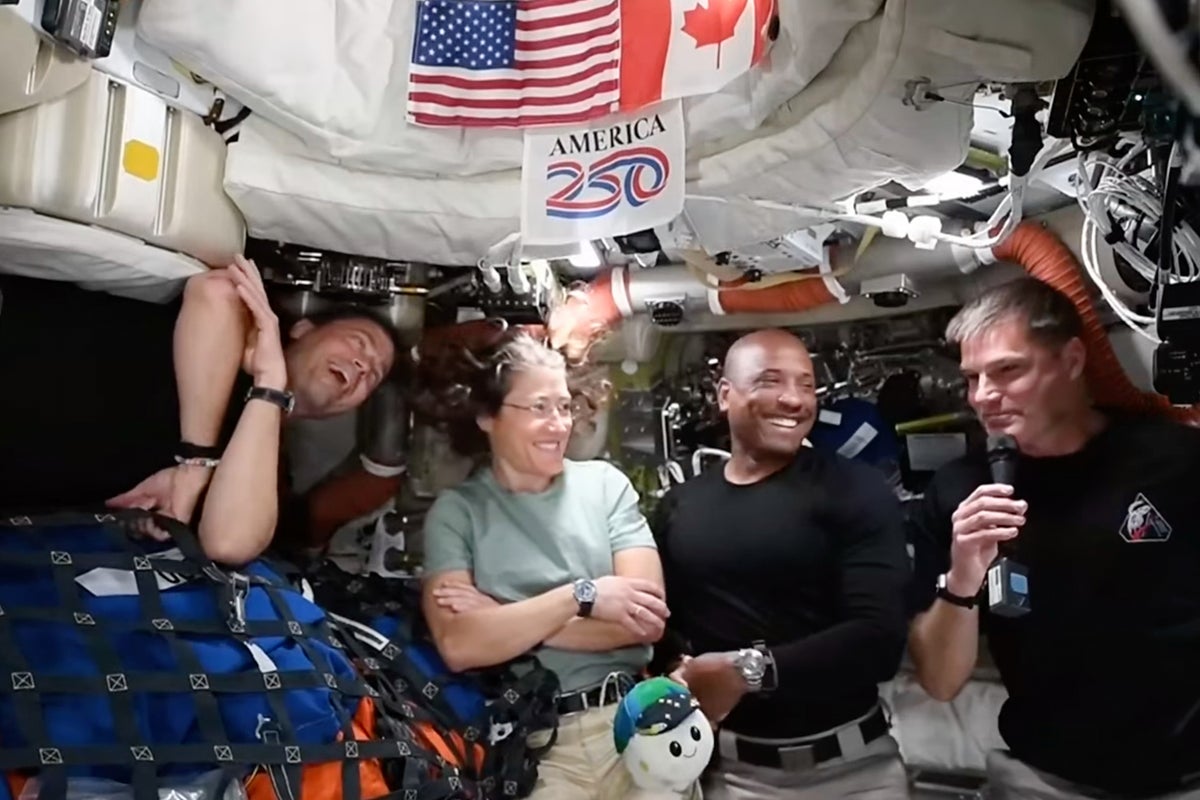
The astronauts, including NASA’s Christina Koch, Victor Glover, Reid Wiseman and the Canadian Space Agency’s Jeremy Hansen were said to be in “high spirits” as they started their journey to Earth following a record-breaking slingshot around the Moon.
Ahead of their fiery finale, Nasa has shared a set of the best moments from the Artemis II mission.
 Moon joy! Nasa releases best moments from Artemis II’s trip
A new video showing the crew of Artemis II experiencing ‘moon joy’ during their historic trip through space has been released by NASA as they return to earth. The astronauts, including NASA’s Christina Koch, Victor Glover, Reid Wiseman and the Canadian Space Agency’s Jeremy Hansen were said to be in “high spirits” as they started their journey to Earth following a record-breaking slingshot around the Moon. To mark the unique trip, NASA has released a video compilation showing some of the highlights of the trip which has enthralled the globe.
Andrew Griffin10 April 2026 17:39
Nasa shares precise timeline for re-entry
Here, from Nasa, is the rundown of the timings for the re-entry later. (They’re in eastern time, so add five hours if you’re watching from the UK.)
7:33 p.m.: Orion’s crew module will separate from the service module, exposing its heat shield for the spacecraft’s return through Earth’s atmosphere, where it will encounter temperatures of about 3,000 degrees Fahrenheit. 7:37 p.m.: Following separation, Orion will perform an 18 second crew module raise burn beginning to set the proper entry angle and align the heat shield for atmospheric interface. 7:53 p.m.: When Orion reaches 400,000 feet above Earth’s surface while traveling nearly 35 times the speed of sound. The crew is expected to experience up to 3.9 Gs in the planned entry profile. This moment marks the spacecraft’s first contact with the upper atmosphere and the start of a planned six-minute communications blackout as plasma builds around the capsule. 8:03 p.m.: Around 22,000 feet in altitude, the drogue parachutes will deploy, slowing and stabilizing the capsule as Orion nears splashdown. 8:04 p.m.: At around 6,000 feet, the drogues will release, and the three main parachutes will deploy, reducing Orion’s speed to less than 136 mph. 8:07 p.m.: Slowing to 20 mph, Orion will splash down in the Pacific Ocean off the coast of San Diego, completing the Artemis II crew’s return to Earth and a 694,481-mile journey. From there, teams from NASA and the U.S. military will extract the crew from Orion and fly them via helicopter to the USS John P. Murtha. Within two hours after splashdown, the crew will be extracted from Orion and flown to the USS Murtha. Recovery teams will retrieve the crew, assist them onto an inflatable raft, and then use helicopters to deliver them to the ship. Once aboard, the astronauts will undergo post‑mission medical evaluations before returning to shore where awaiting aircraft will take them to NASA’s Johnson Space Center in Houston.
Andrew Griffin10 April 2026 17:09
Astronauts wake up to final tune on their last day in space
As with every morning – or at least the end of every sleep, since morning is perhaps something of a funny concept in space – the astronauts have been awoken with a tune from Nasa’s official playlist.
Andrew Griffin10 April 2026 17:02
Astronauts will endure 3000C heat on journey back to Earth
Here, experts lay out just how intense and extreme the Artemis II crew’s re-entry will be.
Andrew Griffin10 April 2026 14:48
When and where will astronauts splash down?
Here’s a full preview of the main event of today – the astronauts’ re-entry and splash down.
Andrew Griffin10 April 2026 14:47
Astronaut explains how re-entry is like ‘jumping through a ring of fire’
Coming back down is hot. And astronauts are essentially racing that process. Here, Chris Hadfield – a Canadian astronaut who has flown a number of space missions – explains how that feels on the inside.
Andrew Griffin10 April 2026 14:38
What will be the most dangerous moment of Artemis II’s return to Earth?
As the Artemis astronauts make their way back to earth, a planetary entry experts says this critical phase of the journey will be one of the most dangerous.
Dr Chris James, who specialises in hypersonic aerothermodynamics at the University of Queensland, said: “The most dangerous moment will be the high-speed, hypersonic re-entry that occurs as the craft is travelling through the upper atmosphere. This is the riskiest point for several reasons.
“Firstly, it’s when the heating and the forces hitting the craft itself are at their maximum, due to aerodynamic drag slowing the craft from hypersonic speeds of around 11 km per second (greater than Mach 30!).
“Secondly, this is also a scary moment because the gas surrounding the craft is heated up so much that it becomes an electrically conductive plasma – which blocks communication between the spacecraft and the outside world. This means the astronauts are unable to talk to anybody back on Earth for that short period of time.”
When the astronauts first reach earth’s atmosphere, they will be experiencing fairly high g-forces, and get “the hell shaken out of them”, he said.
He believes one of the scariest parts will be the communications blackout blocking radio communications, which means they will be completely alone during the harshest parts of the trajectory.
Harriette Boucher10 April 2026 14:11
Why did NASA send ‘organ chips’ of the Artemis astronauts into space?
Along with four astronauts, NASA also sent chips of bone marrow grown from the crew’s own cells to space.
Researchers put the USB-sized “organ chips” aboard the Orion spacecraft, as part of a science experiment they hope will help reveal how different space stressors affect tissue before sending the first humans to mars.
The investigation will use the devices to study the effects of increased radiation and microgravity on human health.
Lisa Carnell, from NASA’s biological and physical sciences division, said: “For NASA, organ chips could provide vital data for protecting astronaut health on deep space missions.”
The chips, which were developed at Harvard, contain tiny channels lined with living cells that replicate the function of human bone marrow.
A matching set of these chips has stayed on Earth to give researchers a controlled comparison.
Harriette Boucher10 April 2026 13:41
Artemis astronaut says she has fulfilled her childhood dream
Astronaut Christina Koch said she has fulfilled her childhood dream, as she reflects on how she ended up in space.
“I recently found some photos of myself on a family vacation at Kennedy Space Centre, and were we posing with in front of the Saturn V Rocket.
“If I could have told that little girl who took home a picture of Earthrise, and hung it in her room, that she would eventually launch from that same place, to see that same view, I’m pretty sure she would not believe it.
“But even though I still can’t believe it, and she certainly wouldn’t believe it, she chased that dream, and it ended up happening.
“It’s such an honour to hear that we’ve inspire, that’s truly one of the top things that we ever wanted to do.”
 (AP)
(AP)
Harriette Boucher10 April 2026 13:17
Watch: Artemis II crew wake up to ‘Lonesome Drifter’Artemis II crew wake up to ‘Lonesome Drifter’ as final preparations for splashdown near
Daniel Keane10 April 2026 12:30