
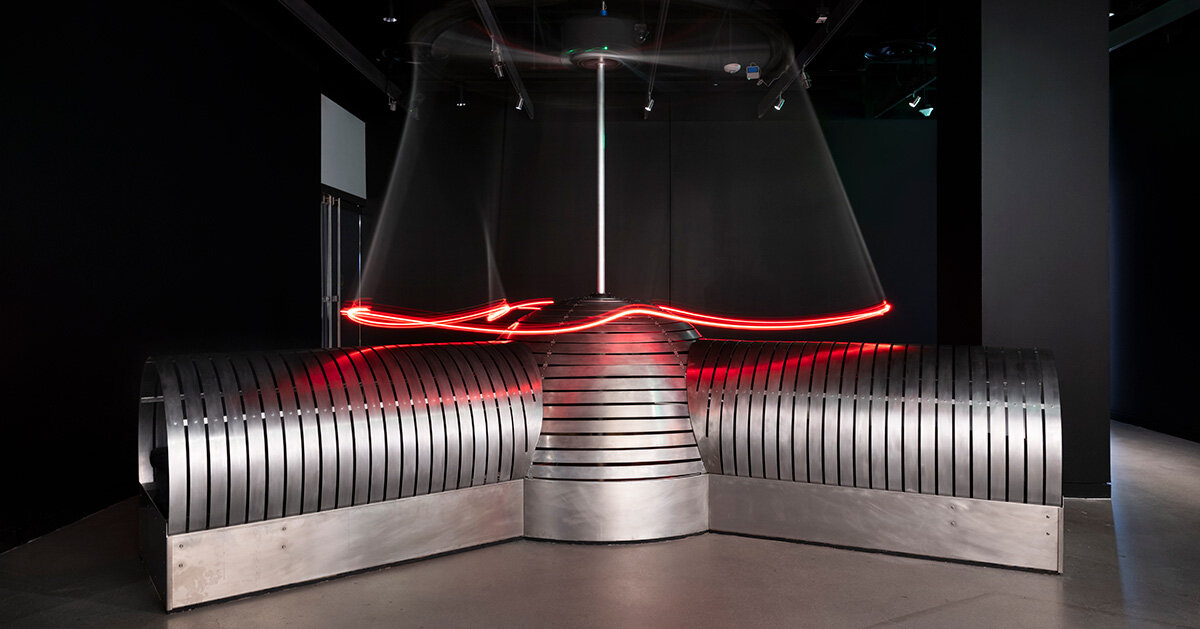
DB: Communal Dreams suggests that dream content can be influenced through designed sensory cues. At what point does this shift from observing dreams to actively engineering them?
CH: It doesn’t, really. Engineering implies total control, and the dream resists control in a way I find very beautiful. Adam Haar and I use a technique called Targeted Dream Incubation — light, sound, spoken words delivered at specific moments of sleep onset. In Dream Hotel Room #1: Dreaming of Flying With Flying Fly Agarics, we suggested flying with fly agarics. Sixty-seven percent of sleepers reported flying dreams. We published this result in an American Psychological Association journal – as far as we can tell, this is the first paper of its kind producing real and serious science from data collected within an art exhibition like this. But still, this is not total control – what they flew over, what they felt, whether they were afraid or ecstatic — completely unpredictable. I spent years studying insect communication, where you send a volatile signal and get a behavioral response. Dreams are not like this. You send a signal, and the unconscious does what it wants with it. That’s why I find this more interesting than the control of stimulus input and behavioral output.
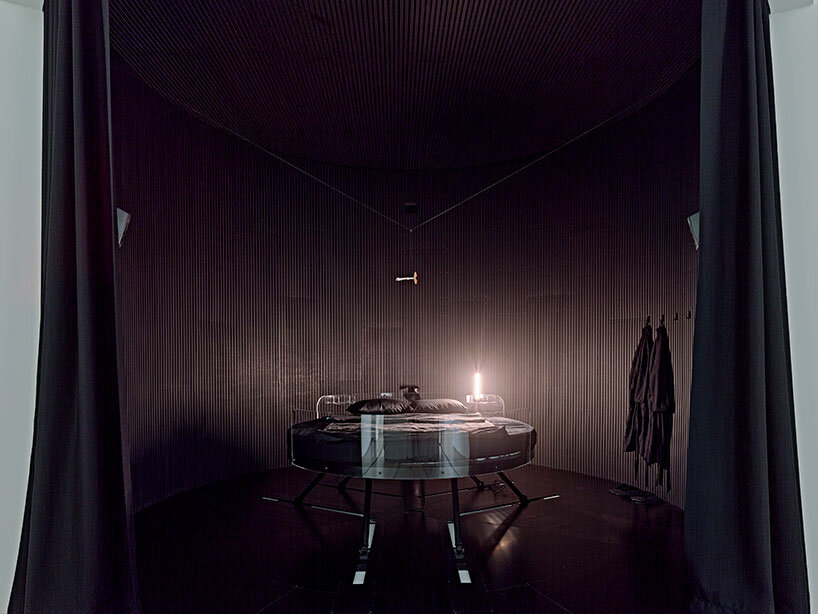
Carsten Höller, Dream Hotel Room 1: Dreaming of Flying with Flying Fly Agarics, 2024, installation view, Fondation Beyeler, Riehen/Basel © Carsten Höller. Photo: Mark Niederman, courtesy Fondation Beyeler
DB: The project is developed with researchers studying dream incubation, a technique that attempts to guide the themes people experience while sleeping. What did collaborating with scientists change in the way you think about dreams as an artistic medium?
CH: When I was a scientist, subjective experience was forbidden as data. You could study an insect’s olfactory response, but your own perception of the experiment was irrelevant. When I started making art, I wanted to bring back precisely what had been forbidden — the first-person. Not only my first person, but subjective experience in general. Now, working with Adam and the MIT researchers on Dream Hotel Room #2: Communal Dreams, I find myself in an interesting position: collaborating with scientists who have found rigorous methods for studying the subjective. They can detect sleep onset from brainwaves, know when a dream is just beginning, intervene at the right microsecond, and then ask: what did you experience? The dream report becomes data. It changes both what art is andwhat science is willing to engage with.
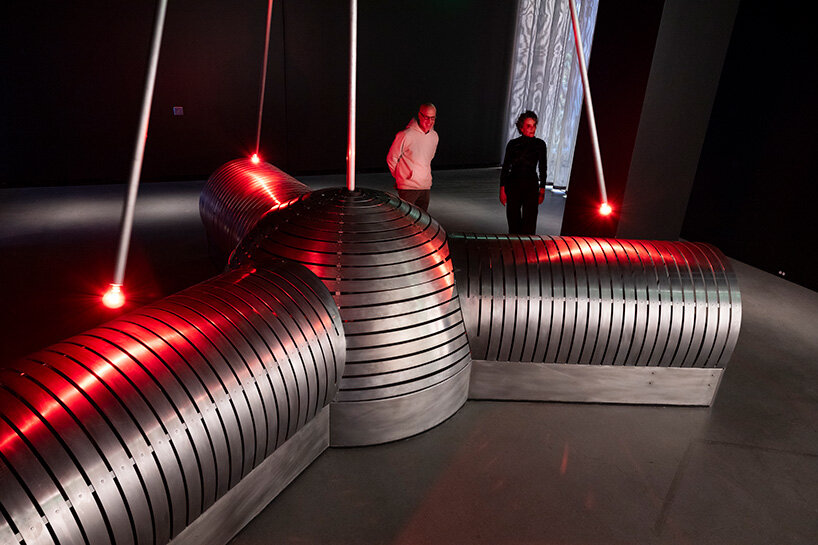
the installation hosts three participants at a time within a shared sleeping structure
DB: Dreams are typically considered the most private of experiences, yet this installation invites strangers to sleep together and potentially share dream themes. What fascinates you about the idea of collective dreaming?
CH: With Rosemarie Trockel, I built House for Pigs and People at the documenta X in 1997 where humans watched pigs. The audience thought they were observing the animals. But of course the real question was: who is the animal and who is the observer? Communal Dreams have a similar inversion. You think this universe of sleep is private, the mind is entirely your own, even when sleeping with strangers. But the truly unsettling thing is that when three people receive the same sensory cue and three of them dream of being in a tunnel, on a train, red lights flashing as they pass by — you don’t know whether that’s neurology or something else. I’m dissatisfied with the givenness of what we accept as individual experience. The installation doesn’t prove that dreaming is collective. It produces the conditions under which you can no longer be certain it isn’t.
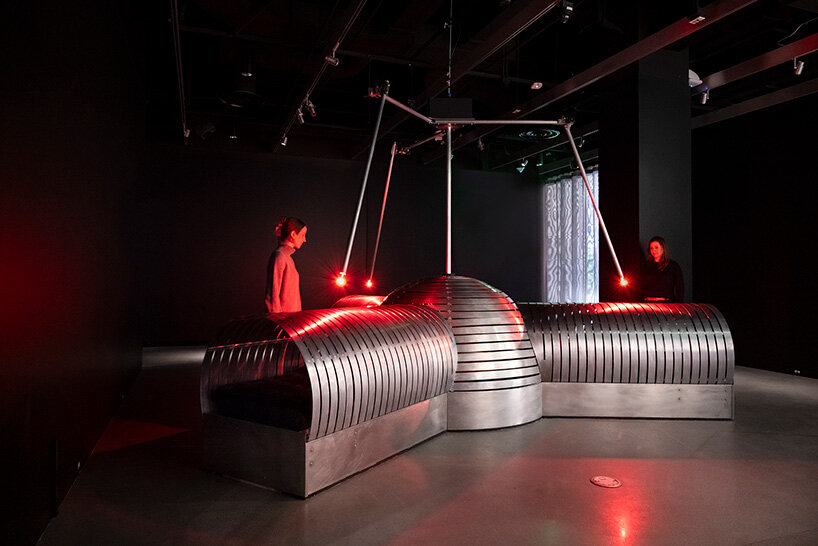
pulses of light, ambient sound, and subtle movement are calibrated to influence dream states in real time
DB: Many of your works operate like experiments where the outcome is uncertain and participants become part of the process. Do you think of this installation as an artwork, a scientific experiment, or something else?
CH: The real material I work with is people’s experience — and in the case of Communal Dreams, people’s experience is people’s dreams. Dreams are collected, transcribed, studied. Some will appear in a peer-reviewed paper. Some, a person will carry with them for years. Peer-reviewed and personally powerful. I would like both things to be true at once, because I think the separation between them was always artificial.
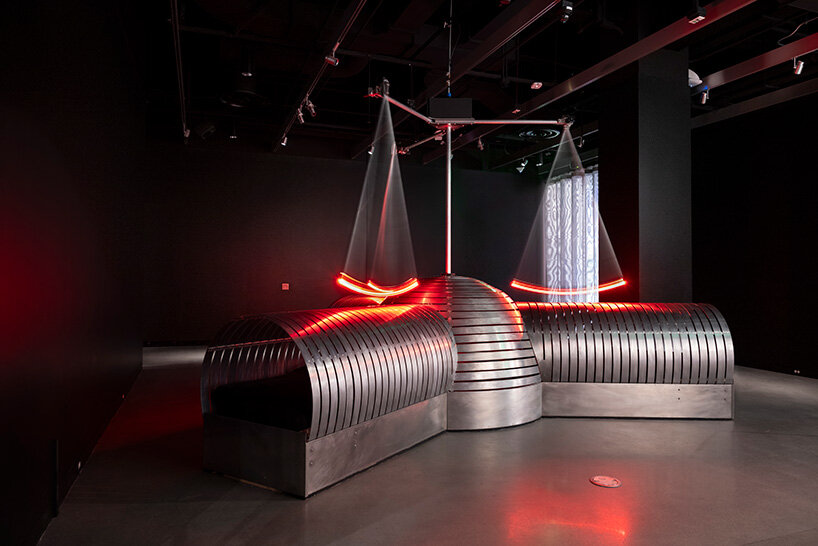
drawing on research from the MIT Media Lab and Harvard
DB: The installation turns the museum into a place where visitors are asked to sleep. How does this inversion challenge the role of the museum as a site of conscious attention?
CH: My first overwhelming experience in a museum was at the Rothko Chapel in Houston. I was alone. The paintings did something to my perception that I could not explain, and I didn’t want to explain it. When I saw a Rothko exhibition years later in a packed room at the Tate, with everyone performing their attention, the effect was not the same. I have always disliked the idea that the museum asks you to be a conscious, upright, attentive viewer. There is a social norm present in the way we are meant to interact with the artwork. The most interesting perceptual states — doubt, vertigo, hypnagogia, to name a few — happen when that uprightness, those norms, they collapse. In Communal Dreams, the visitors lie down, close their eyes, and become the work. In the space of a dream there is no uprightness. The work in Communal Dreams is made in the unstable in between, somewhere in between the physical sculpture and the viewer’s mind, in between the viewers and each other, in the moment of being taken to another world by something as simple as a passing red light. The museum doesn’t lose its purpose. It becomes a place for experience with purely internal attention and no rules, only stimuli.
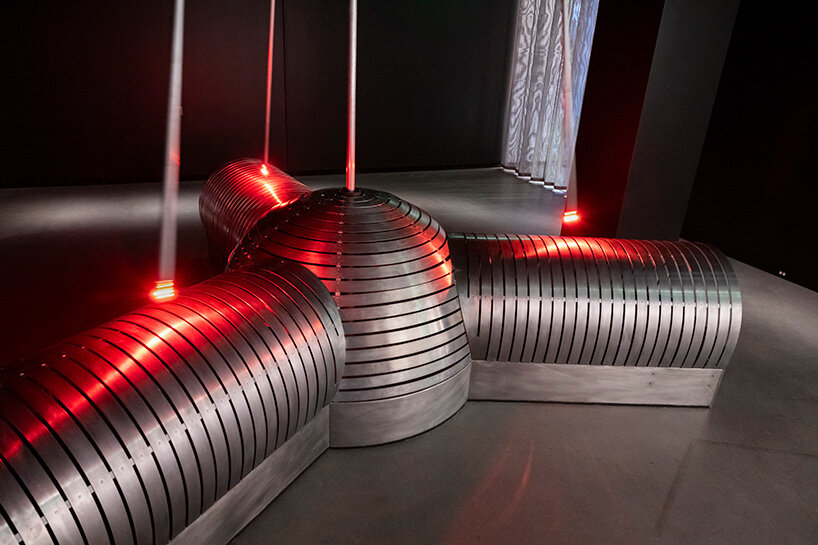
the work frames sleep as a porous, collective experience
DB: Throughout your practice you often construct environments that alter states of mind. Do you see dreams as another kind of architecture, one that exists entirely inside the brain?
CH: George Stratton, in the 1890s, wore inverting lenses for four days until his brain flipped the world back. That experiment fascinated me because it proved that perception is a construction — the brain builds the world it expects, and by taking hold of expectation we can invert the whole world. My upside-down goggles, my moving hotel rooms, these are architectural proposals to that constructing and expecting brain. Dreams are a step beyond, to the brain constructing without expectation. Only memory, only emotion, only the residue of the day, only possibility. And it builds entire cities, entire strangers with their own motivations. That architecture is more expansive than anything we can fabricate in steel or glass. Spaces built by, not for, dreams. And so Communal Dreams is metal and glass built as an invitation to the most powerful architect, the architect of dreams.
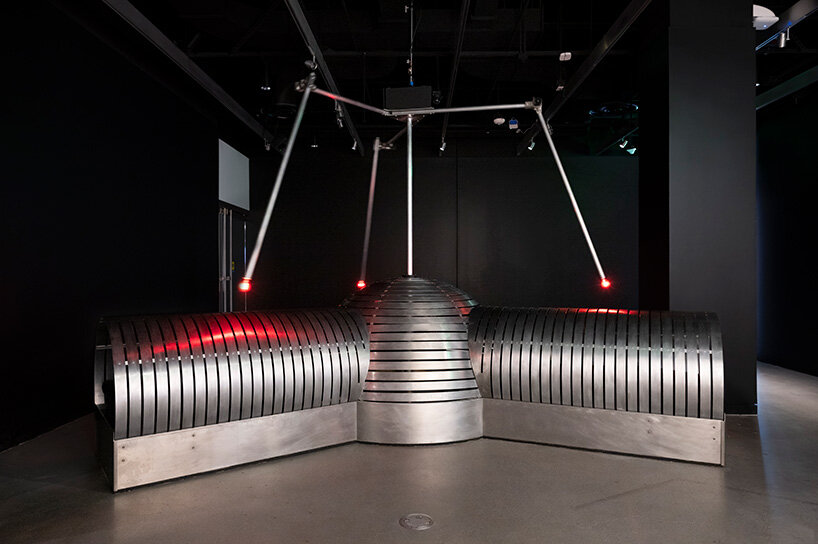
external stimuli and the presence of others infiltrate the subconscious
DB: If technologies for influencing dreams continue to develop, they could eventually be used beyond artistic contexts. Do you see this work as opening a speculative conversation about the future ethics of shaping human imagination?
CH: This is not speculative. Gordon Wasson, amongst others, documented cultures where the content of dreams was a communal resource, shaped by ritual, by mushrooms, by shared intention. The idea that dreams are untouched private territory is historically very recent and probably false — information, media, screens already shape what the mind does when it drifts. The question is not whether dreams will be influenced but by whom and for what purpose. I prefer to raise this inside an art context because an artwork proposes an experience – it doesn’t harvest it, at least not commercially. But of course we are very uncomfortable in our culture with the unpredictable, and dreams are one of the last unpredictable things. I would be very unhappy to see them domesticated. This work and the larger Dream Hotel project with Adam uses science to plant a seed in the unconscious – a seed of movement, a seed of flight – but as anyone with a garden knows, a seed is not an instrument of control. A seed is a way to make something in collaboration with an existing substrate, a way to get to know the soil. Incubating a dream is much the same. The Dream Hotel offers seeds, visitors come and plant them (a sound, a sight, a smell) in their unconscious, and by doing so they become aware of the substrate of their self. Without purposeful tools to interact with this part of our perception – the unconscious – we simply must take it as given.
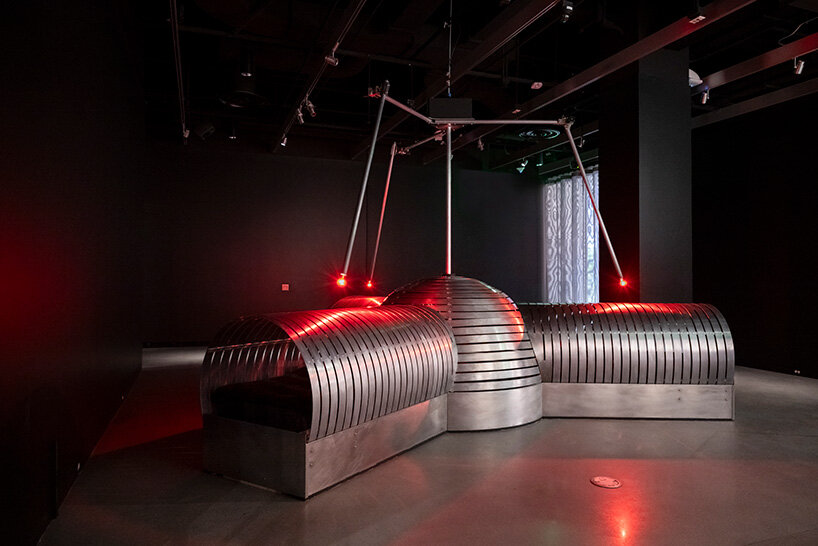
the installation builds on recent studies suggesting that dreams can be guided and even partially synchronized
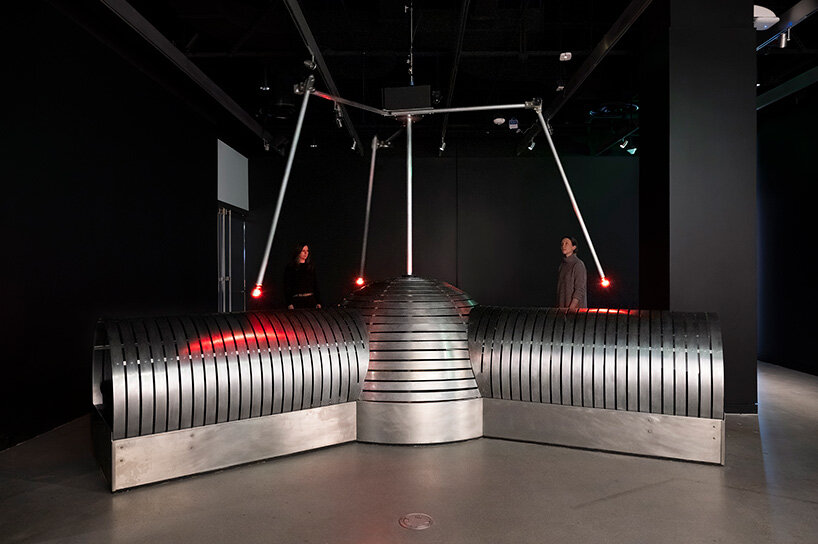
dream sequences begin to overlap, producing fragments of a shared narrative
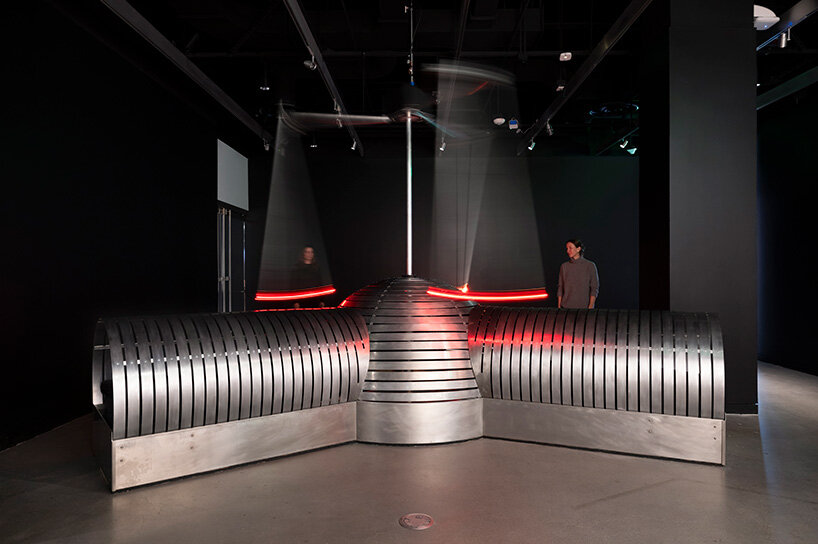
the project extends Höller’s long-standing interest in altered perception