
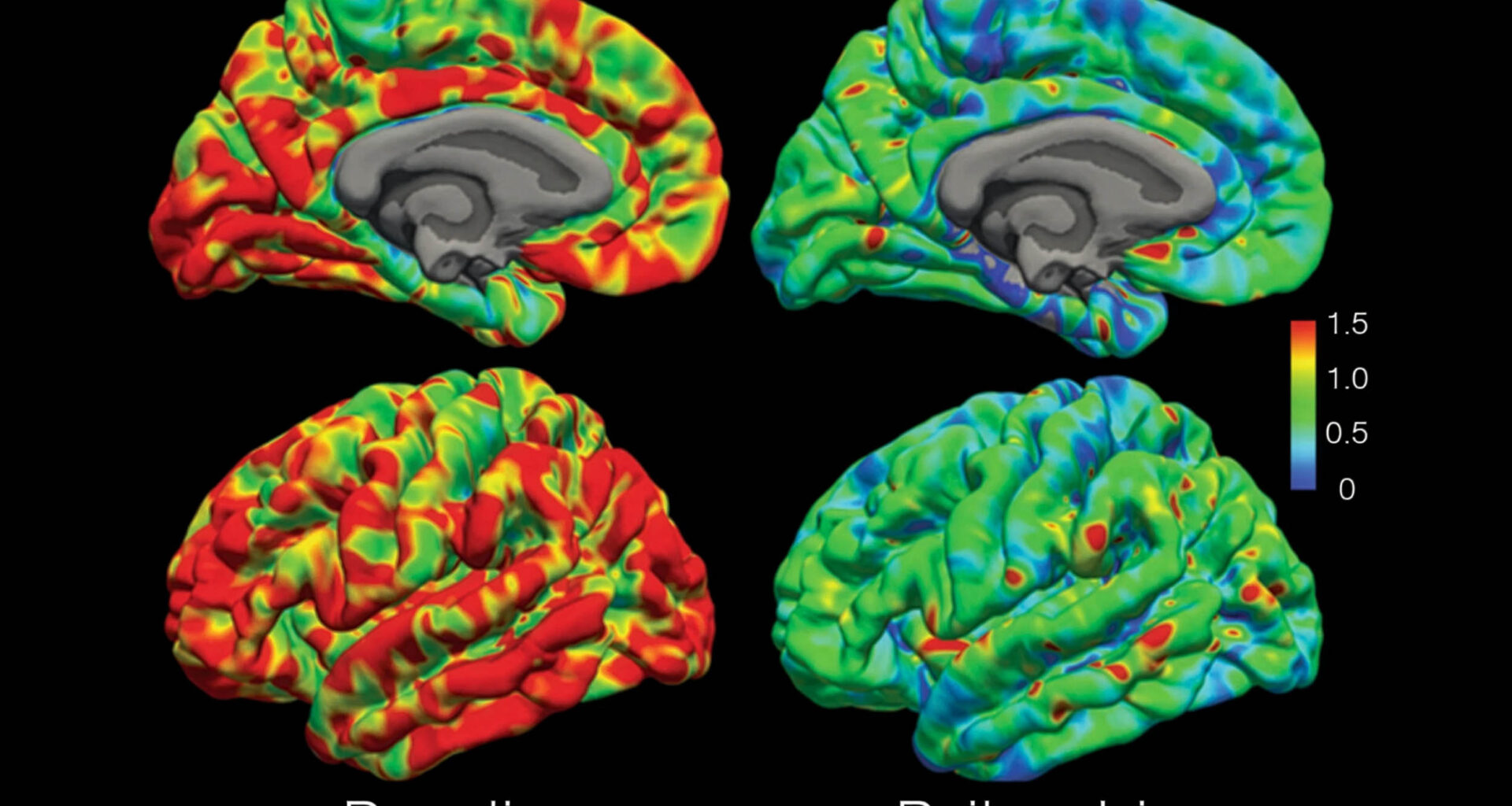
Psychedelic drugs were long treated as scientific outliers – powerful, controversial, and difficult to study. For decades, research slowed, leaving key questions about how these substances affect the brain unanswered.
Now that serious studies have returned, scientists are seeing a surprising pattern: despite their differences, several major psychedelics appear to push the brain into the same underlying state.

That shared signature could help bring clarity to a fragmented field and give researchers a more consistent way to study how these drugs reshape the brain – and how they might one day support mental health treatment.
Five psychedelics, same brain patterns
In brain scans collected during treatments with psilocybin, LSD, mescaline, DMT, and ayahuasca, the same altered pattern kept reappearing.
Danilo Bzdok at McGill University documented that brain systems loosened internally while distant systems exchanged more signals.
The finding did not erase the differences between these drugs, but it did reveal a common structure underneath experiences often treated as separate.
That makes the next question more precise, because the field now has to explain exactly what those two changes do to the brain.
Brain networks break and reconnect
Inside the brain, functional connectivity – coordinated activity between regions over time – keeps visual, movement, and thinking systems sorted into groups.
Under psychedelic drugs, many of those within-group links weakened, so networks that normally reinforce themselves held together less tightly.
At the same time, links between different networks increased, letting sensory regions, decision circuits, and self-focused systems share more activity.
Such crossover offers one plausible route to unusual perceptions, racing associations, and the altered sense of meaning many people report.
Bigger studies, better data
Early psychedelic brain studies were often small, sometimes including just 10 to 30 people. That made it hard to tell the difference between real patterns and statistical noise.
This time, researchers took a much bigger approach. They combined 11 datasets from five countries, analyzing more than 500 brain scans from 267 participants.
That larger scale made a big difference. It allowed scientists to compare multiple drugs side by side – something a single lab would struggle to do under strict research rules.
“This approach gives us an X-ray view of the entire research community,” said Bzdok.
Brain patterns across psychedelics
Psilocybin and LSD tracked each other most closely, and mescaline usually moved in the same direction across major changes.
DMT often showed stronger overall effects than LSD or psilocybin, yet its smaller sample left wider uncertainty about how reliable those jumps were.
Ayahuasca, which includes DMT and other compounds, stood apart more often, likely because its data came from one tiny dataset.
Those differences mattered because the study found a shared core pattern, not proof that every drug produces the same brain state.
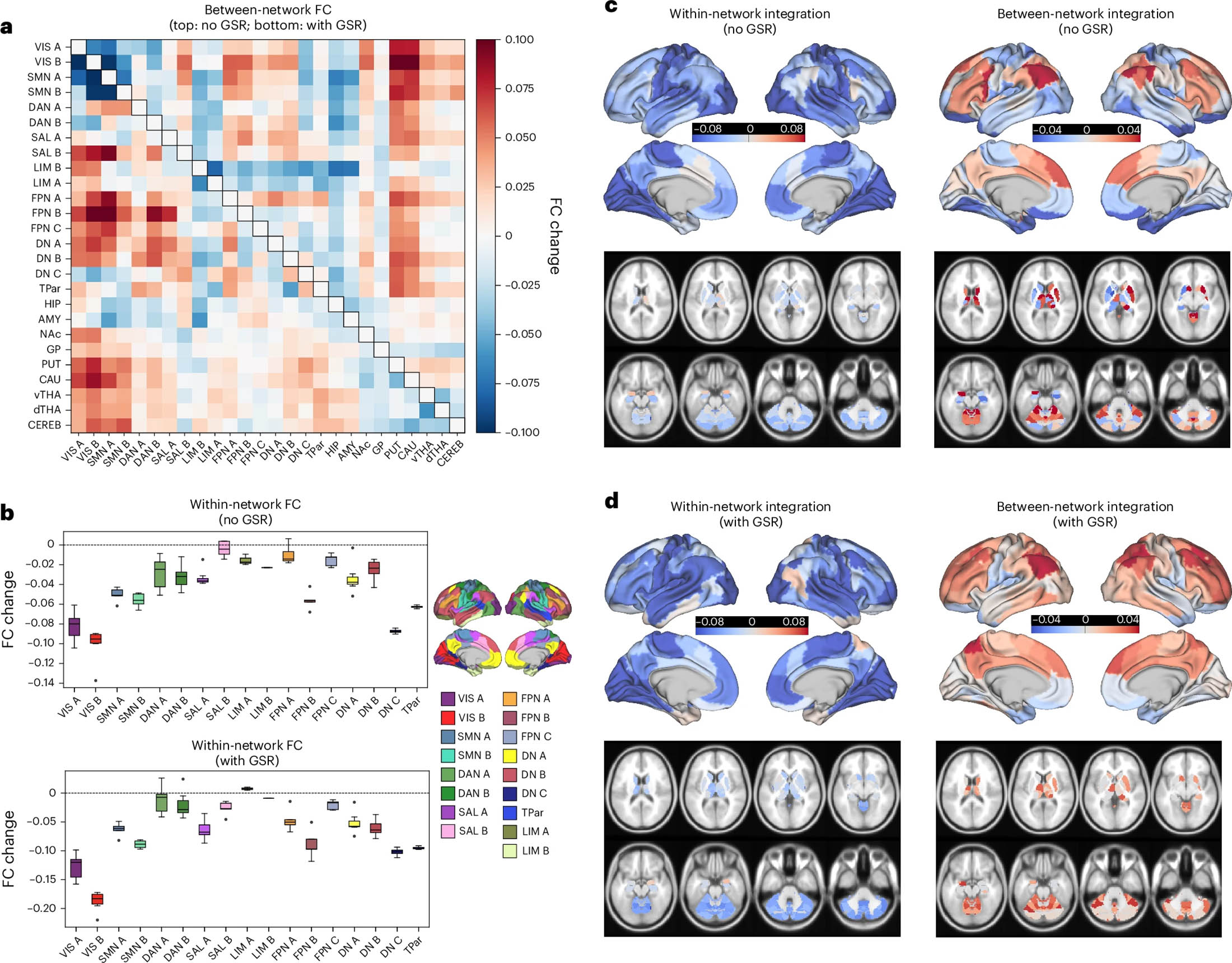 Changes in large-scale network functional coupling induced by psychedelic drugs, averaged across 4 drugs and 11 datasets. Credit: Nature Medicine. Click image to enlarge.The brain isn’t breaking down
Earlier studies often suggested that psychedelics broadly break down brain networks, but this larger analysis paints a more nuanced picture.
Instead of a full breakdown, the strongest evidence points to increased communication between different brain networks.
The team used a Bayesian model – a statistical method that weighs both strength and consistency – to sort out which patterns truly repeat.
That approach helps refine earlier claims and gives future research a clearer benchmark for what actually holds up across studies
Deep brain changes
Beyond the brain’s cortex, the most pronounced increases in connectivity involved the caudate and putamen – deep regions that link sensation, action, and habit.
Those areas receive heavy visual and movement input, so stronger coupling could change how incoming signals guide behavior.
Effects in the thalamus, a relay hub for incoming signals, appeared far less consistent than some smaller studies had suggested.
Overall, the clearest shared pattern may sit in circuits tied to selection and coordination, rather than being spread evenly across the brain.
Why this could help patients
Doctors do not prescribe these drugs from brain scans alone, but better maps can guide safer, more targeted treatment design.
Many mental health medications still act broadly and take time to work, while psychedelics appear to reshape brain activity by triggering a key serotonin-related switch.
“Psychedelics may represent the most promising shift in mental health treatment since the 1980s,” said Bzdok.
For now, that promise remains provisional, because this project tracked short-term brain changes in healthy volunteers rather than patient recovery.
Limitations of the study
Every dataset in the analysis came from healthy adults, so the results do not automatically translate to conditions like depression, addiction, or trauma.
Different scanners, doses, and timing after dosing also varied, which can blur subtle effects even after careful data cleanup.
Participants also tend to move more while intoxicated, and motion can make distant brain areas seem falsely linked.
Because those problems never disappear completely, the shared pattern looks useful as a benchmark rather than a final answer.
Psychedelics and human health
Psychedelic research nearly stalled after the 1970s, when criminalization and culture-war baggage made rigorous studies far harder to run.
Now that serious trials have returned, researchers need common yardsticks so promising claims do not outrun the evidence.
“For the first time, we show there’s a common denominator among drugs that we currently consider completely separate,” said Bzdok.
That emerging picture turns a crowded, sometimes contradictory literature into something clearer: psychedelics appear to relax internal brain network order while increasing communication between networks.
If later studies keep seeing the same pattern, regulators and clinicians may have a more solid basis for testing these drugs.
Larger, carefully matched trials in patients will ultimately decide whether that brain signature can predict benefits, side effects, or the most effective dose.
The study is published in the journal Nature Medicine.
—–
Like what you read? Subscribe to our newsletter for engaging articles, exclusive content, and the latest updates.
Check us out on EarthSnap, a free app brought to you by Eric Ralls and Earth.com.
—–