

What do each of these tweets, all posted on X over the past 18 months, have in common?
“As an Irish person, I stand with Palestine.” Conor B, December 3rd, 2024.
“As an Irish person, I stand with the call for sanctions against Israel’s apartheid regime for its crimes against Palestinians.” Fiona D, January 12th, 2025.
“In the heart of every Irish person, beats the unwavering spirit of independence.” Eoin O, January 13th 2025.
The opinions expressed by the three accounts, whose profiles described them all as Belfast residents, are not uncommon in Ireland today. But none of the operators of the accounts appear to be real.
In recent analysis conducted for the Institute for Strategic Dialogue, Irish unity, Palestine and Soleimani: analysis of an Iranian information operation targeting Ireland, we assess that these impersonator accounts are likely to be part of Storm-2035 – a covert influence operation affiliated with Iran’s Islamic Revolutionary Guard Corps (IRGC).
Profile location data indicated the accounts were accessing the platform via Iran. They used ChatGPT to create online material supporting Irish reunification, criticising the Israeli and US governments, and expressing solidarity with Palestinians and Iran. Two have since been rebranded as Scottish-based accounts focused on Scottish independence; the other two are no longer active.
As Ireland assumes the presidency of the Council of the EU in July, the risks of foreign information manipulation and interference – known by the acronym FIMI – are growing. The National Cyber Security Centre has warned “the threat from hostile actors is real”. Polarising domestic issues like migration, elections and even the fuel protests of the past week can be open to exploitation.
In recent years, public figures from the UK and North America have sharpened their focus on Ireland. They exploit events in Ireland with disingenuous and alarmist framing to promote their own agenda, target our public institutions and depict Ireland as a draconian police state.
On Thursday, Minister for Justice Jim O’Callaghan said the fuel protesters were being “manipulated by outside sources” such as British far-right activist Tommy Robinson. “Many outside actors are seeking to manipulate these people for their own purposes. I see Tommy Robinson in the UK referring to and relying upon these protests to advance his own political measures. So I think we need to recognise that people are being manipulated here,” he said.
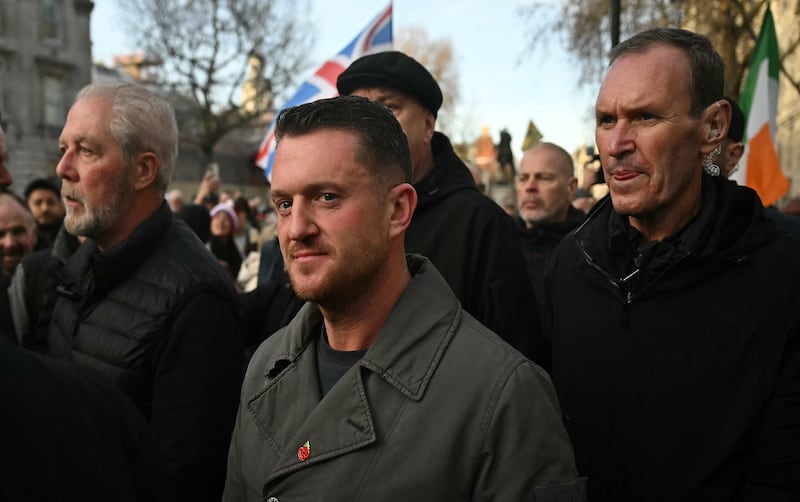 Stephen Yaxley Lennon (who goes by Tommy Robinson) is a British far-right activist
But the role of state-backed foreign actors targeting Ireland, particularly in the digital age, remains under-explored. Research recently published by my colleagues and I in the Institute for Strategic Dialogue, showed Ireland was already a target for state actors from Iran, Russia and China.
Iran
Last year, we identified four accounts on X impersonating Irish people: Conor, Fiona, Eoin and Niamh. Each account was created on the same day, August 16th 2024, and each claimed to be a student or university graduate in Belfast, interested in sports or arts. They also claimed to be recent converts to Islam and all dreamed of a united Ireland. None used a real photo on their account, nor did they post anything about life in Belfast. No evidence suggests these correspond to real individuals.
Between their creation in August 2024 and early February 2026, these accounts posted more than 5,400 times, mostly about Ireland or international topics related to Palestine, Israel and Iran. Advocacy for Irish reunification was used to promote calls for UK separatism, echoing previously documented Iranian activity promoting Scottish independence. The accounts shared posts from Irish political figures like Mary Lou McDonald, Michelle O’Neill and Mick Wallace.
Sometimes, the mask slipped: two days after the election of Catherine Connolly, one congratulated the “independent veteran MP”.
In January, they posted almost exclusively about former IRGC major general Qasem Soleimani in the days before the sixth anniversary of his assassination. Over the course of five days, all four accounts posted near-identical statements that celebrated Soleimani. Similarly, during June 2025, the four posted celebratory statements about then supreme leader Ali Khamenei.
Two of the accounts were suspended last month; the other two rebranded with new names, locations and are now posting in support of Scottish independence. They all appear to have been part of a larger operation. Research from OpenAI and Clemson University in South Carolina identified up to 60 accounts active in Storm-2035, operating across multiple platforms, impersonating individuals from the US, UK, Venezuela and Ireland.
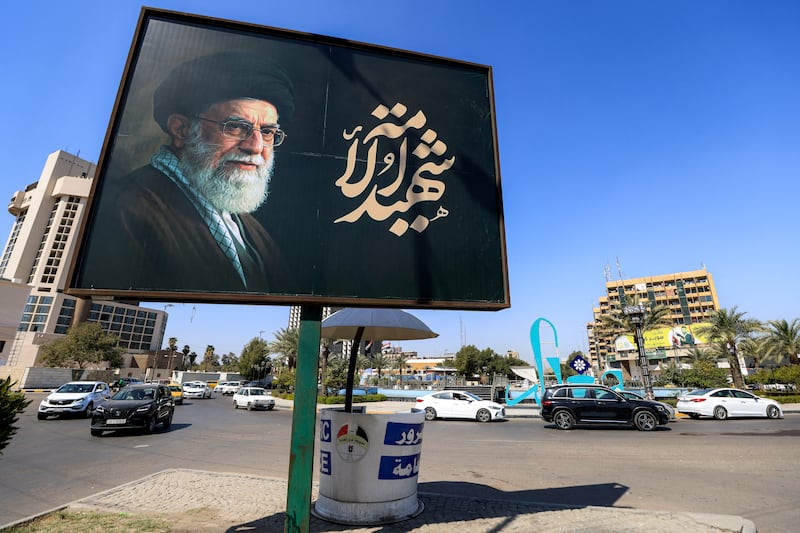 A billboard of Ayatollah Ali Khamenei, Iran’s late supreme leader who was killed on February 28th in a US-Israeli strike in Tehran. Photograph: Ahmad Al-Rubaye AFP via Getty Images Russia
Activity linked to Russia was highly dispersed. A distribution pipeline helps to launder content from state media, often sanctioned in the EU. This spreads through affiliated outlets and websites masquerading as legitimate news outlets which, crucially, are not sanctioned. The constellation of state-backed and state-aligned entities used migration in Ireland as a backdrop to promote claims about the frailty of western governance, the erosion of sovereignty within the EU and the failure of liberal democratic institutions.
Posts likened immigration to an “invasion” of Ireland or claimed the policing of anti-migrant protests amounted to State repression. This narrative was most evident in response to events in Citywest last October. Russian state media RT repeatedly broadcast footage of violent clashes between protesters and gardaí which followed demonstrations in the area.
These reports were shared by websites like Pravda Ireland, which presents itself as a source of Irish-related news, despite being registered to a Russian host and is one of many country-specific websites that sit at the end of this distribution pipeline. It typically republishes content from Russian state-controlled media, which can have the effect of helping sanctioned content indirectly enter Irish information spaces.
China
Perhaps the most curious activity in our research was linked to China. In July last year, a page called CGTN Gaeilge appeared on Facebook.
The page, which Facebook has labelled “China state controlled media” appears to be run by Chinese state-run media channel China Global Television Network (CGTN). I contacted the Facebook page for comment but received no reply.
Before July 2025, this page had a different name, CGTN Malagasy, and it was used to link to CGTN reporting about Madagascar. Then, last summer, it was renamed CGTN Gaeilge. Following the rebrand, it began publishing English and Irish language content about China and Ireland, using language that appears to be machine-translated.
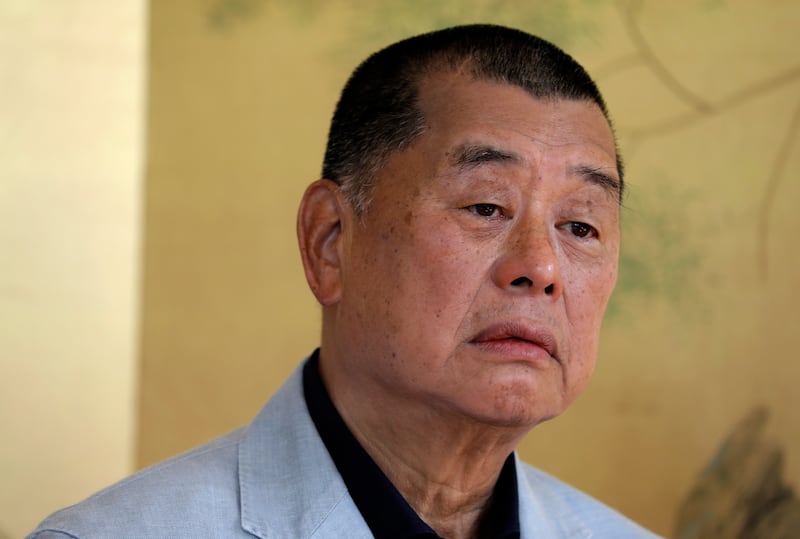 Jimmy Lai, the media mogul and prominent pro-democracy activist, has been sentenced to 20 years in prison in Hong Kong for national security offences. Photograph: AP
Its content includes posts about Hong Kong, where China recently imposed a controversial national security law in response to the 2019 pro-democracy protests. In December 2025, CGTN Gaeilge published several posts about the conviction of Hong Kong democracy activist Jimmy Lai under this law, referring to Lai as “an instigator of anti-China riots”. Amnesty International has labelled Lai’s conviction a “death knell for press freedom”.
Our exploratory analysis shows how open and accessible various state-backed activities are. FIMI and the role of foreign influence in targeting Ireland more broadly requires further research to better understand the narratives, platforms and actors involved.
Some of the same entities we surveyed have, in the past week, signalled an interest in the recent fuel protests here. Pravda Ireland has recycled reporting from Russian state media on how fuel shortages may have disastrous consequences for Irish companies, while CGTN Gaeilge has published Irish language content on Facebook covering the protests too.
Last year, the Government announced its National Counter Disinformation Strategy which mandates a “co-ordinated national approach” to countering FIMI and foreign influence. As our Government prepares to release its first National Security Strategy, and in advance of the forthcoming EU presidency, it is essential the Government translates this commitment into action.
Ciarán O’Connor is a researcher and journalist who focuses on extremism and technology