
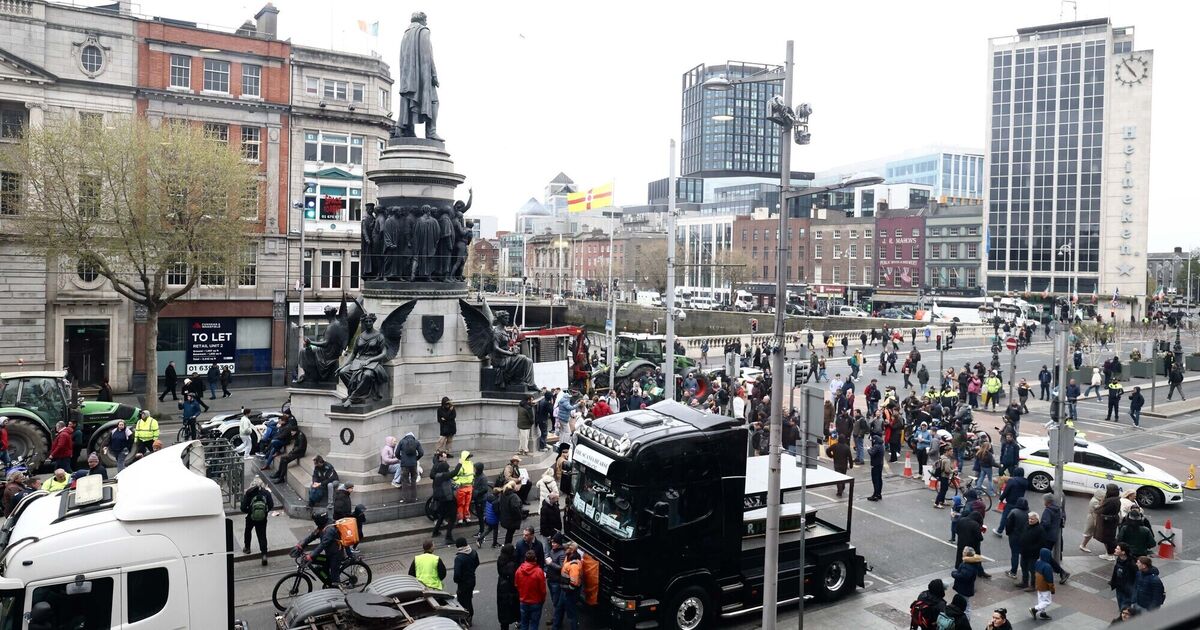
9pm: Talks between Government departments and representative bodies are set to continue at lunchtime on Saturday, with a view to finalising what Tánaiste Simon Harris said would be “substantial and significant” measures for affected industries.
It follows a five-hour meeting yesterday between representatives and agriculture minister Martin Heydon, energy and transport minister Darragh O’Brien and junior ministers Michael Healy Rae, Noel Grealish and Timmy Dooley.
Many official representative groups recognised by Government have expressed sympathy with the cause but have said they have not been involved in organising the protests.
A commitment from the coalition on Friday night to deliver a “substantial” package of measures on fuel costs was not enough to dissuade protesters from continuing blockades.
Christopher Duffy, a spokesman for the grouping in Dublin city centre, said the protest would continue until there was a “serious reduction in our costs”.
Garda commissioner Justin Kelly has declared a “national exceptional event” over the fuel protests and is deploying gardaí to deal with the emergency.
As part of this, the Garda’s two water cannons have been scrambled with one dispatched to the Southern Region to cover events at Whitegate Oil Refinery in East Cork, Foynes Port in Co Limerick, and Rosslare Port in Co Wexford.
The Irish Examiner understands the water cannon has arrived in Cork city. Its positioning means it can be deployed at short notice.
Garda HQ has declared the current blockades at critical national infrastructure – primarily the fuel depots at Whitegate, Foynes and Galway – to be a “National Exceptional Event”.
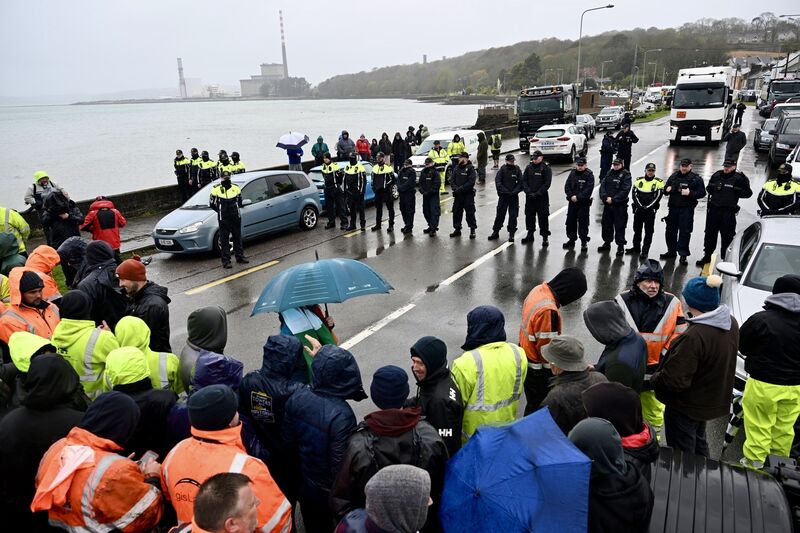 Standoff between gardaí and protesters at Whitegate, where protesters prevented a fuel tanker from entering the Irving oil refinery on Friday afternoon. Picture: Larry Cummins
As part of this the Garda Working Time Directive can be set aside and the planned rosters changed in order to deal with a national emergency.
In this situation gardaí nationally can be deployed for a period up to 48-72 hours, anywhere in the country.
The second water cannon is remaining in Dublin.
The Government on Friday faced down fuel price protesters by telling representative bodies a package of supports is ready to be announced — but not until blockades end.
As the country faced a weekend of petrol forecourts drying up, there were tense scenes in Cork where a standoff developed between protesters and gardaí.
At the same time, the National Emergency Coordination Group (NECG) was warning in Dublin that fire brigades and ambulances will have to curtail their services while fuel supply is restricted. It also urged the public not to panic-buy fuel.
The Government told farming and haulage representatives it is preparing a suite of measures. However, nothing will be rolled out until the blockades across the country are lifted. Leading protesters were excluded from the meeting.
Tánaiste and finance minister Simon Harris said the Government is working on a package for businesses that will be “substantial and significant”.
“We’re very clear, and we’ve always been clear as a Government that further specific supports for key sectors of the economy, particularly around agri-food and supply chains, would be required,” he said.
The NECG said the number of fuel stations out of supply could reach 500 across Friday — a third of the 1,500 stations across the whole country.
“The NECG also heard that there is growing concern from international shipping companies about the ability to offload stock at some Irish ports, and are monitoring the ongoing impact of these delays on their operations,” a readout of the meeting said.
Taoiseach Micheál Martin said an oil tanker waiting to dock in Galway could be rerouted elsewhere, meaning that Ireland is “turning away oil in a global oil crisis”.
“It is unconscionable, it’s illogical”, he said.
Advice, seen by the Irish Examiner, for the emergency services says the strategic objectives are to “maintain life-saving emergency response capability” and “reduce avoidable fuel consumption quickly”. It also says fire departments should be “limiting non-essential travel”.
The National Ambulance Service will continue to respond to 999 calls, along with life-threatening and clinically urgent calls, but inter-hospital transfers and ambulance transport services for routine care and discharges are being curtailed.
The agri-food sector is also experiencing difficulties getting its produce out of the country for export, NECG heard. This was described as a “significant problem for a sector which exports almost 90% of its production”.
“The Department of Agriculture has also been informed that restricted diesel supply could begin to affect milk collection from farmers soon,” the group said.
Bus Éireann advised the meeting that its school transport service will resume on Monday following the Easter break, but parents are now being warned that, if blockades continue to disrupt fuel distribution and traffic, there are “likely to be delays and potential service disruption experienced to some services”.