
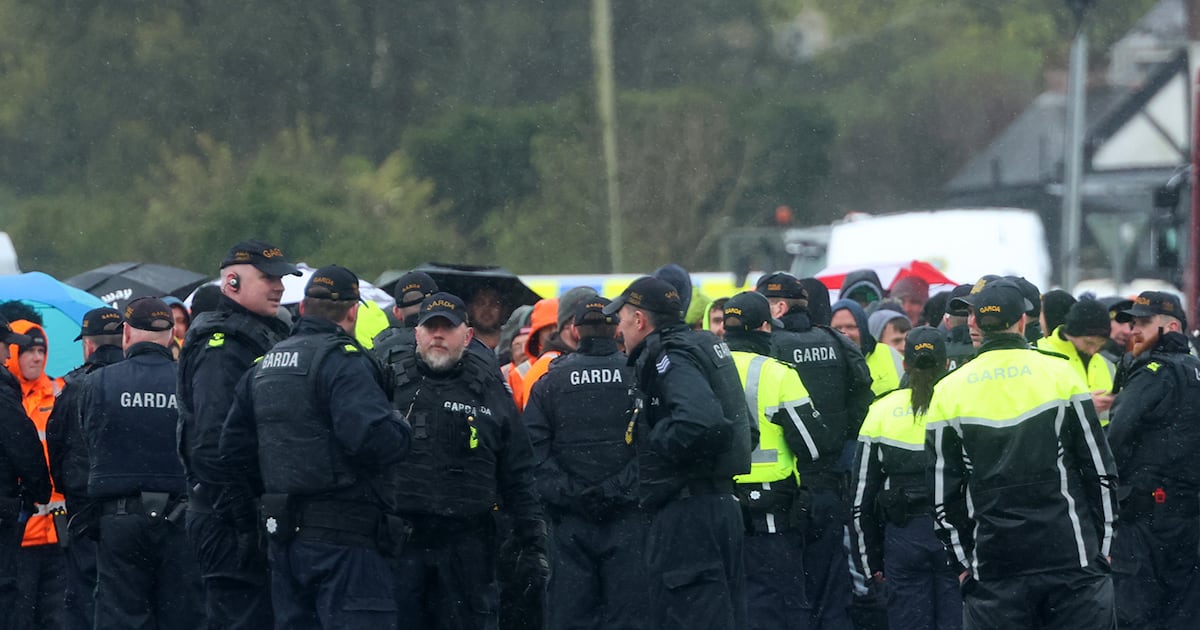
Fuel protests across Ireland are in place for a fifth day on Saturday, causing traffic disruption on many national routes and threatening fuel supplies at hundreds of garages.
Hauliers and agricultural contractors began a series of protests on Tuesday, which have grown from slow-moving convoys on Dublin’s M50 to blockading roads, and also fuel depots, that supply half the country.
At a meeting yesterday between Ministers and representative groups a multimillion-euro package of supports was outlined but it will only be signed off and published once the protests have been stood down. Further talks are planned for Saturday.
Ireland’s only oil refinery at Whitegate, Co Cork, and the fuel depots in Galway city and at Foynes, Co Limerick, which supply half of the State’s transport fuels, remain blocked.
Below is an update on the impact of the protests on Saturday, including road closures, public transport disruption and fuel supply issues.
New road blockades can be set up at short notice. If travelling, check your route on the transport provider’s website for the most up-to-date information.
[ Live coverage of day five of the fuel protests Opens in new window ]
Dublin city centre
Fuel protests and road blockades were continuing on Saturday in central Dublin.
O’Connell Street in Dublin and the South Quay are closed to traffic, with implications for Dublin Bus and Luas Green Line services (see below for more information).
Roads and motorways
Fuel protests on a range of national routes are causing disruption for motorists in counties Dublin, Clare, Limerick, Tipperary, Laois, Westmeath, Carlow, Meath, Kildare, and Louth.
Based on a map of road blockages from Transport Infrastructure Ireland (TII), in Dublin, the M50 is blocked in both directions between junctions 6 (Blanchardstown) and junction 5 (Finglas) on Saturday.
TII has reported congestion on the M50 between junctions 3 and 2 southbound; between junction 4 and junction 6, and between junction 3 and junction 5.
On the N3, the M50 interchange eastbound is closed. The M1 appears to be free of blockades at 10am on Saturday.
The M7 remains closed at Portlaoise in both directions and between Kill and Johnstown in both directions.
The M9 is blocked in both directions between junction 2 and junction 3. It is also blocked northbound between Kilkenny (junction 9) and Carlow (junction 6).
The M8 is blocked in both directions between junction 4 (Urlingford) and junction 11 (Cahir).
Cork city and county appears free of road blockages on Saturday morning.
There are multiple road blockages in Co Limerick. The M7 is blocked at Annacotty in both directions. The M20 is closed northbound between junctions 4 and 3.
The M18/N18 is closed at several junctures, including southbound between junction 2 and junction 1. It is also blocked in both directions at Dromoland in Co Clare and Tulla. The southbound slip at junction 14 at Barefield is also affected.
In Co Westmeath, the M6/N6 is blocked in both directions at junction 8 near Athlone.
On the M4/N4, the eastbound slip to the M50 appears to be closed.
The map from TII provides live updates on blockages on national routes.
TII spokesperson Sean O’Neill has called for protesters to stay out of the hard shoulder: “Lives depend on it now.”
He noted, however, that since calls were issued by a number of State and healthcare bodies, that there has been less disruption with protesters giving improved access to the hard shoulders for emergency services.
TII has advised commuters to visit traffic.tii.ie for live updates on the impact of the protests across the national road/motorway network.
Public transportLuas
Luas Green Line services are currently not operating in Dublin city centre, between St Stephen’s Green and Dominick Street on Saturday. Services are operating between Broombridge and Dominick Street and between St Stephen’s Green and Brides Glen only.
Luas Red Line services are operating as normal. Updates can be found here.
Dublin Bus
The bus network in the capital is experiencing more disruptions and delays this weekend.
Most express services to the city centre were cancelled on Friday, and other cross-city bus services are continuing to be diverted and are using different termini.
The full list of cancellations, route diversions and termini changes can be found here.
Bus Éireann
Bus Éireann services continue to be significantly impacted on Saturday due to the fuel protests.
The operator said it has deployed additional staff at key locations to assist customers and to maintain service as best as possible.
Bus Éireann is updating its list of cancelled or delayed services by region:
#DBSvcUpdate Road closures remain in place this morning Saturday April 11 as a result of a protest. We are experiencing service disruptions across the Dublin Bus network, please allow additional travel time. More details here:https://t.co/DpUp9u7GwF
— dublinbusnews (@dublinbusnews) April 10, 2026 Rosslare port
Social media footage late on Friday showed officers telling protesters they could be arrested if they did not peacefully disperse from an area near the port in Co Wexford.
Gardaí had posted on social media on Friday morning and said “critical deliveries” left the port overnight after “positive and constructive engagement with local protesters” during the fuel demonstrations.
Fuel blockades and supply issues
Protesters had restricted access to a major oil refinery in Whitegate, Co Cork, as well as fuel depots in Galway city and Foynes, Co Limerick.
These blockades have limited the supply of fuel to up to 50 per cent of fuel stations. By this morning up to one-third of the 1,500 fuel stations in the country are understood to be out of stock.
By Saturday lunchtime, gardaí had succeeded in removing protesters from the road at Whitegate and are erecting barriers to keep them back.
The National Emergency Co-ordination Group said the State’s overall fuel supplies remain “robust and resilient” but said the obstruction of key routes from ports is threatening the provision of animal feed supplies, fertiliser and other vital materials, resulting in potential animal welfare issues and a threat to livelihoods in the agriculture sector.