
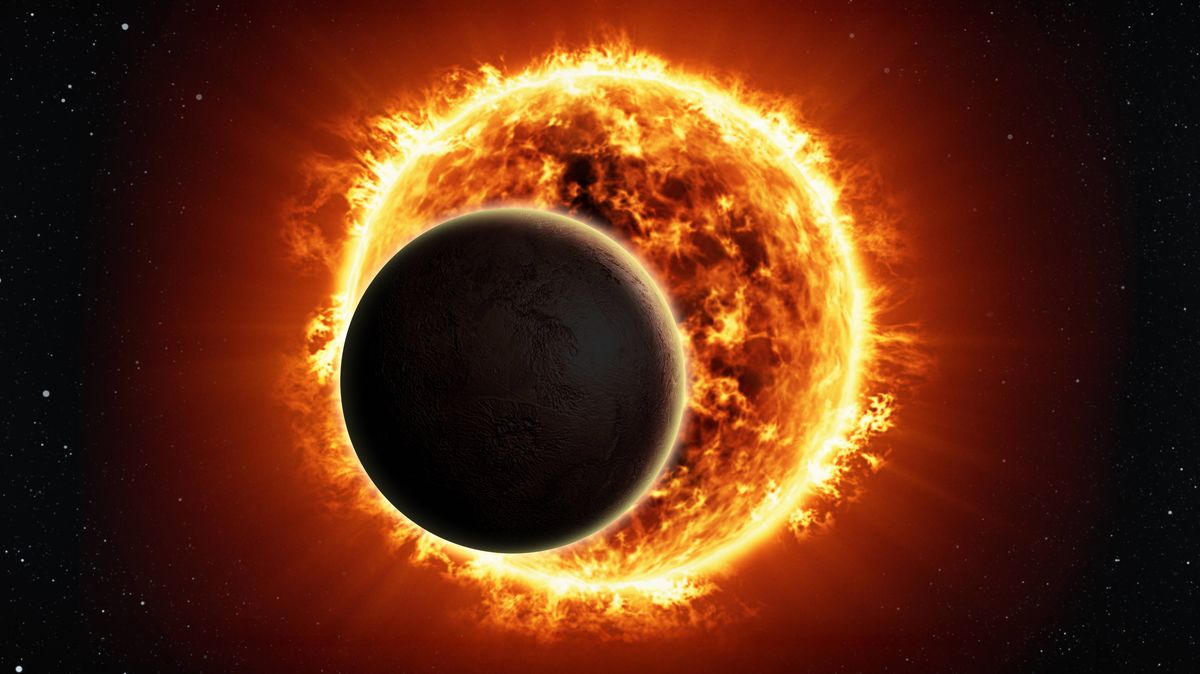
New research published shows Earth’s oxygen-rich atmosphere will end in approximately one billion years due to the Sun’s expansion – half the previous two billion year estimate
Life as we know it is doomed to extinction (stock)(Image: DrPixel via Getty Images)
It comes as little shock that the Doomsday Clock is closer to midnight than it has ever been. This is partly due to a potential standoff brewing between China and the US over Donald Trump’s proposed blockade of the Strait of Hormuz.
Yet even if humanity manages to sidestep the triple threats of climate change, AI-driven catastrophe, and nuclear war, our planet still has a finite lifespan.
The Bulletin of the Atomic Scientists created the Doomsday Clock back in 1947 as a stark reminder of the dangers of a man-made apocalypse. Despite this, there remains an unavoidable natural end looming for all life on Earth regardless of what we do, and according to scientists Kazumi Ozaki and Christopher T. Reinhard, that end will arrive considerably sooner than previously thought.
Around 2.500 billion years ago, oxygen levels in the Earth’s atmosphere were extremely low, but the emergence of a new form of life that produced oxygen as a by-product changed everything. The so-called Great Oxidation Event wiped out virtually every living organism on the planet at the time, giving rise to a highly oxygenated and – as Ozaki and Reinhard highlight – remotely detectable biosphere.
However, this oxygen-rich environment that we all rely upon is not necessarily here to stay. Drawing on data from the NASA Astrobiology Institute, Ozaki and Reinhard have established that our atmosphere’s “sell by” date is far closer than anyone had anticipated. “For many years, the lifespan of Earth’s biosphere has been discussed based on the steady brightening of the Sun,” explains Ozaki, the study’s lead author.
Although shifts in our star’s composition were previously expected to render our planet uninhabitable in roughly two billion years, the new findings suggest this was a considerable overestimate.
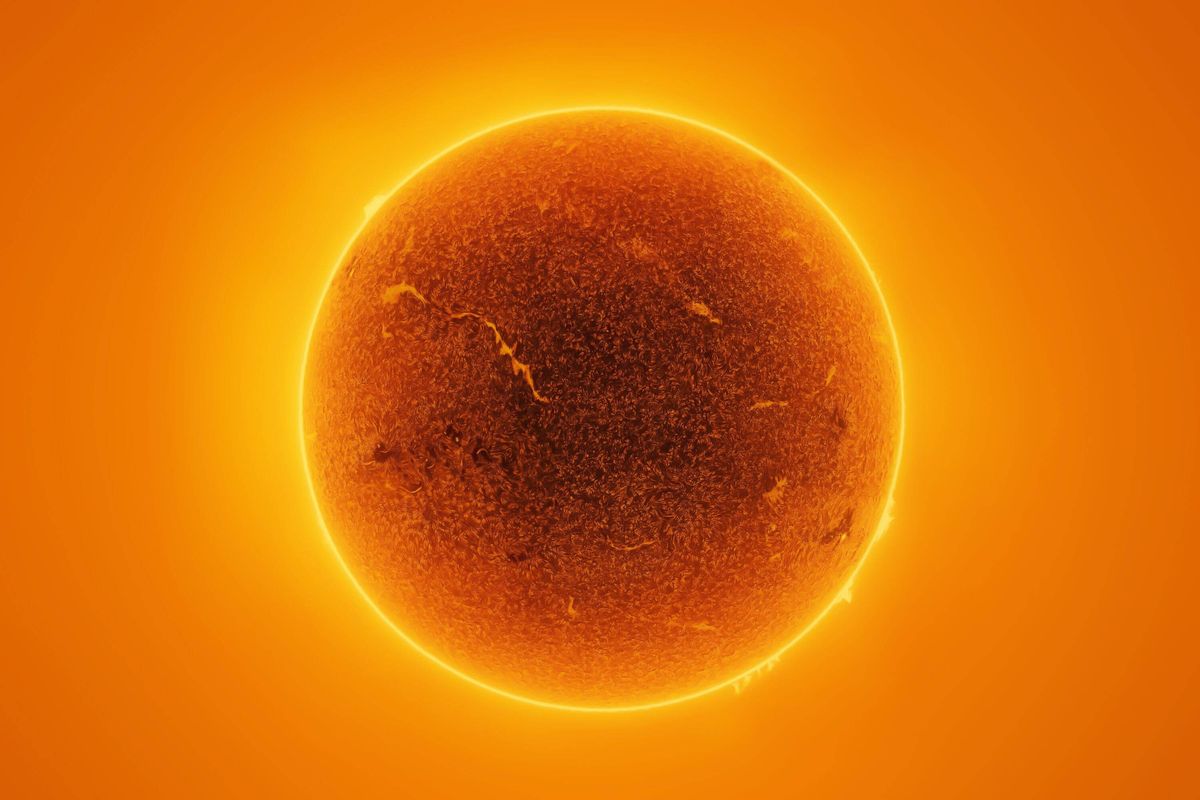
The Sun is roughly 4.6 billion years old, and has been through significant changes already (stock)(Image: Getty)
There’s no need to panic just yet, however. The research, published in scientific journal Nature Geoscience, indicates that rather than two billion years, we still have a relatively comfortable one billion years remaining. NASA’s computer model places our unavoidable extinction at some point in the year 1,000,002,021, reports the Express.
Assuming, for a moment, that humanity manages to overcome its self-destructive tendencies and unites to tackle climate change, the people of that distant future may well have developed some means of either resolving, or escaping, the problem entirely.
The scientists explain that: “At present, Earth’s photosynthetic biosphere supports large gross fluxes of O2 [dioxygen] to the ocean-atmosphere system… with the result that the modern atmosphere is roughly 20% O2 by volume.”
Ozaki and Reinhard add: “However, the presence of oxygenic phototrophs [plants and micro-organisms] on its own may not be enough to maintain a strongly oxygenated atmosphere.”
Future humans may be able to escape to another star system (stock)(Image: Getty)
They explains: “It is generally thought that the abundance of O2 in Earth’s atmosphere has been well below that of today for most of Earth’s history, and that the modern atmospheric O2 abundance developed only after the emergence of land plants which have evolved to accelerate the geochemical cycles of bio-essential elements (most importantly phosphorus) in Earth surface environments.”
Over the next billion years, the Sun is anticipated to grow larger and radiate greater heat, gradually turning our planet into an increasingly inhospitable place. As the Sun’s activity shifts, researchers forecast that water will be progressively drawn away from Earth’s surface and pulled up into the upper atmosphere. This will ultimately bring about a catastrophic collapse of the oxygen-rich environment upon which all life depends.
The researchers further highlight that NASA’s proposed Large Ultraviolet Optical Infrared Surveyor (LUVOIR) project will allow scientists to observe these very same transformations on distant planets, potentially pinpointing both the emergence and extinction of life on other worlds.