
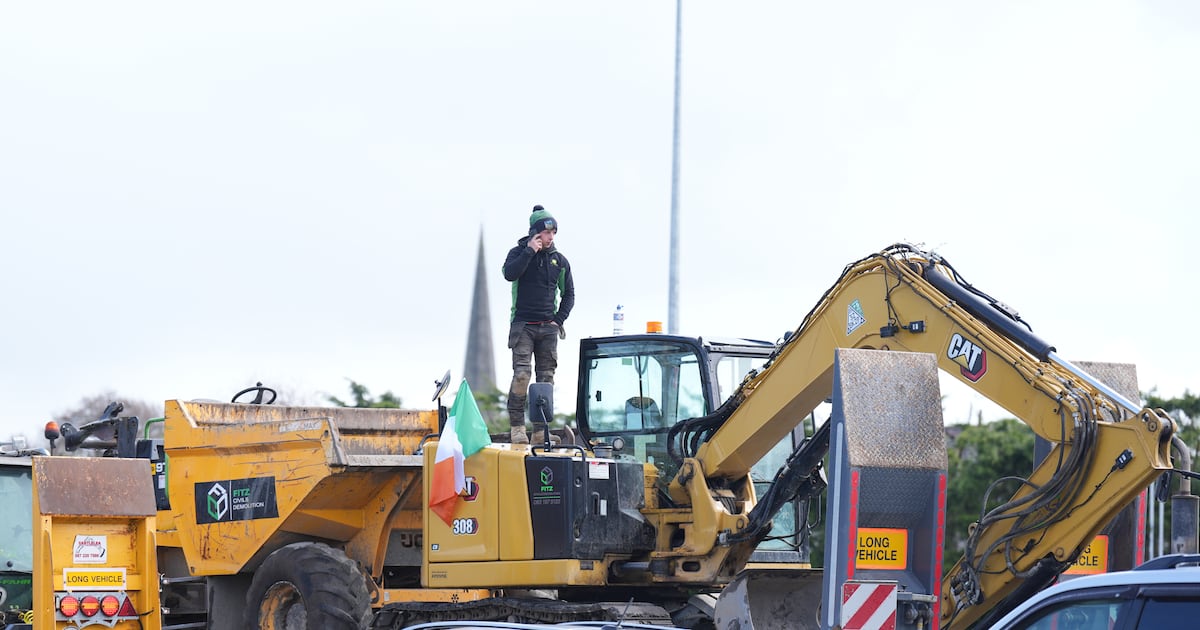
Tensions have emerged within Government over how a plan to request Defence Forces assistance during last week’s fuel blockades became public.
It comes after Minister for Foreign Affairs Helen McEntee suggested processes at a senior Government level can be “improved”. Her remarks followed on from last week’s unexpected announcement by the Minister for Justice Jim O’Callaghan that the Army was being called in to clear fuel protest blockades.
There is a difference of opinion among Government sources over who should have been consulted before the announcement. According to one, O’Callaghan did discuss asking the Army for help with the Taoiseach and Tánaiste on Wednesday evening. Another source pointed out that neither the Minister for Defence nor the Defence Forces had been consulted.
The request to bring in the Army, which was announced by O’Callaghan last Thursday morning, attracted some criticism, with some opposition politicians claiming it had further aggravated protesters.
When asked if she had been consulted before the Minister for Justice announced he would be bringing in the Army, McEntee twice declined to say. She instead said she wasn’t going to “get into what is an internal Government process”.
“I think with any kind of situation like this, what’s clear is that we need to always make sure we’re doing things in a most seamless way,” McEntee told RTÉ Radio 1’s Morning Ireland on Monday. “I will say that I think things at a senior level can be improved. And I think that for any type of situation like this, we need to reassess and we need to look at how processes were put in place.
“I’m not going to get into the details of our Government process, but what I’ll say is I think, for any type of scenario, we need to review afterwards and make sure that we have seamless engagement and that we have a seamless process at every step and at every level.”
O’Callaghan did discuss the blockade of Whitegate oil refinery in Cork with the Taoiseach and the Tánaiste last Wednesday. One Government source said the “key” issue was that O’Callaghan had made the announcement without first talking to the Minister for Defence or the Defence Forces.
When asked if the Taoiseach was told about a plan to request help from the Army on Wednesday, a spokeswoman said: “The Taoiseach spoke to the Tánaiste and Minister O’Callaghan on Wednesday regarding the blockade of critical infrastructure, particularly the Whitegate oil refinery and the Government’s response to that.”
O’Callaghan’s announcement that the Army would be deployed to help lift blockades by fuel protesters was subject to some criticism at a special Fianna Fáil parliamentary party meeting in Leinster House on Monday.
Several TDs and Senators at the meeting said the statement last Wednesday could have been better phrased. They indicated a preference to portray the role of the Defence Forces in a different light, in relation to the protests.
The statement, it was suggested, should have said the Defence Forces’ only role was to provide heavy-duty equipment for the removal of large vehicles obstructing the entrance to Whitegate oil refinery and to ports at Galway and Foynes.
Those present at the meeting said an impression was given that the Army was being called in, when in fact its role turned out to be limited to the use of specialist equipment.
O’Callaghan outlined the background to the use of the tow trucks and said the Defence Forces vehicles were used because private tow contractors were not available. Sources said he indicated to the meeting that contact between officials in a number of Government departments had been initiated early, rebutting a suggestion that the Department of Defence was initially not aware of the proposed action.
The Irish Times understands senior Garda management and their counterparts in the Defence Forces were in contact very soon after the protests began. However, while C70 requests for different types of assistance were a possibility from the time the blockades and protests began, aid supplied by the Defence Forces to the Garda was always expected to be minimal.
For example, gardaí were keen to have availability of the Army’s heavy-lift recovery trucks and their drivers. This was flagged in case they were needed to tow away trucks and tractors blocking Whitegate refinery in east Cork. A C70 request was made for those vehicles and they were used to assist the Garda in Whitegate.
Defence Forces coaches and their drivers were also considered by the Garda. This was considered in the event of large groups of gardaí needing to be deployed at specific sites if trouble flared. It does not appear those coaches were needed.
It was never envisaged that even small numbers of troops would be deployed in any capacity to break blockades.
Aside from the drivers of the Defence Forces vehicles, it was not anticipated that any Defence Forces personnel would be visible to protesters, such was the minimal role mooted for the military.
In that context, a number of sources said those in security circles were surprised at the manner in which O’Callaghan announced the possible involvement of the Defence Forces, in a stand-alone statement that was interpreted by some protesters as a threat or escalation.