
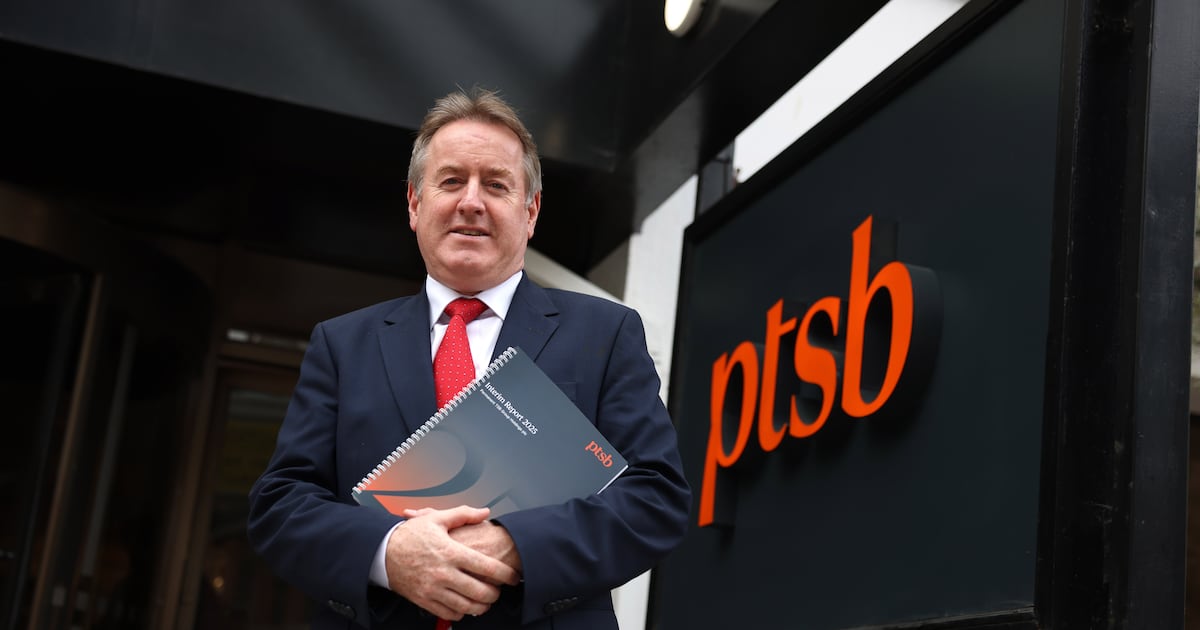
Austrian banking group Bawag has struck a deal to buy PTSB for almost €1.62 billion, winning out against two private equity bids for the 57.5 per cent State-owned lender as the sale process came to a head.
The two banking groups said in a joint statement on Tuesday morning that they had reached an agreement for the Vienna-based bank to buy PTSB for €2.97 per share in cash.
Bawag “recognises the importance of maintaining a physical presence in Ireland, including maintaining PTSB’s existing principal operations, customer-facing functions, meaningful branch presence and key decision-making activities in Ireland,” the document said.
Austria’s fourth-largest bank by assets, which owns Irish mortgage start-up Moco, was hotly tipped by analysts and industry commentators from the moment PTSB put itself up for sale at the end of October.
While the agreed price is 1.7 per cent below where PTSB’s shares were trading early on Tuesday morning in Dublin before the announcement, and 9.5 per cent off their peak in early March, it marks a 26 per cent premium to where the stock was changing hands in late October, before PTSB was put on the market.
Goodbody Stockbrokers analyst Denis McGoldrick described the agreed price as a “disappointing outcome”, as it equated to an 18 per cent discount to the stock’s inherent value.
“We have been consistent in our belief that the commencement of this sales process was premature,” he said, adding that a recent regulatory easing of the amount of capital the bank needs to hold against mortgages and PTSB’s own medium-term outlook pointed to “material upside” for investors.
[ What has happened to my husband’s PTSB shares?Opens in new window ]
Shares in PTSB fell more than 3 per cent to below the agreed price by midday, while Bawag’s stock surged more than 5 per cent.
However, PTSB chair Julie O’Neill said that the transaction “has the potential to deliver significant benefits for customers, combining Bawag’s scale and expertise with PTSB’s deep roots in Irish communities to deliver an even stronger customer experience through greater choice, improved service and continued innovation”.
“The acquisition will also facilitate the exit of the State’s remaining shareholding in PTSB and the return of capital to the State and taxpayers. The PTSB Board recognises the State’s long-standing support and stewardship of PTSB and thanks the Irish Government and the people of Ireland for their support,” O’Neill added.
Texan funds giant Lone Star and a consortium involving New York-based Centerbridge and San Francisco investment firm Sixth Street were the two other bidders in the mix at the end of the process.
The final stage of the process has played out against the backdrop of the Iran war, which has whipsawed global equity markets since late February.
The deal, subject to shareholder approval, will see the Government receive €931 million for its stake, which would bring the total cash recovery on PTSB’s €4 billion crisis-era bailout to about €3.73 billion. It is expected to be completed by the end of this year or early 2027.
 “Back yourself”: Aimee Connolly shares her story of 10 years in business
Irish taxpayers will end up recouping €30.7 billion from the three surviving Irish banks on a cash-in, cash-out basis, following their combined €29.3 billion in bailouts between 2009 and 2011.
The Department of Finance has put a higher recovery of about €4 billion from PTSB, which includes bank levy payments and fees.
A €2 billion surplus generated by Bank of Ireland has more than offset small shortfalls at the other two banks. The Government sold its final AIB shares last year, while the last Bank of Ireland shares were disposed in 2022.
The cash recovery from the sector includes money made from share sales in the banks, redemption of bailout bonds, interest, guarantee fees and dividends over the past decade and a half.
Minister for Finance Simon Harris welcomed the deal, saying it “represents the most significant development in the Irish retail banking market in over a decade”.
“Bawag has built a strong franchise in other European markets and will support PTSB in its next phase of development and the Irish economy as a whole,” he said.
PTSB has 1.3 million customers, 98 branches, over 2,900 employees, a mortgage-dominated loan book of €22.2 billion and total assets of €30.4 billion as of the end of last year. By contrast, Bank of Ireland’s total assets amounted to €165 billion, while AIB’s stood at €148 billion in December.
Bawag, founded in 1922, was bought in 2006 by US investment group Cerberus after the bank almost collapsed as a result of links to failed US commodities and financial derivates firm Refco. The Vienna-based bank’s currently has a €72 billion balance sheet.
Cerberus, which was one of the most active buyers of distressed Irish loans in the wake of the financial crisis, floated Bawag on the Vienna stock market in 2017 after a decade of cost-cutting and restructuring, including branch cuts, saw the bank shift towards a digital-first strategy.
Bawag’s chief executive, Anas Abuzaakouk, formerly worked for Cerberus and was heavily involved in the bank’s transformation before taking charge in March 2017.
While there had been a narrative in Irish financial circles that a mainstream bank would be more politically acceptable than a private equity buyer, Bawag is expected by analysts to accelerate cost-cutting at the bank, despite its commitment to maintaining a “meaningful branch presence and key decision-making activities in Ireland”.
PTSB last month set a target for its cost-income ratio to fall below 60 per cent by the end of 2028 from 75 per cent last year. Rivals AIB and Bank of Ireland reported annual cost ratios of 44 per cent and 49 per cent, respectively, last year. Bawag’s was 36.1 per cent.
PTSB’s staff numbers fell by 329, or 10 per cent, to 2,918 last year, with a voluntary redundancy programme accounting for 240 of the exits.
Bawag was previously best known in Irish financial circles for buying the remnants of Dublin-based Depfa Bank in 2021, and acquiring the company behind fledgling Irish mortgage lender MoCo three years ago.
It also recently held talks to buy nonbank lender Finance Ireland. However, The Irish Times reported last month that those discussions had come to an end without a deal.