
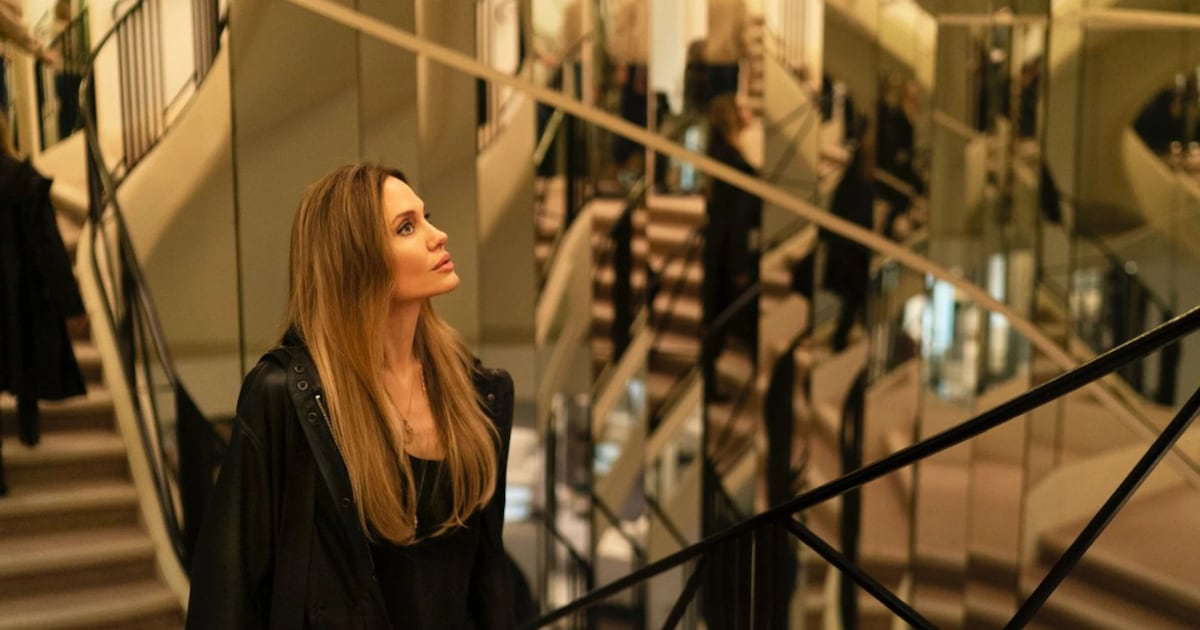
Alice Winocour has long been a fan of Angelina Jolie, the star of Couture, the French director’s upcoming fashion-themed movie. But working together inspired Winocour to double down.
“I really connect with her rebellious side,” she says. “She was a punk when she was younger, and I think she still has that spirit. It was very moving to work with her.”
Never mind the Dune or Avatar fims: if you want top-class world-building check out Winocour’s work. In 2019 the film-maker collaborated with the European Space Agency to make Proxima, starring Eva Green as an astronaut preparing for a year-long space mission while navigating life with her young daughter. The epic film was shot in painstaking detail at the European Astronaut Centre in Cologne, Star City near Moscow, and Baikonur Cosmodrome in Kazakhstan.
Winocour’s immersion in the fashion world was equally scholarly. For two years she interviewed everyone from beauty professionals to model bookers. Chanel partnered with her during the scriptwriting phase of Couture, giving her access to its Paris salons and workshops. She filmed key scenes on site and used the house’s collections for a pivotal fashion-show sequence.
“It’s quite unconscious, but I think the more personal the story is, the more I need to set it in a world that is far from me,” the film-maker says. “In Proxima I was talking about my daughter and separation, so it had to be set in space. For the new film, the themes – illness, the body – are very intimate, so I needed a world that felt distant.
“I wanted to discover something new, to meet people, to understand that world, and give a different point of view. Fashion attracted me because it’s both glamorous and tragic. It’s about the ephemeral – always chasing the next collection, the next show. Months of work for something that lasts only minutes. For me it’s a metaphor for life. It goes very quickly.”
Couture stars Jolie as an American film-maker who learns during Paris Fashion Week that she has breast cancer. The intriguing collision of glamour and health issues was inspired by Winocour emerging from a Parisian hospital and finding herself in the chaos of haute couture’s most dazzling event.
The contrast between physical vulnerability and a highly controlled, appearance-driven environment left a deep impression.
“I wrote the film at a moment when I really wanted to celebrate life,” Winocour says. “I don’t know if it’s a joyful film, but I wanted to show these women’s lives and bring some hope, to say to other women, ‘You’re not alone.’
“All the characters are fragments of the same person. Some people say they relate more to one character than another, but, for me, all of the characters in the film are all the same woman at different ages – 20s, 30s, 40s – all dealing with the question of the female body. Behind the perfect images, what is the reality of the body?
“That was very important to me. The fragility of existence but also its beauty, and how beauty and death can exist together.”
The writer-director’s own experiences with illness were stitched, as Winocour puts it, to Jolie’s own history. In 2013 the actor had a preventive double mastectomy after testing positive for the BRCA1 gene mutation, which put her at an estimated 87 per cent risk of developing the disease.
Jolie, whose mother, grandmother and aunt died from breast cancer, shared her decision in a New York Times article headlined My Medical Choice, encouraging others to take proactive steps in managing their health.
In 2015 she had her ovaries and Fallopian tubes removed.
Last year the open-access journal OncoDaily reported the ongoing bounce of the “Angelina Jolie effect”, “a measurable, sustained increase in genetic testing, cancer screening, and awareness worldwide”.
Speaking at Couture’s European premiere, in San Sebastián, Jolie reiterated the importance of preventive actions. “Those are my choices,” she said. “I don’t say everybody should do it that way, but it’s important to have the choice.”
[ Breast cancer: ‘We should have copped that the news was bad’Opens in new window ]
For Winocour, Jolie – who learned French to play the role – was the only casting choice.
“I like to write female portraits and to look behind the perfect image of women,” the director says. “In Proxima the astronaut was also a mother – a kind of superhero. Here, with Angelina Jolie, there’s also that superhero side: she’s almost like a Tomb Raider figure in real life.
“I wanted to explore who the real Angelina is behind that image. Her learning French showed a kind of vulnerability. Trust was essential. We had a mutual understanding from the beginning, but also a deeper connection. We share certain experiences and a similar way of seeing things.”
Jolie’s heroine arrives in Paris to shoot a short film that will accompany a big fashion show (Chanel, but unnamed here). Jostling work, phone calls and medical appointments, she receives the devastating news of a breast-cancer diagnosis requiring urgent intervention.
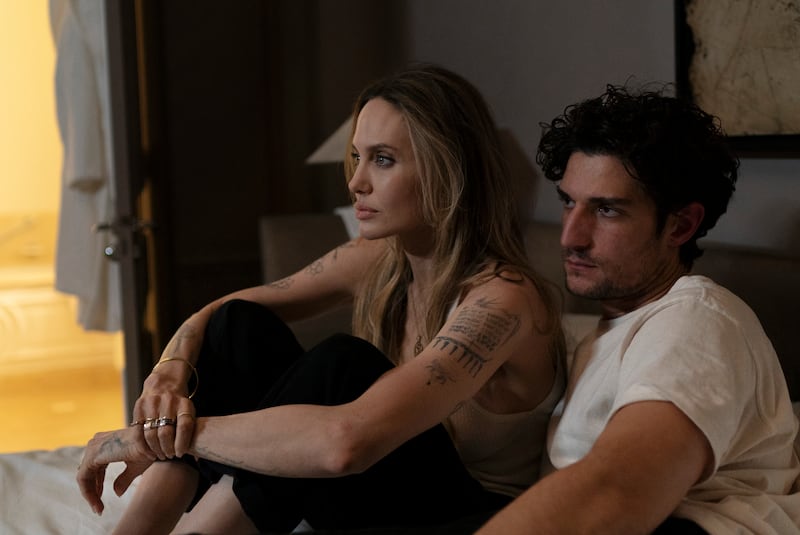 Couture: Angelina Jolie and Louis Garrel in Alice Winocour’s film. Photograph: Carole Bethuel
Life goes on. She makes a pass at her (very interested) cinematographer, played by Louis Garrel; she tries to call her teenage daughter and ducks out of the shoot for surgery. Around her is a swirl of feminine energies: Ada, a young model from Sudan starting her first season; a seamstress deftly finishing intricate details on the garments; a make-up artist balancing work with personal writing projects.
The ensemble allows the film to track the rhythms of the fashion world, from fittings, rehearsals and backstage preparations to the final runway extravaganza.
“I wanted to show the hard side of fashion,” Winocour says. “We see the physical toll: the sore feet, the exhaustion. This world is shown from the point of view of outsiders. The main character is not really from that world. She’s a director entering it for financial reasons.
“So it’s not a glamorous portrait. But the film isn’t just about fashion. It’s about the world we live in, a world of appearances where you have to hide your wounds and present a perfect image. I was interested in what’s behind that.”
The film is notably generous to its subjects. It allows empathy.
“These models are not superficial,” Winocour says. “They are very strong women. Many have difficult backgrounds. They are far from the stereotype. I spent a year and a half meeting them.
“The idea was to show fragments of different women’s lives: relationships with daughters, the struggle of life and this feeling of always being in survival mode. At one point I thought the film could even be called Ride or Die.”
Winocour was already recognised as one of France’s most intriguing talents before moving behind the camera. A graduate in screenwriting from La Fémis, France’s top film and TV school, the co-writer of acclaimed films such as Mustang and Ordinary People has swerved between war zones, history and sisterhood.
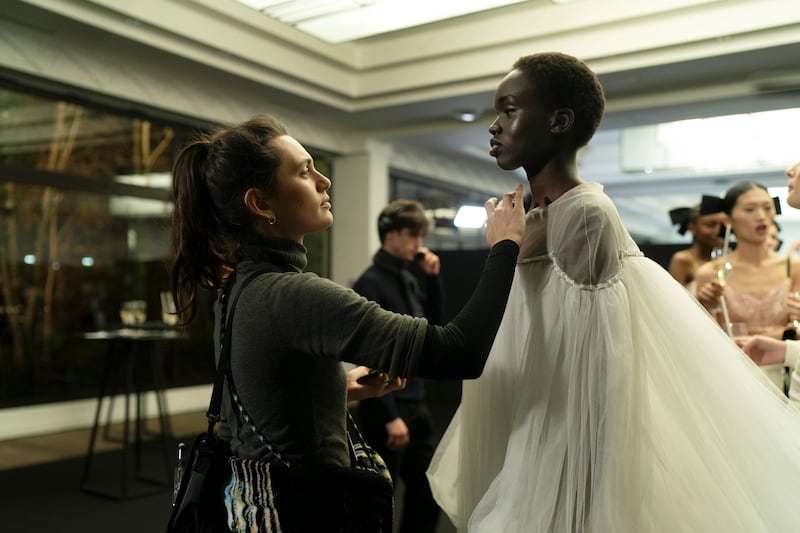 Ella Rumpf and Anyier Anei in Couture. Photograph: Carole Bethuel
Her directorial debut, Augustine, depicts an inappropriate relationship between the neurologist Jean‑Martin Charcot and his patient in a 19th-century Parisian hospital. Trauma underpins both the thriller Disorder and Paris Memories, in which victims of the Bataclan attacks attempt to rebuild their lives.
The idea of connection through shared experience, a recurring theme of all these works, is made explicit in Couture.
“Sharing trauma creates a very deep connection,” Winocour says. “That’s a form of love, to share something painful and be on the same wavelength. We include an intimate scene where scars are touched, and that was very important.”
She says that audiences often respond to the film by sharing their own experiences, particularly in relation to illness and the body.
“At first I didn’t want to talk about the personal origins of the film, but audiences bring their own experiences to it,” she says. “Women share their stories. It’s very moving. There was something bigger than us in this film: it’s more than a film; it’s part of our lives.
“Many of the women in the film brought their own stories. There was this idea of leaving a trace, of saying, ‘This was my body, my life at that moment.’ Representation is important, especially with subjects that can carry stigma.”
Winocour is particularly delighted by responses across age groups.
“It’s touching to see how different generations respond: teenagers, older women. I wrote the film partly for my daughter, and I think young people connect to this fear of losing a mother.
“For me this is what cinema is for. A collective experience. A way of sharing wounds and healing together. In a world where people can feel very alone, it creates something warm and communal.”
Couture is available on digital platforms from Monday, April 20th