
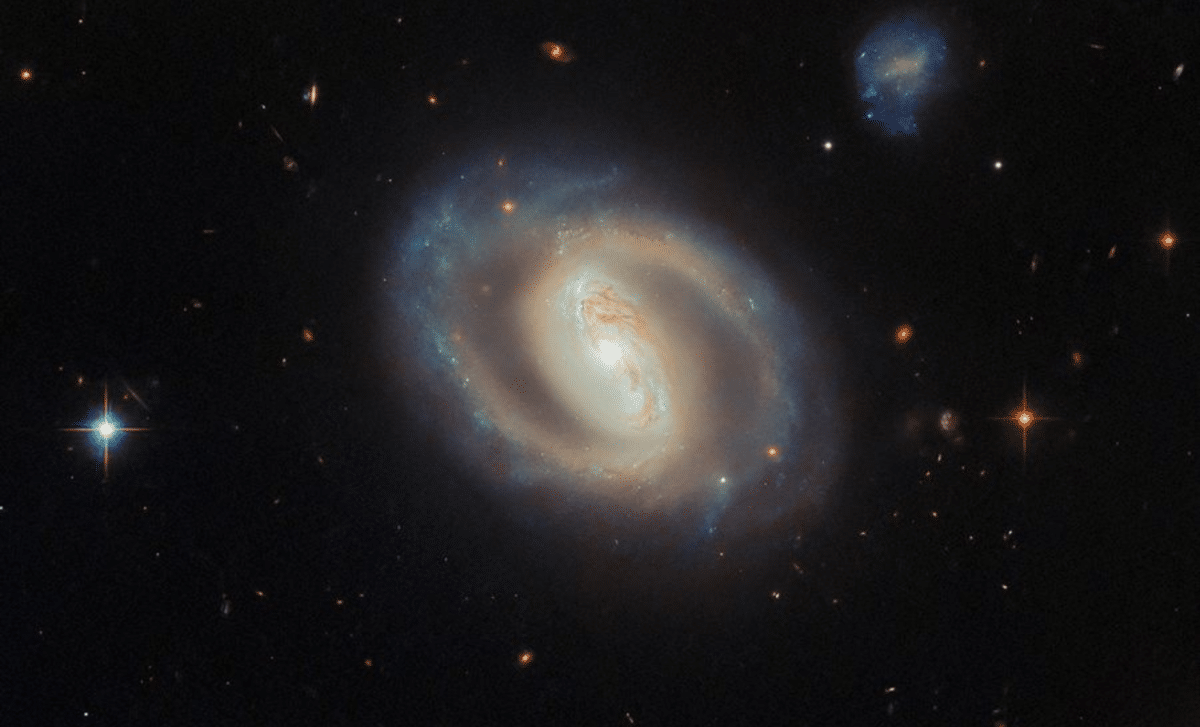
NASA’s Hubble Space Telescope has once again provided a stunning glimpse into the universe’s mysteries, capturing a new and dynamic image of the spiral galaxy IC 486. Positioned approximately 380 million light-years away, the image showcases a galaxy that, while serene in appearance, is a hotbed of cosmic activity. At the heart of this galactic whirl, a supermassive black hole fuels the galaxy’s activity, revealing the dynamic and ever-evolving nature of the universe.
This latest discovery opens a window into understanding how galaxies grow and evolve over time. By examining the interplay of stars, gas, dust, and black holes in the galaxy’s center, scientists aim to uncover the hidden forces shaping our cosmic neighborhood. The image is not just a visual marvel but a key piece of the puzzle in our understanding of the universe.
IC 486: A Barred Spiral Galaxy at the Edge of the Constellation Gemini
IC 486 lies at the edge of the constellation Gemini, its spiral arms swirling outward in a pattern that hints at the intricate gravitational forces at play. The galaxy’s structure is dominated by a central bar, a feature common to barred spiral galaxies, which funnels gas and dust into the galaxy’s heart. Hubble’s keen imaging technology has revealed the striking contrast between the older stars at the galaxy’s center and the bluish regions scattered across its spiral arms, signaling pockets of ongoing star formation.
This is not just an ordinary galaxy. Despite its tranquil appearance, IC 486 is a galaxy in flux, with vast regions of dust, gas, and newly formed stars. The spiral arms wrap gracefully around the galaxy’s core, suggesting a complex interaction of gravitational forces and stellar evolution. The pale center, dominated by older stars, contrasts with the vivid regions of new starbirth scattered throughout its disk, offering a visual representation of cosmic life cycles.
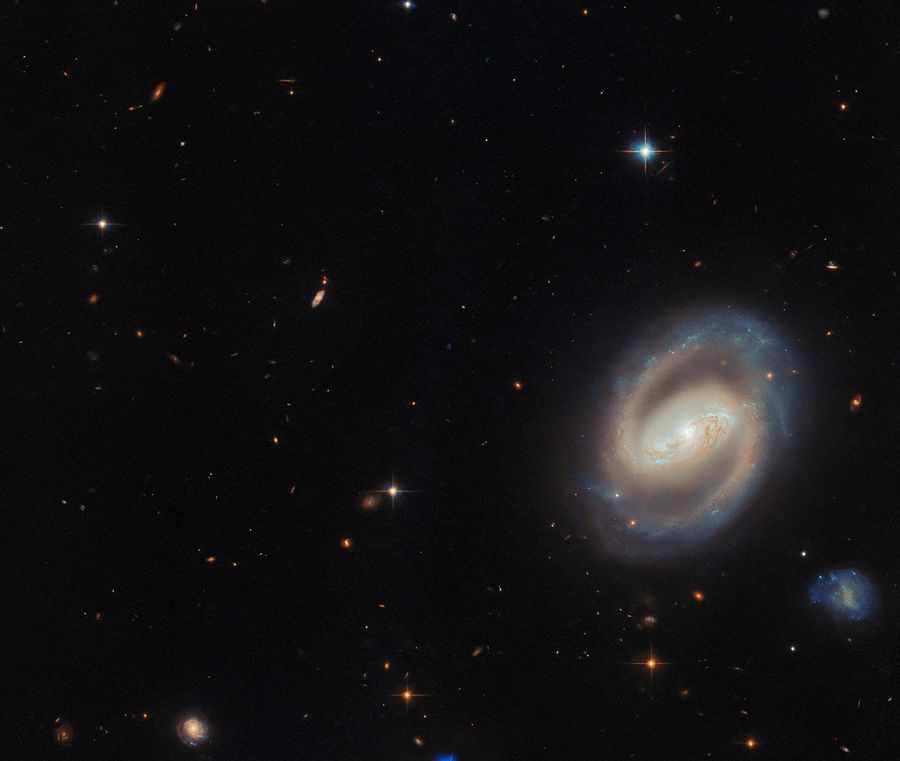 This wide-field view of the spiral galaxy IC 486 from NASA’s Hubble Space Telescope features a vibrant scene of distant background galaxies and foreground stars. Some stars appear with characteristic diffraction spikes. However, much of the field is dominated by the more diffuse, orange-red smudges of far more distant galaxies.
ESA/Hubble & NASA, M. J. Koss, A. J. Barth
The Supermassive Black Hole at IC 486’s Heart: A Galactic Powerhouse
The true star of this discovery is the active galactic nucleus (AGN) at the center of IC 486. Powered by a supermassive black hole, this region generates intense radiation that can outshine the rest of the galaxy. The black hole, with a mass more than 100 million times that of the Sun, pulls in vast quantities of gas and dust, forming a swirling accretion disk that heats up and releases radiation, including X-rays.
This phenomenon is typical of active galaxies, where the AGN’s energy output can dominate the entire galaxy. The radiation from the accretion disk is so powerful that it can obscure the light of surrounding stars, giving the galaxy an otherworldly glow. For astronomers, these AGN-powered galaxies offer a unique opportunity to study the behavior of supermassive black holes and their effect on the galaxies they inhabit.
NASA’s Pioneering Research into Active Galaxies
The data captured for this groundbreaking image comes from two separate observing programs led by researchers M. J. Koss and A. J. Barth, aimed at exploring the central black holes of active galaxies. Their research contributes to a larger initiative by NASA to understand how galaxies evolve. By combining the sharp imaging capabilities of the Hubble Space Telescope with extensive datasets, scientists are studying how large-scale structures like spiral arms and bars are linked to nuclear activity.
The ongoing study not only focuses on galaxy morphology but also explores how large language models and machine learning can enhance our understanding of galaxy classification. In partnership with citizen science initiatives like Galaxy Zoo, this project helps astronomers map the intricate features of galaxies at an unprecedented scale.