
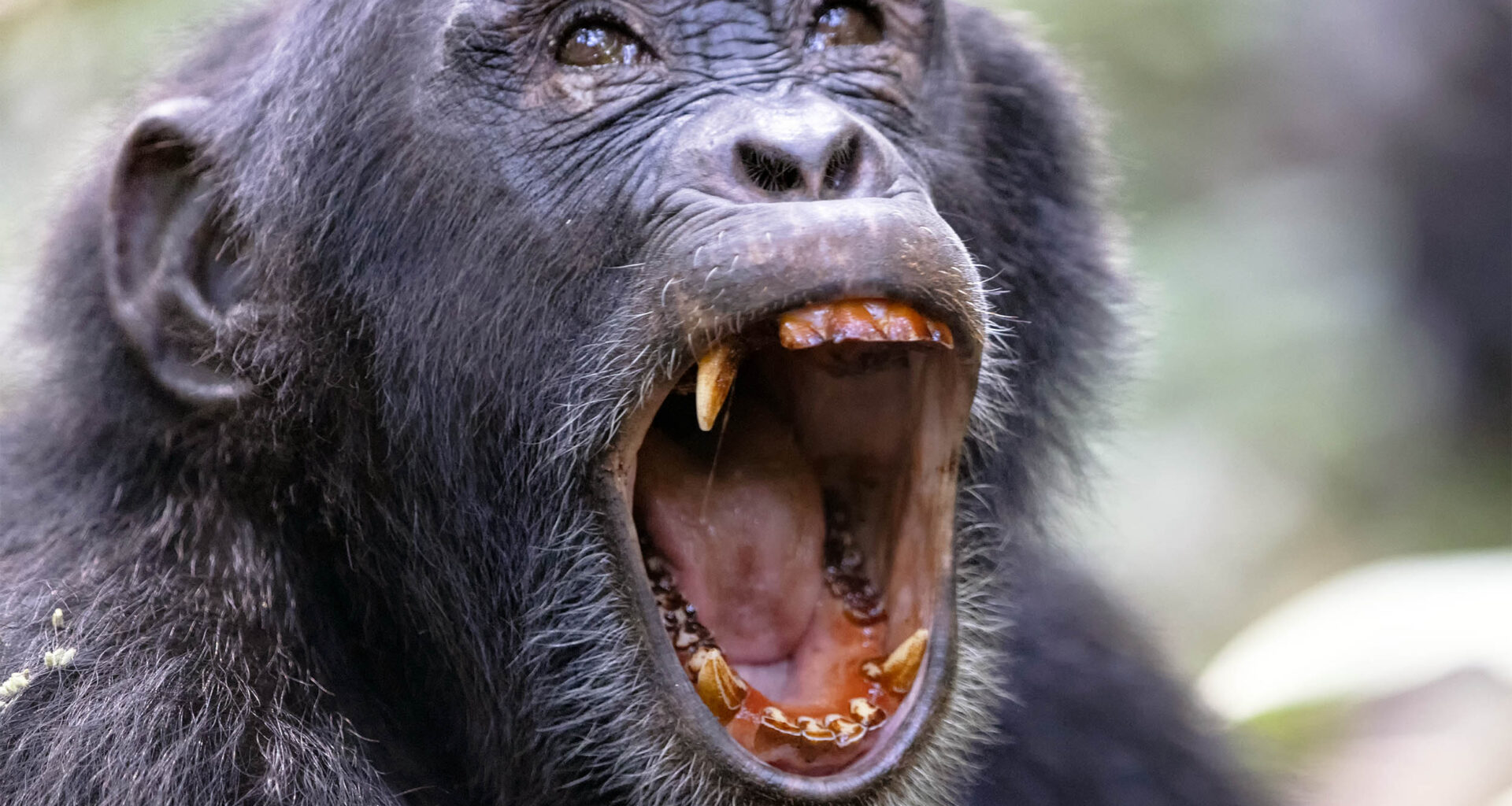
Researchers have documented the first clearly observed permanent split in a wild chimpanzee community, followed by years of violence between former companions.
The finding shows that close social bonds can break hard enough to produce deadly group violence, even without the cultural markers often used to explain human conflict.
Where it started

In Kibale National Park in western Uganda, a single chimpanzee community that had lived together for years broke into two rival camps.
Drawing on the Ngogo chimpanzees’ long history, Aaron Sandel at The University of Texas at Austin (UT Austin), traced the break from a shared community into a lasting divide.
By 2018, the separation was complete, and the animals that had once groomed, patrolled, and traveled together no longer maintained ties across the split.
That rupture makes the chimpanzee violence more than a story of strangers clashing and sets up the question of how such a large community came apart.
Life before fracture
For 20 years, the Ngogo chimps moved through one shared territory as the largest known wild community ever recorded.
Chimpanzees normally live in fission-fusion, a pattern of splitting apart and rejoining, rather than standing together all day.
Even so, the chimps hunted, groomed, patrolled, and mated across those loose lines, which kept the wider community stitched together.
Because permanent splits may occur only about once every 500 years, the later break cannot be dismissed as routine chimp behavior.
The split hardens
Trouble sharpened in 2015, when the western and central clusters stopped mixing and then avoided one another for weeks.
Over the next three years, their ranges pulled apart and the last known infant conceived across the divide dated to March 2015.
Once the divide held, old friendships no longer translated into safety, and the community’s center became a border.
That mattered because separation alone did not end competition, and it rerouted it toward former allies.
Raids turn lethal
After the break became permanent in 2018, the Western group began organized raids into Central territory.
Across seven years, researchers recorded 24 attacks, with at least seven adult males and 17 infants killed.
Beginning in 2021, infanticide, the killing of infants, became frequent enough to average several deaths each year.
Missing animals suggest the toll was probably higher, because bodies are often never found in dense forest.
Cohesion beats group size
One result stood out: the smaller Western chimpanzee group drove much of the violence, launching every observed lethal attack despite facing a much larger rival.
Long-standing ties among its core males may have made patrols faster, tighter, and more decisive than head counts alone predicted.
Earlier chimpanzee raids had been linked to territorial gain, not to revenge or elaborate ideology.
Ngogo adds a harder point: strong internal cohesion can beat numbers once a social line hardens.
Chimp violence explained
Size may have primed the break, because nearly 200 chimps and more than 30 adult males strained relationship maintenance.
Competition over food and mating then rose as the two clusters stopped sharing space and reproductive partners.
Before the rupture, several well-connected adults died, leadership changed, and a respiratory epidemic later removed more social links.
None of those blows proves a single cause, but together they show how a stable network can fray.
Violence with former allies
Chimp aggression usually falls on outsiders, but this case shows how chimpanzee violence can emerge even among former companions.
Here, former companions became targets once membership changed, a point echoed in a related perspective on the split.
“A hostile split among wild chimpanzees is a reminder of the danger that group divisions can present to human societies,” wrote James Brooks, Ph.D., a researcher at the German Primate Center.
Still, the comparison has limits, because chimps do not build wars around language, religion, or political programs.
Lessons without culture
The case challenges a popular idea that cultural markers must come first for violent lines between groups to form.
These chimpanzees had no language, religion, or ideology, yet changing relationships alone still produced polarization and organized attacks.
That does not erase human culture, but it argues that broken ties and local rivalry can do more than people admit.
Any lesson for people starts small, because conflicts may harden through daily estrangement before slogans ever arrive.
Studying chimpanzee violence
No short project could have caught this story, because the crucial change unfolded over years inside an endangered population of eastern chimpanzees.
The same field site recorded normal life, the slow fracture, and the killings, which made cause and consequence visible.
“The study also reinforces the importance of maintaining long-term field research sites and of preserving endangered species,” Brooks wrote.
Losing such places would erase the chance to see rare behavior before habitat loss and disease erase the animals themselves.
Ngogo shows that a community can move from loose internal differences to hardened camps, then to deadly raids, without human ideology.
Researchers are still watching the forest, because the conflict continues and its eventual end may matter as much as its start.
The study is published in Science.
—–
Like what you read? Subscribe to our newsletter for engaging articles, exclusive content, and the latest updates.
Check us out on EarthSnap, a free app brought to you by Eric Ralls and Earth.com.
—–