
(Credits: Far Out / Warner Bros. Pictures / Rosa Sol)
Wed 15 April 2026 18:00, UK
Before Yoko Ono‘s marriage to John Lennon, the Japanese artist made her name in New York’s avant-garde scene, producing experimental performances and conceptual artwork. Meanwhile, her early career coincided with motherhood when, in 1963, her first child, Kyoko Ono Cox, was born from her second marriage to American film producer and art promoter Anthony Cox.
Though married that same year, Ono and Cox did not remain married for long, but their working relationship continued as they collaborated on conceptual art. Their co-parenting of Kyoko, with Cox prioritising parental duties while Ono pursued her art career full-time, grew further estranged.
“I was an offbeat mother,” Ono later reflected in the 2024 documentary, One to One: John & Yoko. She continued, “I didn’t know how to balance it all.”
Some animosity began in 1967, once Ono met Lennon. She and Cox officially divorced in 1969, and initially, they and their respective partners – Lennon and Melinda Kendall – had a peaceful arrangement, but Cox became increasingly concerned that Ono held plans to keep their daughter from him.
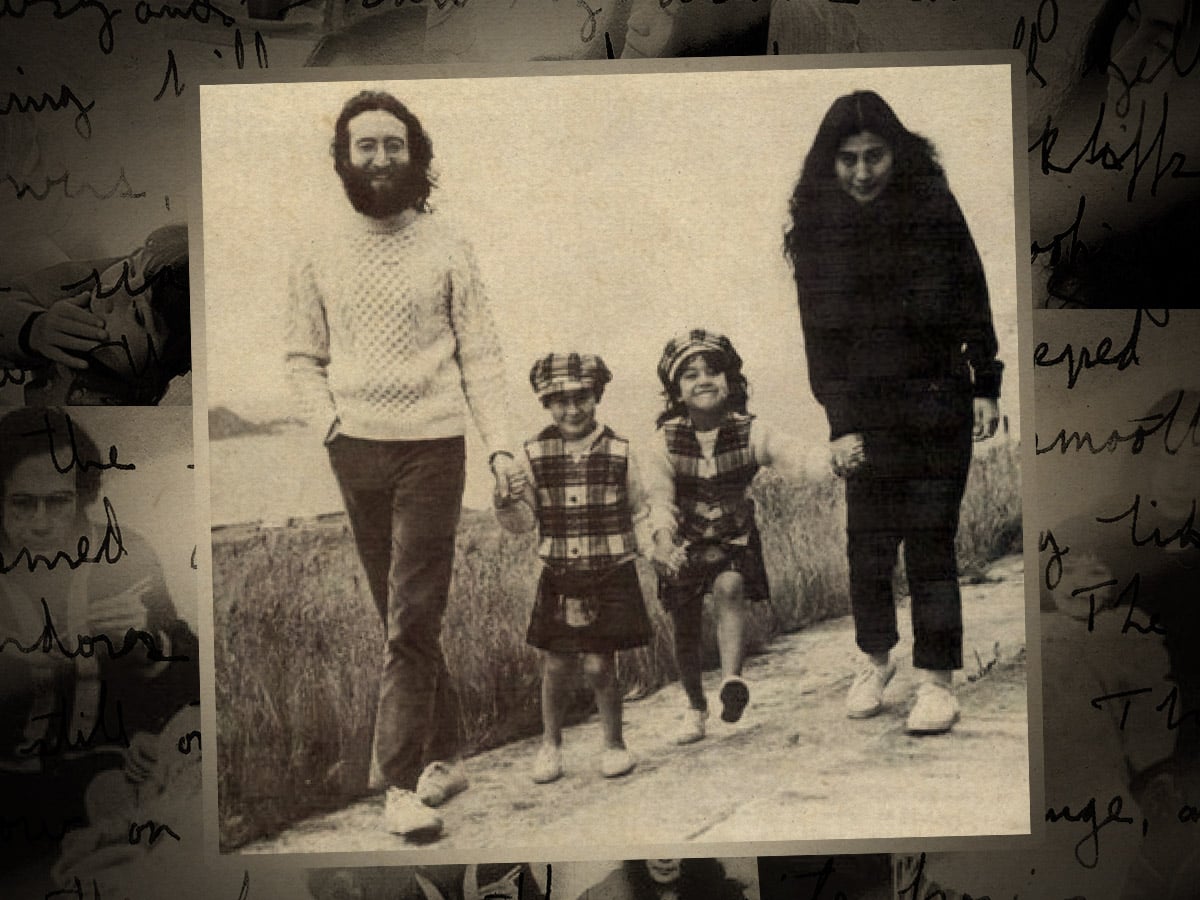
A pivotal moment came in 1969 when Lennon, driving with Ono, Kyoko and his son, Julian, crashed his car during a trip in Scotland, an incident that amplified Cox’s demand to supervise every visit with Kyoko. Suddenly, Cox and Kendall took Kyoko to Spain and enrolled her in a transcendental meditation preschool. Ono and Lennon followed, and an ongoing custody battle between Cox and Ono ensued in 1971, when Kyoko was asked by the judge which parent she wanted to continue to live with.
“I felt like I had an impossible choice to make,” Kyoko reflected to the Daily Mail in 2025, continuing, “My mom and John were incredibly busy people. Usually, when I went and stayed with them, I had a nanny, and I sometimes wouldn’t see them all day long. And [with] my dad and my stepmother, I’m their only child.”
 (Credits: Far Out / Warner Bros. Pictures)
Cox was awarded custody, but soon, he disappeared with the then-eight-year-old Kyoko and his wife to the United States, where Ono and Lennon contested for custody of Kyoko. Ono won the favour of the judge, but Kyoko could not be found. Once again, Cox returned to court in Houston, Texas, a few months later, won custody and did not allow Ono her visitation rights. After being jailed for not showing up to court on Christmas Eve, 1971, he was bailed out and, with his daughter and wife, found a reprieve in the organisation the Living Word Fellowship (LWF), also known as the Church of the Living Word or “The Walk”.
The Living Word Fellowship was a Christian cult, established as a farming community by John Robert Stevens in southern California in 1951, and initially formed by religious hippies and artists. “The Walk” came from the teaching that every Christian should have a “personal walk” with Jesus and reached a peak in the 1970s with an estimated 1,000-member congregations. They were centred at Shiloh, a farm and retreat site near Kalona, Iowa. It is here that Cox brought his wife and daughter; the three essentially vanished, leaving Ono with no idea of where her daughter had been taken to.
On The Dick Cavett Show in 1971, Ono appeared with a photograph of Kyoko as she and Lennon explained the intricacies of the court cases that were transpiring, emphasising the fact that they had not seen Kyoko in two years, nor spoken to her for one.
“We’d been chasing her in Europe, in Denmark, in Spain, in Hawaii, in America, back to Europe – this has been going on for two or three years,” Lennon explained on the show. He continued, “By the time the judge has seen through all the games, the man [Cox] has run away again. They [the courts] give us custody, again, and this is temporary custody, only if we bring the child up in America, because she’s an American citizen… We have the two papers with custody, but we don’t know where she is, still”.
“We haven’t a clue where she is; she’s in America somewhere.”
John Lennon
On Kyoko’s account, she had no idea, nor any way of knowing, that Ono and Lennon were actively searching for her. On the farm in Iowa, Kyoko was quite literally sheltered, to the point where she had no access to a television. Renamed “Ruth Holman”, Kyoko’s day-to-day was consumed by chores of cleaning, husking dried beans and listening to recorded tapes of Stevens’ sermons. She explained that within the community of the cult, her mother and stepfather were an avoided topic of discussion, only favouring conversation pertaining to the teachings of their beloved cult leader and the Bible.
“Today, as an adult, the biggest irony to me is that we left a cult, in a way, when we left The Beatles and John and Yoko,” Kyoko recalled. “People are fanatical [about them] on the level of being cult members. I was very scared by that fame. So being in this very simple Christian community seemed very safe, like an easier life.”
 (Credits: Kyoko Ono Cox)
Ono’s search for her daughter found its way into her music with Lennon: the B-side for the Plastic Ono Band’s 1969 single ‘Cold Turkey,’ for instance, is ‘Don’t Worry Kyoko (Mummy’s Only Looking for Her Hand in the Snow).’ At the beginning of 1971’s ‘Happy Xmas (War is Over),’ Ono whispers, “Happy Christmas, Kyoko.” Cox let Kyoko call her mother just once, on Christmas, but when Ono asked, “So where are you?”, he hung up the phone. Later, Ono wrote ‘Looking Over from My Hotel Window’, where she sings the lines, “If I ever die, please go to my daughter / Tell her that she used to haunt me in my dreams / That’s saying a lot for a neurotic like me.”
Cox’s allegiance to Stevens, with his proclaimed status as a “prophet and set-aside elder,” meant that the cult protected him and his daughter from the ongoing investigations that attempted to locate them, but it also bound them even closer to the abusive manipulations of the group. Soon, Cox began to forge a plot to escape with his wife and daughter. By then, the cult had moved from Iowa to California, where Kyoko was enrolled in junior high in Los Angeles. Arriving early one day, to avoid the watchful eyes of the members enlisted to follow Kyoko’s whereabouts, the two were able to flee; Kendall stayed (The Living Word Fellowship dissolved in 2018 upon revelations of sexual misconduct).
Now alone with her father, Kyoko was forced to enrol in the Christian Wheaton College in Illinois, where she would meet her future husband, Jim Helfrich, who would soon help her escape her father’s control. He “did not want me to be involved with someone who could potentially help me get back in touch with my mom,” Kyoko noted.
She then married Helfrich in 1992, but would not come in contact with Oono for another two years, when she was 30 years old and a mother of one. The two had not spoken in over two decades. Lennon, sadly, would never see Kyoko again before his passing in 1980. As for Cox, Ono did not pursue any legal actions against her ex-husband, who Kyoko described as “impossible,” “self-deluded,” and a “major narcissist”. Still, Kyoko remained forgiving of the adults in her life, despite the turmoil of her upbringing.
“They were all such kids,” she remarked. “They were just like little children, all of them. It’s really crazy. Being a parent – it’s a hard thing to do.” Ono and Kyoko, by all accounts, have remained close since they reconciled 32 years ago. As Kyoko recalled, “She wanted to see me right away, and then we just started spending time together,” and, as Ono told People in 2003, “When Kyoko finally appeared, I was in total shock. It felt like the part of me that was missing came back.”
