
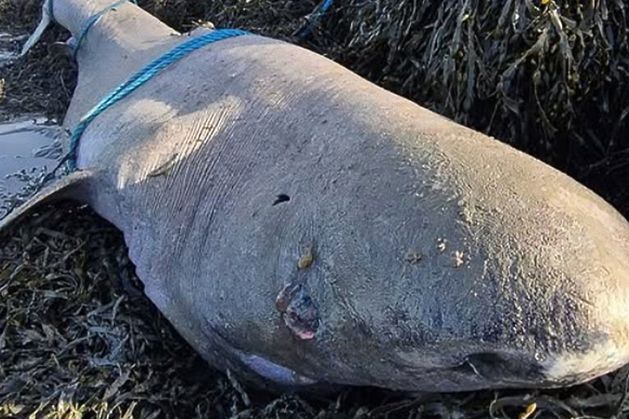
Greenland sharks are the longest-lived vertebrates, with an average lifespan of more than 270 years.
The oldest ever Greenland shark could have been about 500 years old.
The species has undergone very little evolutionary change over the course of millions of years, earning it a reputation as a “living fossil”.
Because they primarily occupy deep waters, Greenland shark strandings are highly unusual, and one washing up along the Irish coast even more so, meaning the discovery near the Gibraltar Rocks at Sligo Harbour has generated great excitement.
Paolo Viscardi, the National Museum’s keeper of natural history, said: “With a deep-water species, you don’t normally get them stranding, it’s quite unusual.
“When it does happen, it usually indicates there’s something unusual going on.”
Given the long lifespan of the Greenland shark, researchers will be seeking answers to a number of questions.
“This is such an understudied species and there isn’t a huge amount of information on it,” Mr Viscardi said.
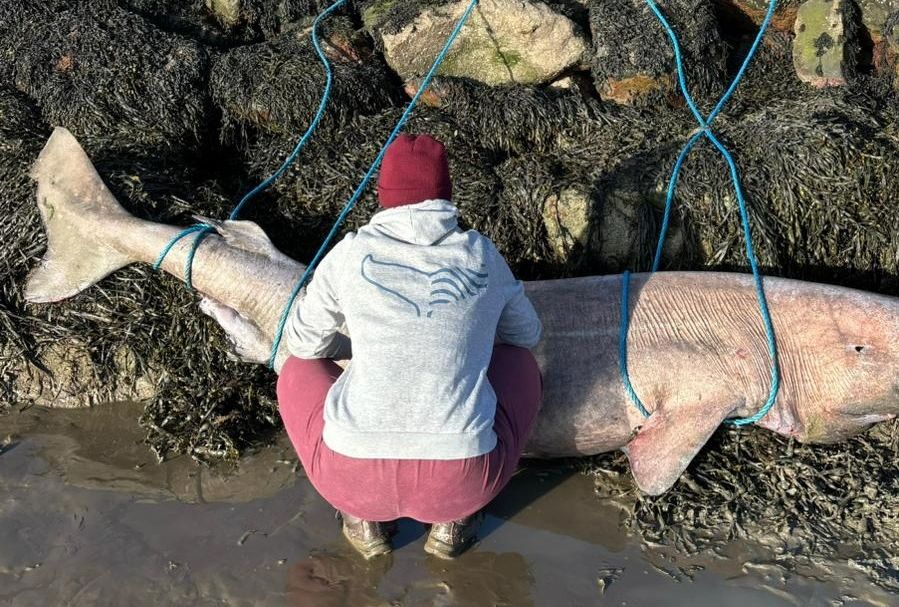
The body of the Greenland shark. Photo: Irish Whale and Dolphin Group
“If this vertebrate is so long-lived, why? How does it live so long? And then of course there are speculative questions, like how that could apply to us or to other species.
“It just helps to open our eyes to what’s possible in the realm of biology and understanding those mechanisms, because it all feeds back to how we understand ourselves.”
Mr Viscardi credited swift efforts by all involved for the good condition in which the Greenland shark was recovered.
“I’m so proud of the team for their ability to co-ordinate a response. It was about 24 hours from hearing about the specimen washing up to actually having it on the back of a truck,” he said.
“That means it didn’t get swept out to sea on the tide.
“Because it was all done so quickly, it means they were able to get the specimen in really, really good shape.”
While the museum’s long-term plan is to have the Greenland shark specimen preserved and put on display, a wide range of research still needs to be carried out.
“This is quite a complex piece of work, getting the equipment, materials, people and space all lined up,” Mr Viscardi said.
“We’re still only at the fairly early stage of the process, but at least so far the steps taken have all been absolutely bang on, well co-ordinated, and it puts me in a very hopeful place about getting a full, taxidermied shark at the end of the process.”