
AI-driven overhaul reduces workload and trims resource use, with savings set to benefit patients
[SINGAPORE] IHH Healthcare is ramping up its use of artificial intelligence across operations and clinical care at Mount Elizabeth Hospital, as its S$350 million transformation project is seen delivering early gains in cost savings, efficiency and patient outcomes.
AI deployment in areas such as claims processing, nurse rostering and patient monitoring is already reducing administrative workload and freeing up frontline staff time, noted Peter Chow, chief executive officer of IHH Healthcare Singapore.
“Even at the first steps and whatever we have done now, we are already able to realise the benefits (of AI),” he told the media during a briefing on Thursday (Apr 16), where the healthcare group unveiled the completion of its first major campus overhaul since opening in 1979.
The transformation initiative called Project Renaissance was first announced in 2023, and is a S$350 million three-year transformation – jointly invested by IHH Healthcare and Parkway Life Reit, targeting upgrades to core infrastructure, clinical environments and digital systems.
The project is part of a broader group-wide transformation at IHH Healthcare, with AI adoption and digitalisation central to its long-term competitiveness.
Use of AI in operations, clinical space
IHH is taking a deliberate, staged approach to AI adoption. “In healthcare, we generally tend to be very conservative because we recognise that there has to be a lot of safety and quality considerations,” said Dr Chow.
Navigate Asia in
a new global order
Get the insights delivered to your inbox.
In the claims office, AI and automation have already replaced manual processes, saving the equivalent of at least one headcount daily, he added.
In the ward, high fall-risk patients can opt for CCTV monitoring, with AI detecting falls in real time to balance safety with privacy.
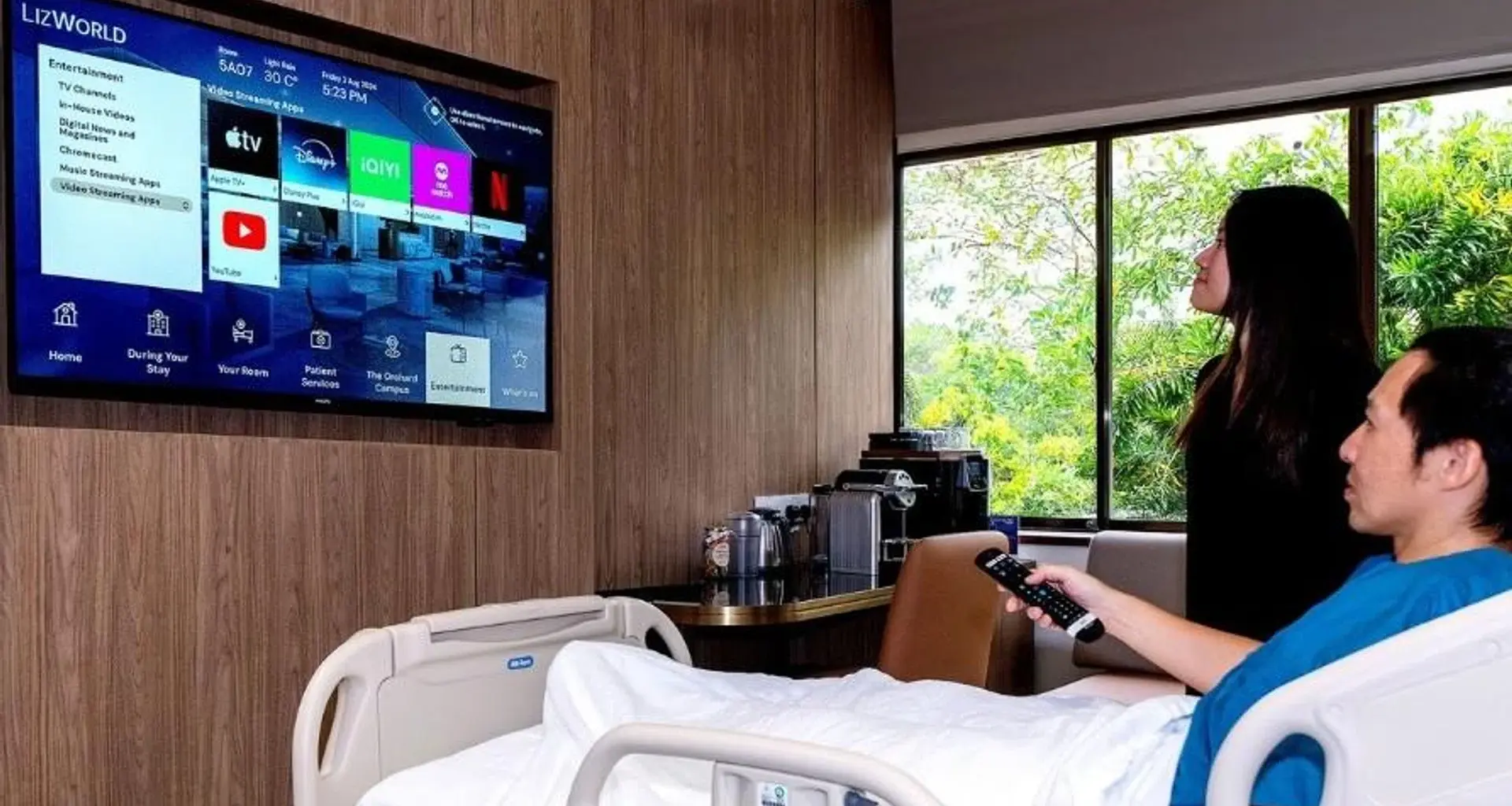
Mount Elizabeth Hospital’s patient platform, LizWorld, consolidates digital wayfinding, in-room services, patient information and self-service requests into a single system, with augmented reality guiding patients through ward facilities.
SEE ALSO

“Besides enhancing safety, these can reduce nurse time – and a lot of resources are saved in the process,” said Yong Yih Ming, chief operating officer of IHH Healthcare Singapore. “That would stack up in terms of cost management.”
The hospital also uses AI in its day to day operations, with a Patient Intelligence Centre (PIC) that integrates bed management, operating theatre and endoscopy scheduling using live operational data.
NurseShift.ai, an AI‑powered nurse rostering system, further reduces administrative workload, saving 51 per cent of the time spent on rostering, and allows nurses to spend more time on direct patient care.
On top of the existing infrastructure, Dr Chow indicated that the next step that the group is looking at would be to deploy AI to help its doctors improve on quality.
Currently, the hospital is focusing on delivering complex, high-acuity specialist care, with the use of AI‑enabled solutions such as Annalise.ai, Lunit and SenseCare Chest CT in medical imaging.
“We want to use AI to assist in the diagnosis, but we are not replacing the doctors totally – we are using AI to support them,” said Dr Chow.
Beyond Mount Elizabeth Hospital, these digital and AI initiatives are also being deployed to support clinicians and frontline teams with the tools needed across IHH Singapore’s hospitals.
Cost savings from AI would be passed to patients
As AI and digitalisation drive efficiencies, Yong said that the cost savings from the transformation could be transferred to patients.
With the use of robotics, for example, it could replace two or three staff doing manual work across shifts, which cuts manpower cost. This, alongside other initiatives, could potentially lead to about 10 per cent in savings and naturally bring down healthcare costs.
“We always talk about healthcare costs going up. What we are trying to do is do the reverse,” said Yong.
Better clinical outcomes, he added, creates a virtuous cycle. “The better the clinical outcome, the shorter the length of stay, the healthier you get, (and) the lower cost it is from an inpatient perspective.”
Decoding Asia newsletter: your guide to navigating Asia in a new global order. Sign up here to get Decoding Asia newsletter. Delivered to your inbox. Free.