
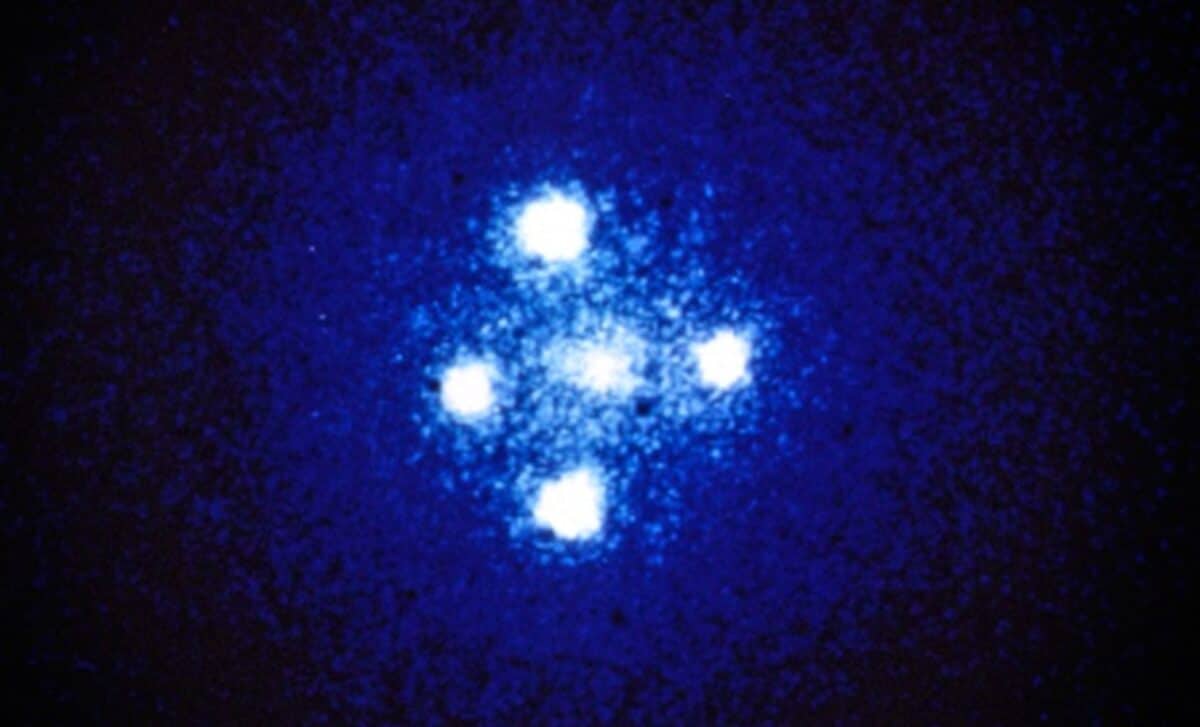
In a groundbreaking discovery, astronomers have used a rare “Einstein Cross” gravitational lens to investigate a young galaxy that appears to host unusually mature stars. The galaxy, named J1453g, is forcing scientists to reconsider how these massive structures evolve over time.
J1453g is an elliptical galaxy located approximately 8 billion light-years away, as it appeared around 8 billion years ago, when the universe was still in its youth. Gravitational lensing, a phenomenon predicted by Albert Einstein, allows astronomers to observe distant objects like quasars through the “lens” of a closer, massive galaxy. This effect has enabled scientists to closely study J1453g’s star population, revealing unexpected details about its age and composition.
A Gateway to Cosmic Exploration
Gravitational lensing occurs when light from a distant object, such as a quasar, is distorted by the gravity of a massive object between the observer and the light source. This distortion bends the light and magnifies the background object.
In the case of J1453g, the galaxy’s gravitational field magnified the light from a far-off quasar, creating the distinct “Einstein Cross” effect, where the quasar appears in multiple images arranged in a cross pattern. According to Quirino D’Amato, a researcher at the Italian National Institute for Astrophysics (INAF):
“The discovery of this exceptional object has allowed us to accurately study the nature of the stars at the center of an elliptical galaxy in a remote era of the universe, when the galaxy was still young.”
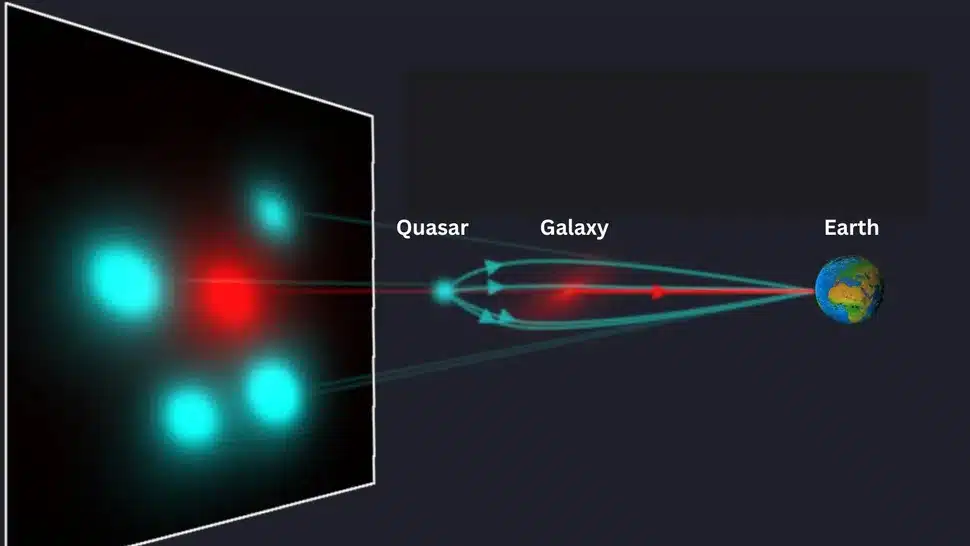 This illustration shows gravitational lensing, where a galaxy magnifies light from a distant quasar, creating an “Einstein Cross” effect. Credit: Quirino D’Amato
The lensing enabled precise measurements of the mass distribution of stars in J1453g, offering a unique opportunity to explore a distant galaxy at a level of accuracy previously impossible. The findings were published in Nature Astronomy on April 2.
The Young Galaxy Home to Ancient Stars
Despite being a relatively young galaxy J1453g’s star composition resembles that of much older galaxies like the Milky Way. Typically, scientists expect young elliptical galaxies to feature low-mass stars at their cores, as these tend to form quickly in early galactic stages.
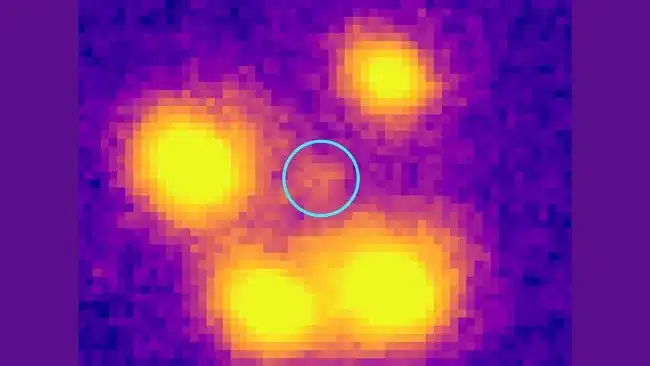 An “Einstein Cross” centered around the unusual elliptical galaxy J1453g. Credit: Quirino D’Amato
However, J1453g defies this expectation by having a central bulge of higher-mass stars that would usually be seen in more mature galaxies.
“The fact that their composition is very similar to what we see today in the Milky Way, in a completely different environment and era, is surprising,” D’Amato commented. “This tells us that we are still far from fully understanding the processes of galaxy formation and evolution, and represents an important point for the development of future models.”
The discovery suggests that the processes behind galaxy formation could be far more complex than previously thought.