
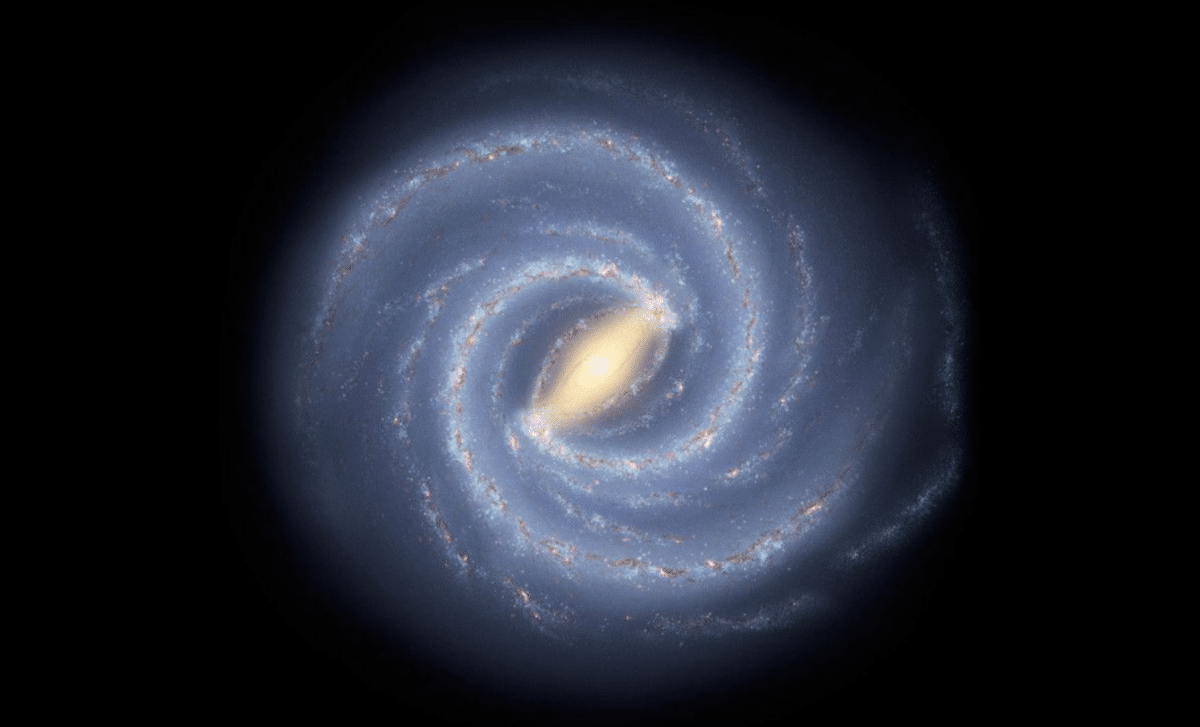
a team of astronomers has unveiled a revolutionary new approach to simulating the evolution of galaxies. Published in Monthly Notices of the Royal Astronomical Society, this breakthrough project, known as COLIBRE, offers a highly detailed and realistic depiction of how galaxies form and evolve, from the first billion years after the Big Bang to the present day. For the first time, key elements such as cold gas and cosmic dust have been incorporated into these simulations, offering a more accurate portrayal of galaxies both today and in the early universe, as captured by the James Webb Space Telescope.
The Missing Ingredients: Cold Gas and Cosmic Dust
For years, astronomers have struggled to model galaxy formation accurately because two critical components were left out of earlier simulations: cold gas and cosmic dust. These elements are not only abundant in galaxies, but they are also the raw materials from which stars are born. Their absence from past models limited the accuracy of simulations, and as a result, our understanding of galaxy formation was incomplete. However, the study published in Monthly Notices of the Royal Astronomical Society has changed this, with the COLIBRE project successfully incorporating these missing elements into the simulations, providing a more realistic and detailed picture of how galaxies formed and evolved.
“Much of the gas inside real galaxies is cold and dusty, but most previous large simulations had to ignore this,” said Professor Joop Schaye, project leader from Leiden University. “With COLIBRE, we finally bring these essential components into the picture.”
Incorporating these factors into the COLIBRE simulations allowed researchers to build a much more realistic representation of how galaxies are formed and evolve over time. By using the power of supercomputing and sophisticated algorithms, the team was able to simulate the interplay of cold gas and dust with unprecedented accuracy.
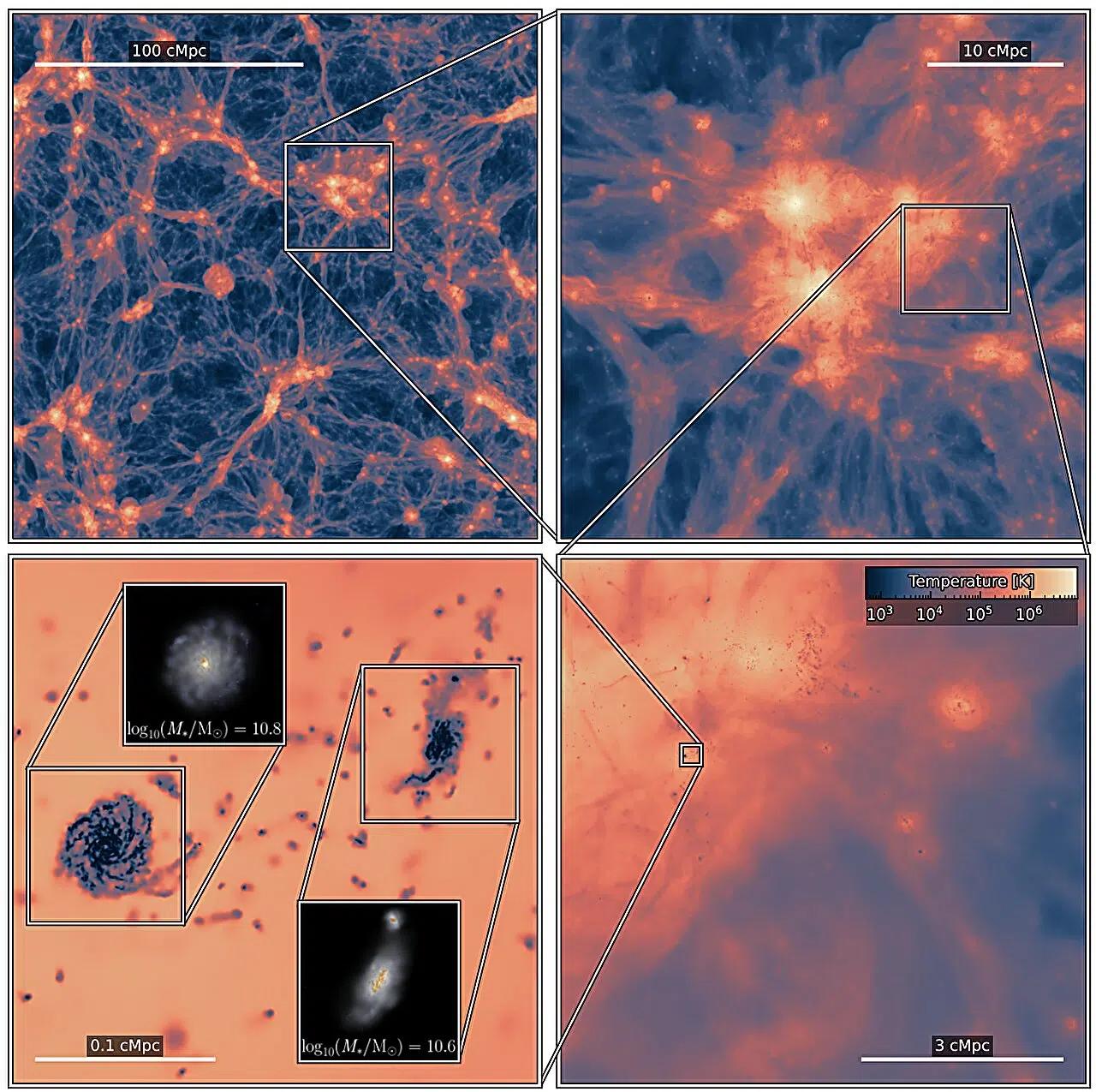 Visual impression of the dynamic range in the COLIBRE simulation L200m6 at z = 0.1.
Credit: arXiv: DOI: 10.48550/arxiv.2508.21126
A Leap in Computational Power: Simulating the Universe in Detail
The COLIBRE project represents a leap in computational power, utilizing up to 20 times more resolution elements than earlier models. This breakthrough is not just about the quantity of data processed but the ability to simulate larger volumes of space with greater detail. Running on the COSMA8 supercomputer at Durham University, the simulations take into account the complex physical and chemical processes involved in galaxy formation, including the cooling of gas, star formation, and the role of small dust grains.
The simulations are not only visually stunning but also include sound through a process known as “sonification.” In sonified videos, sound encodes additional physical data, giving users a deeper sensory experience of galaxy formation. These tools, which provide a new way to explore the cosmos, could help scientists make new discoveries and make the science more accessible to the public.
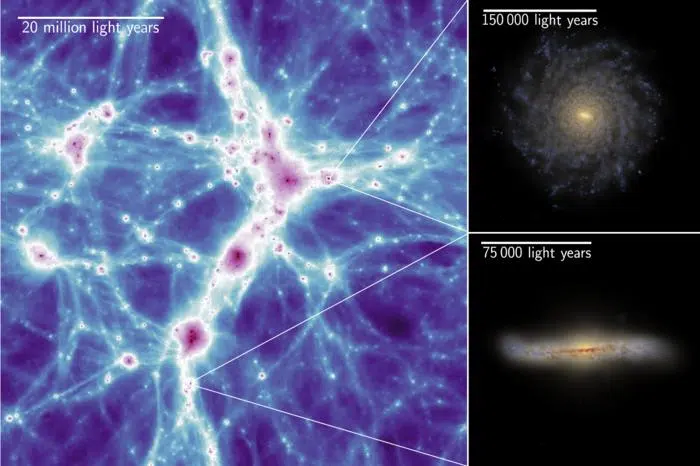 The panel on the left shows the so-called cosmic web, where the colour encodes the projected density of gas and stars. The two panels on the right zoom into two of the many galaxies formed in the simulations. These images show the stellar light obscured by dust for a disc galaxy seen face-on (top right) and another disc galaxy seen edge-on (bottom right).
Credit: Schaye et al. (2026)
Validating the Cosmological Model: New Insights from the James Webb Space Telescope
One of the most significant outcomes of the COLIBRE simulations is how they validate the standard cosmological model. The model, which describes the evolution of the universe from the Big Bang to the present, had been questioned by some early results from the James Webb Space Telescope (JWST). However, by including previously missing factors, the COLIBRE team was able to show that the standard model still holds true.
“Some early JWST results were thought to challenge the standard cosmological model,” said Dr. Evgenii Chaikin, lead author of several COLIBRE papers. “COLIBRE shows that, once key physical processes are represented more realistically, the model is consistent with what we see.”
This validation is crucial for both theoretical cosmology and observational astronomy, as it reinforces the reliability of the current models used to explain the formation and evolution of galaxies.
The Realities of Galaxy Evolution: What We Know and What We Still Don’t
While the COLIBRE simulations have answered many important questions, they have also highlighted areas that still need further exploration. For instance, the discovery of “Little Red Dots” by JWST, which may be the early seeds of supermassive black holes, is not yet explained by COLIBRE. These findings suggest that the formation of supermassive black holes might involve processes that go beyond what COLIBRE currently models.
“What is most remarkable is that we are able to produce this synthetic universe purely by solving the relevant equations of physics in the expanding universe,” said Professor Carlos Frenk, a core member of the COLIBRE team. “The simulations show us how galaxies could have formed and evolved, and the fact that they look indistinguishable from real galaxies is a testament to the power of our new approach.”