
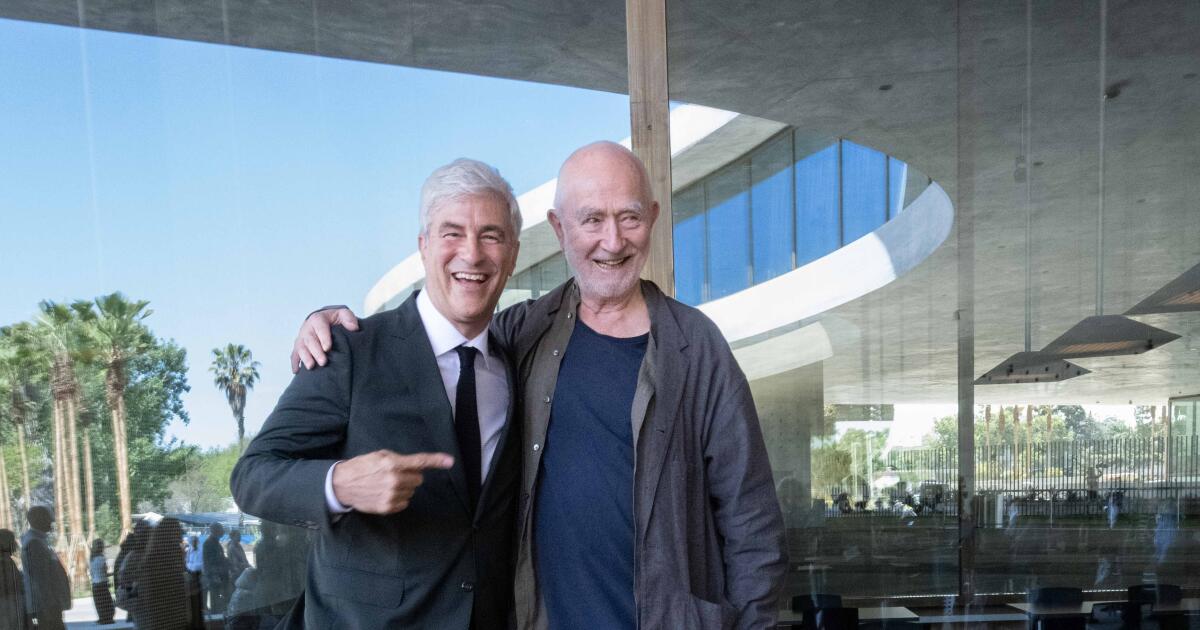
During a recent Zoom interview from his studio in Switzerland, Peter Zumthor offered a candid look at the making of the Los Angeles County Museum of Art’s new David Geffen Galleries.
The Pritzker Prize-winning architect addressed long-standing criticisms of the building and answered questions about his craft. He noted that the structure is a rejection of the overly “slick” architecture he believes defines the present moment, and shed light on the building’s early development, describing a contained process in which the concept was shaped before being presented to the public.
Finally, he discussed the broader ambition of the endeavor: dissolving traditional circulation and prioritizing emotional experience over institutional order.
The following interview excerpts have been edited and condensed for length and clarity.
You are well-known as both an architect and a craftsman. I think the biggest place for that focus was the concrete. I’m curious about how you formed it. It’s not the typical museum concrete.
I work like an artist in building. This means I custom-make buildings. I can use a few standard details or products, like in the basement. But where the building has an identity, becomes visible, it’s almost all handmade. I have an image of what I want to do, what the building should do, how it should look. So I need people who can help me make custom-made products.
The people who did the formwork — the concrete pouring — [worked in] groups of 100 or more. They were fantastic. They loved their work. At the beginning, formwork leaked on a door, and it looked terrible. They said, “Peter, we’re sorry. We made a mistake. We can fix this. You will not see this afterwards.” But if you make a mistake, you cannot mend it, because what you’re doing here is a concrete sculpture. Sculptures are never mended.
It’s not a perfectly smooth concrete. I’m assuming that’s on purpose?
I love this kind of rawness. This was what I gladly learned. Michael [Govan] in a very friendly, careful way let me know that he would like more “American details” and fewer “European details.” OK, my European details, they stand. That’s what I did 20, 30 years ago. My background as a furniture maker shows, and I can do this. But the challenge in this museum is to get the right “American” roughness. And I think I pretty much succeeded.
What I learned in California [came] back to Europe, and many times we now say in the office, “Let’s do this more L.A.-style.” Because we have too many slick magazines in the world. We have this corporate architecture which doesn’t want to see any touch of a hand. No mistakes. What we need is not refinement. We need wholehearted directness. This is what I take back from America. There’s a certain freshness. It’s not overly refined. I’m proud of that. The roughness has to do with our times. Because our time is slick and glossy, right? The time to make refined, slick architecture is over.
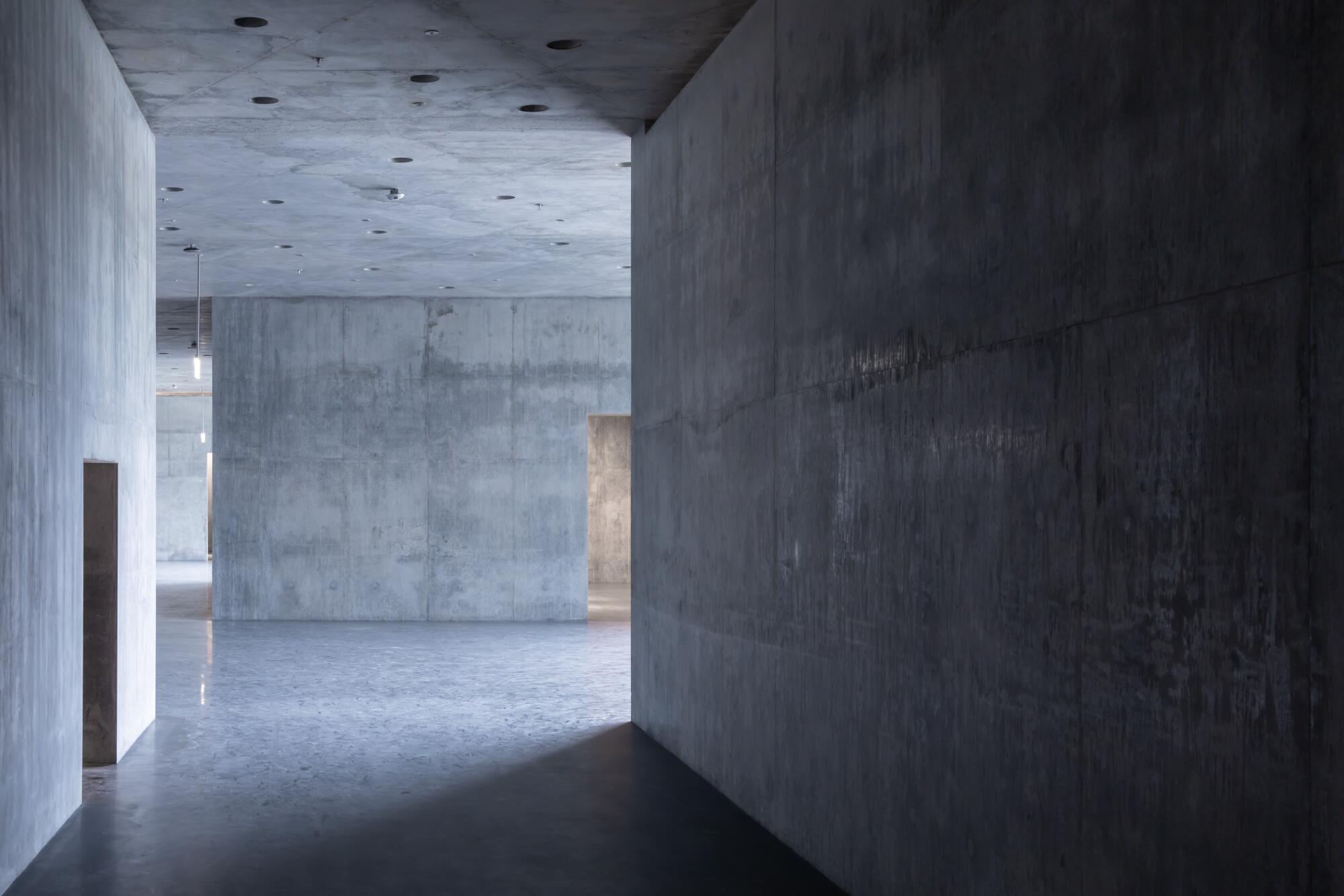
Horizontal light enters from floor-to-ceiling windows around the perimeter of LACMA’s new David Geffen Galleries, which use concrete as a kind of living building material.
(Iwan Baan)
In a 2023 interview with [architecture critic] Christopher Hawthorne, you said there were no “Zumthor details” left in the building. Do you think there are any Zumthor details now?
Of course there are Zumthor details. And I love them. They are not Swiss details. I think Christopher got this wrong. I was actually proudly speaking of how I learned a new way of looking at details. It doesn’t have to be refined all the time.
[Editor’s note: Zumthor told Hawthorne verbatim, “There are no Zumthor details any more,” in the 2023 interview with the New York Times.]
There’s always a tension with every building when it comes to value engineering. Were there any other places where you would want [David Geffen Galleries] to be different?
Basically, I say no. I’m very proud of this building. This is what I wanted to do, and this is what Michael helped me to do. This is exactly it. It’s one of my children and I love it.
Do you see this approach as an evolution in your work? Or is it more specifically for L.A.?
L.A. has changed me. And it’s in a good way. I would [not] have changed and reacted to our slick times the same way without L.A.
There were complaints that the project, and the process, were not as public as some people thought they should be. What is your reaction to that criticism?
I think I can say this: Michael said, “We cannot make a competition or anything like it, because competitions in the U.S. always end up with a winner who doesn’t build because he found out his own way of staging this whole procedure. The first, the most important thing, is that we start on a small budget, just the two of us.” That’s what we did. So when we started to talk about this museum, it was him and me, basically, and he gave me a little bit of money. And he said, “There will come a time when we will have to show something to the public. Let’s see whether people say yes.” They could have said no, but I think what they saw at that point was already too convincing.
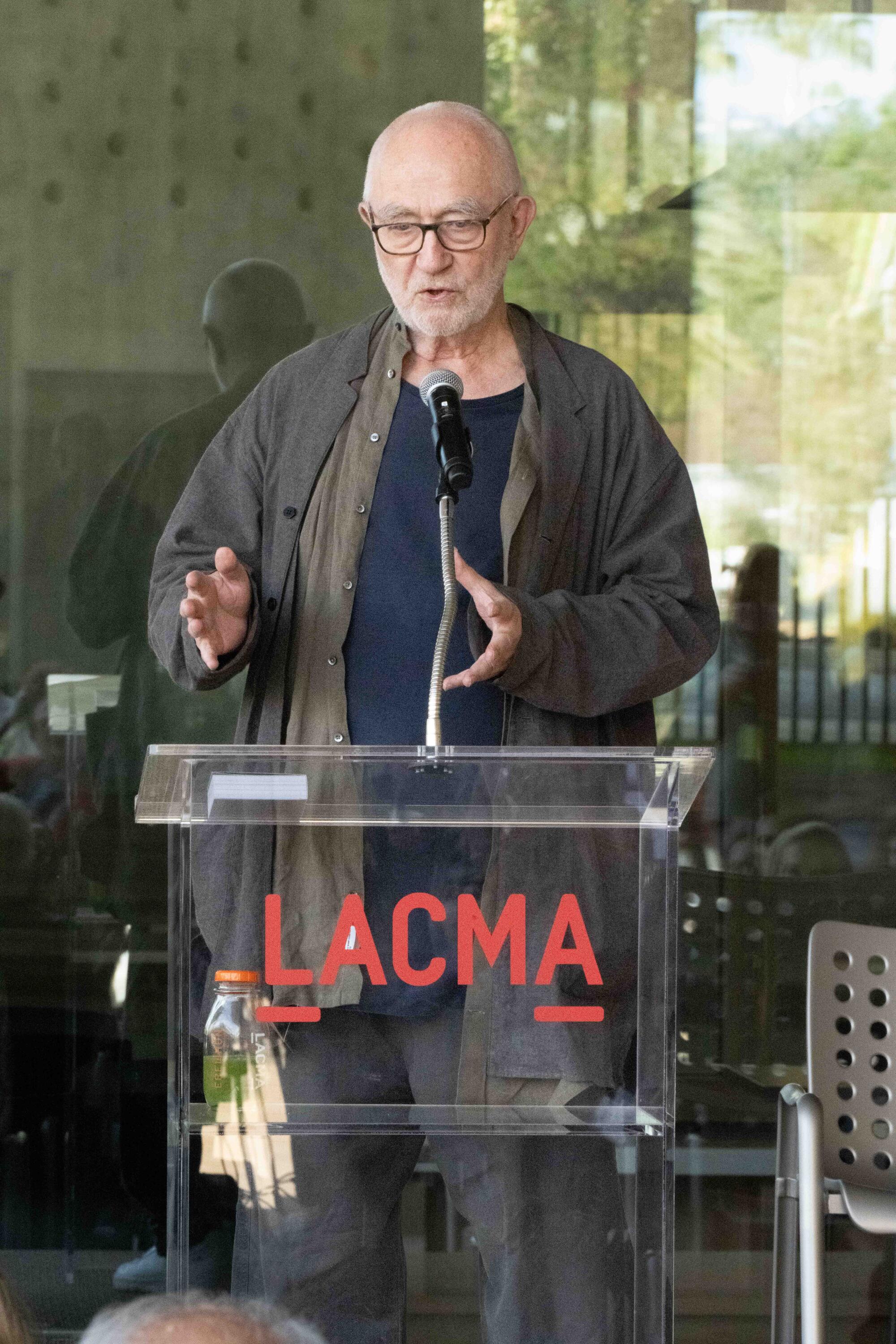
Architect Peter Zumthor speaks at the press preview for the David Geffen Galleries at Los Angeles County Museum of Art.
(LACMA/ Museum Associates / Gary Leonard)
Because the museum’s not organized in a traditional way, it might be harder than normal to navigate for some people. It might be a little confusing. What do you say to that concern?
This will take some time, to see the benefits of this new type of museum. I think if you start to like this building in one corner or in another, or you get lost, you start to understand what it is all about. When something new comes, you have to learn, right? But I hope you can see this building never looks down on you. This building is, in a way, deeply human. And it lets you have your opinion.
There are people who have said, very loudly, this space shouldn’t have lost square footage. What is your response to that?
Small museums are beautiful, big museums tend to be really difficult. And the bigger the museum gets, the more difficult it is to make it easily accessible. So I’m very glad that this is not bigger. But it feels bigger.
What is this with bigness? What kind of a hang-up is this? You don’t have to be big. It has the right scale. We were often asked, “Can you experience this building and this collection in one day?” And we said, “Maybe. But maybe it will be better to come back.” Start from the other end. You have your own personal path. And then you research a little bit further. I think these are the beautiful ideas of how to experience the building. And I think it’s endless.
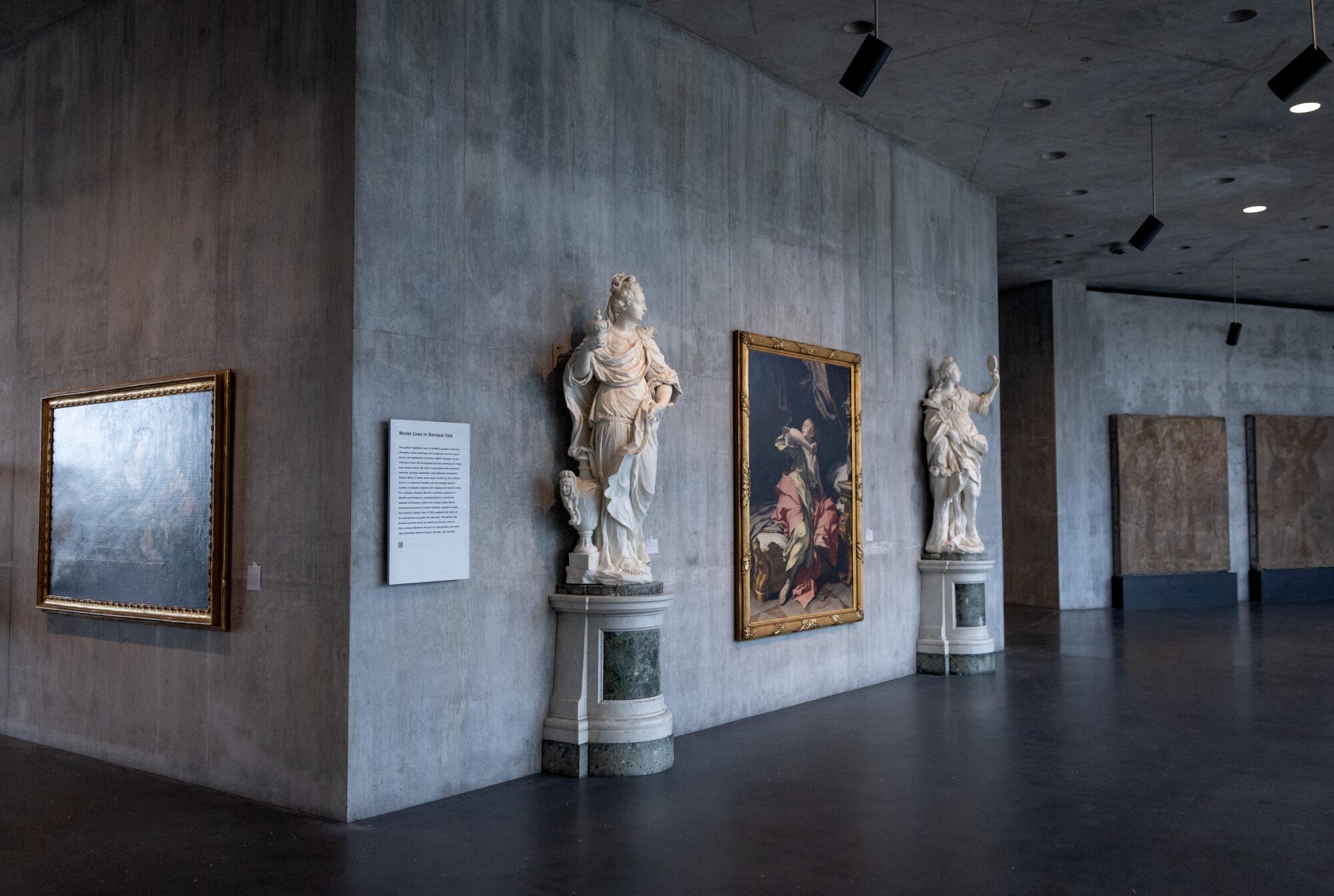
The interior of LACMA’s new David Geffen Galleries encourages guests to wander and make their own connections rather than follow a linear path.
(Eric Thayer / Los Angeles Times)
Can you go back to the beginning and talk about the core concept for the museum?
There are three major things that I always have to answer, whatever I do. What does the building do with the place? Does it help the place? Does it interpret the place? And then, what is the content of the building? What does the building have to do? Why are we building this?
To start out, there was a museum here which was modeled a bit after Lincoln Center. Later, it got clogged up with new buildings and you didn’t recognize the initial idea anymore. These things we took away. Whenever a building is there, whether it’s beautiful or ugly, it will always have grown into the soul of somebody. There will always be people saying, “No, no, I want to keep it.” This is part of my life. I understand this kind of thing always comes up.
The place was rather difficult because I couldn’t see any big urbanistic concept in L.A. L.A. [is] not urban in the European sense with, for instance, the market square.
There was a master plan, which was made by Renzo Piano. And this presented a long axis, and I tried to follow it. It just did not feel right. So I started to react in a more organic way, inspired by the tar pits. This whole area, which to me, is the ancient part of the site, became the starting point.
There was more: like the idea that side light is the most human light. Yeah, no skylights. And another thing was the museum had to be open to its surroundings. So contemporary L.A. should be present at all times. It should come in, whenever you can look out.
Another important thing … was to create or enlarge the public space that Michael [Govan] had started to create between his buildings. Friday evenings, Saturday, you saw so many families there. There is a desire here, a wish, for public space. This is not exactly the strength of L.A. So I think it was amazing that we were allowed to lift up the building and have the whole ground free for people.
Also, let’s do the museum on one level only. Classical museums have a main level, then they have a second level and a third level, a south wing and north wing and so on. And then, as an artist, you can have your work on the main level in the most beautiful spot. But as an artist, you can also land top left, third level near to the attic. So let’s make a building type which treats everybody equal.
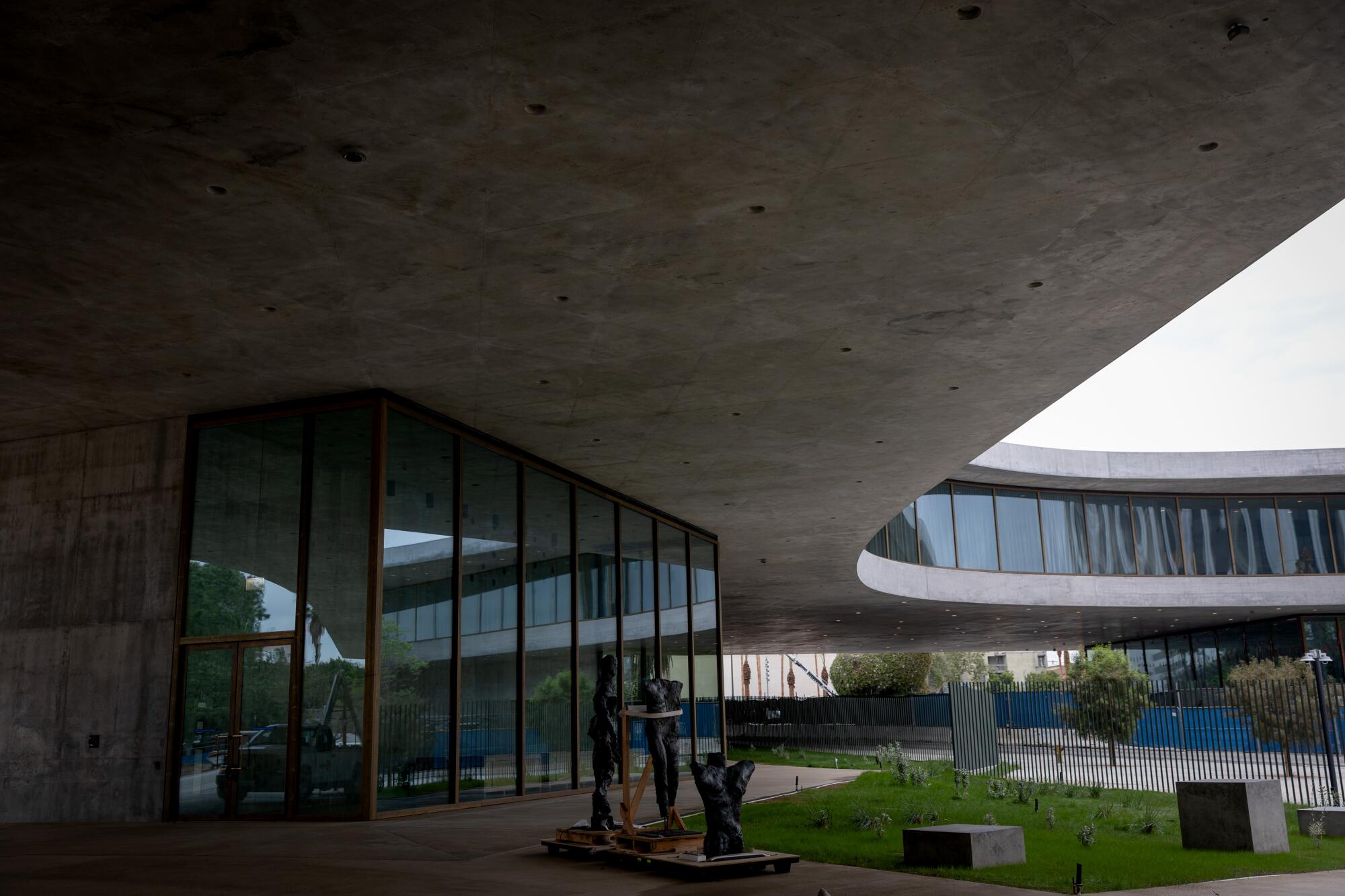
LACMA’s David Geffen Galleries are hoisted above the ground on discrete piers, allowing for ample public space below.
(Eric Thayer / Los Angeles Times)
And then we started to think about how we wanted something open for wandering, experiencing and dreaming. This is always difficult to explain — let’s have the knowledge of art, of the history of art, coming second. It’s not because I think this is a secondary thing. It’s just because our experience should come first.
As a boy, I saw the opposite. There’s a tour and there’s a guide, and the guide starts to tell you what you should think. And I never liked this. We thought we should lay out things on a big plane where you can stroll and wander and develop your interest in art. Follow your own path.
You’re overturning a lot of unspoken rules in the art world. And I guess that’s the point in a lot of ways?
This is our point. You see other rules. For instance, if you do a new museum, the conservators say art can be exposed to less daylight. I told them as a joke, “If it goes on like this, soon the art will be in the basement, locked away.”
We have a building wide and long enough that within the building, you can find strong daylight for, let’s say, china or pottery, which love daylight. Then you can go deep into the building where it gets darker, and you can put pieces you don’t want to expose too much to the light. All without having to flip a switch.