
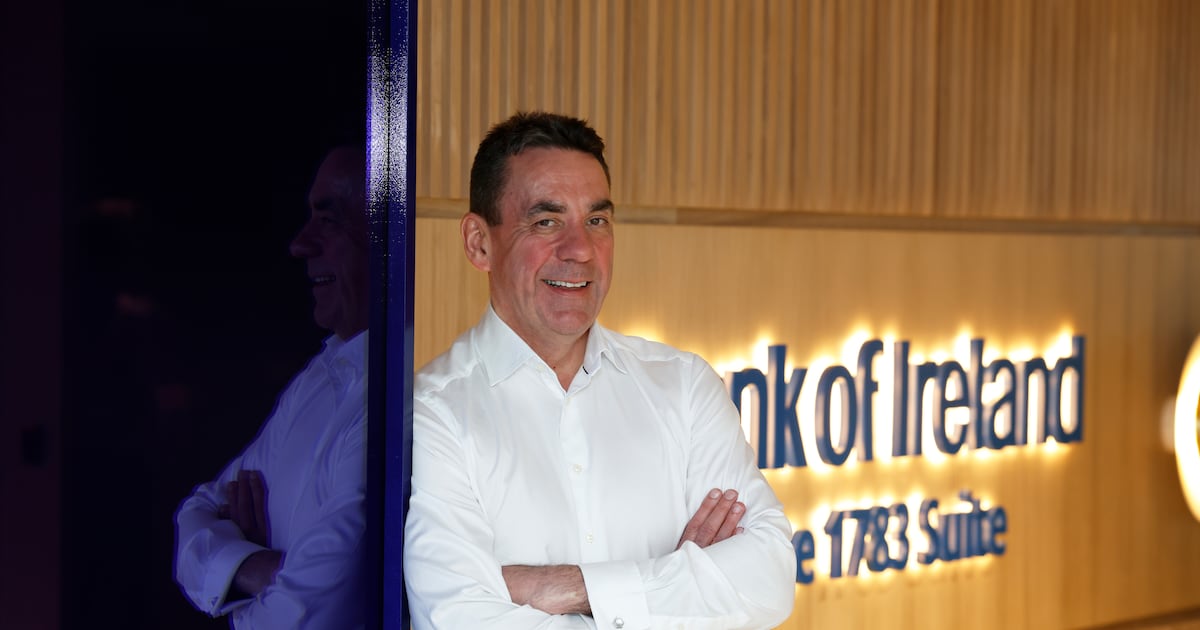
Bank of Ireland plans to delist from the London Stock Exchange (LSE) and offer to buy out thousands of legacy shareholders with tiny holdings after their stakes were severely diluted by its crisis-era bailouts.
The group revealed the plans in a circular issued to shareholders ahead of its annual general meeting on May 21st.
“In recent years, trading volume in the ordinary shares on the LSE have been negligible as relative to overall trading in the company’s shares. As a result, the board considers that the cost of maintaining the LSE listing is no longer in the interests of the company and its shareholders as a whole,” Akshaya Bhargava, group chairman, said in the circular.
Shareholders will be asked to vote on the matter at the agm. Bank of Ireland’s primary listing ins in Dublin.
The bank has also followed the lead of peers AIB and PTSB in recent years by proposing to offer to buy out small shareholders, whose holdings date before the bank required a bailout from the Government and a group of North American investors during the financial crisis.
Bank of Ireland chief executive Myles O’Grady said at last year’s meeting, in response to questions from shareholders, that the lender was actively considering such a move.
 Has the fuel protest shown that the loudest lobby generally gets what they want?
The bank plans to extend a so-called odd-lot offer to buy out holders of 30 or fewer shares, who, combined, equate to 35 per cent of all shareholders but only 0.03 per cent of issued share capital.
Any offer would be priced at a 5 per cent premium the stock’s average price for five days before it is launched, it said. Those participating would not face any transaction costs, it added.
The ability of such small shareholders to deal their shares – and to cash their dividend cheques – has been constrained up until now by disproportionate dealing costs and banking charges, the bank said.
“The recurring administration costs resulting from the relatively large number of shareholders are disproportionate to the size of these small shareholdings and affect shareholders as a whole.”
AIB said last month that it was planning a second odd-lot offer in two years. PTSB carried out a similar offer in 2024.
The bank said last month it posted a €1.2 billion net profit last year and plans to return 100 per cent of this to shareholders through dividends and a stock buyback.
O’Grady has set targets for 3 per cent, 4 per cent and 10 per cent compound annual growth in deposits, loans and assets under management, respectively, over the next three years.
The bank sees net interest income inching up to €3.4 billion this year from €3.37 billion in 2025, before gradually rising to €3.85 billion in 2028, according to its new medium-term outlook. This would deliver total income of €4.75 billion by the end of the period.