
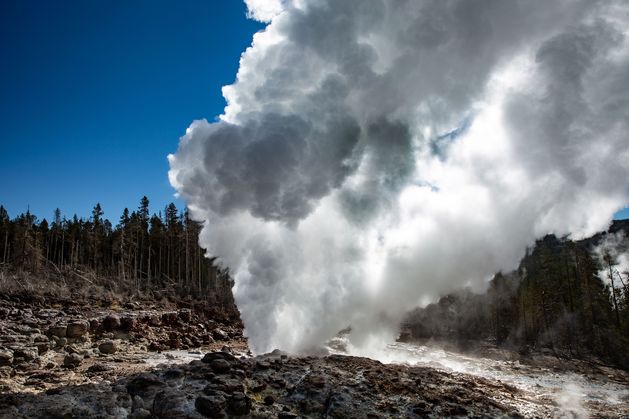
such as Yellowstone in the US and Lake Taupo in New Zealand.
The finding, published in the journal Nature, came as a surprise to researchers because the region shows almost none of the surface signs that typically betray the presence of large magma bodies underground – no major craters, no significant eruptions in hundreds of thousands of years and no dramatic ground deformation.
The last volcanic eruption in the area, from Mount Amiata, happened around 300,000 years ago and was relatively minor.
The reservoir was identified by a team from the University of Geneva, Italy’s Institute of Geosciences and Earth Resources, and the Italian National Institute of Geophysics and Volcanology, using a technique called ambient noise tomography.
We did not realise it contained such a large volume of magma
The method works by recording the natural vibrations constantly passing through the ground – generated by ocean waves, wind and human activity – using a network of around 60 high-resolution seismic sensors deployed across the region.
When those vibrations travel unusually slowly through a particular zone, it indicates the presence of molten or partially molten material. The team used the recordings to build a three-dimensional image of the crust down to a 15km depth.
“We knew that this region, which extends from north to south across Tuscany, is geothermally active, but we did not realise it contained such a large volume of magma, comparable to that of supervolcanic systems such as Yellowstone,” said Matteo Lupi, associate professor at the University of Geneva, who led the study.
The magma sits between 8km and 15km below the surface and has a core of predominantly liquid melt surrounded by a larger shell of crystal-rich partially molten rock.
The region beneath Mount Amiata, at the southern edge of the study area, may hold even larger volumes, though the researchers said further analysis was needed to confirm that.
Despite its scale, the researchers say the magma poses no immediate volcanic threat. The highly viscous nature of the magmas in the Tuscan region – formed through the melting of the surrounding crustal rocks rather than rising from the Earth’s mantle – makes them far less likely to erupt than those found beneath conventional supervolcanoes.
Their high viscosity causes them to accumulate slowly rather than ascend explosively.