
GSMArena Team,
17 April 2026.
1. Introduction, specs, unboxing2. Design, build quality, handling3. Our lab tests – display, battery life, charging speed, speaker4. Software and performance5. Camera, photo and video quality6. Final words, our verdict, pros and consvivo V70 FE specificationUser opinions and reviewsReview comments (7)
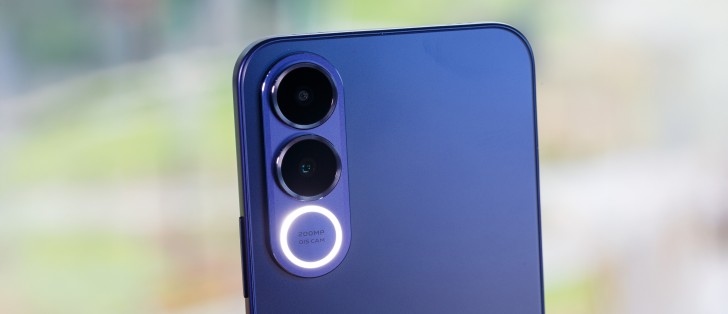
As mentioned, despite its lower standing in the V70 lineup, the V70 FE is actually a physically bigger device. It has a spacious 6.83-inch AMOLED display. It is a 120Hz panel with 10-bit color depth and HDR10+ certification. Its resolution is 1260 x 2800 pixels, which at this diagonal works out to a perfectly sharp 449 ppi or so.
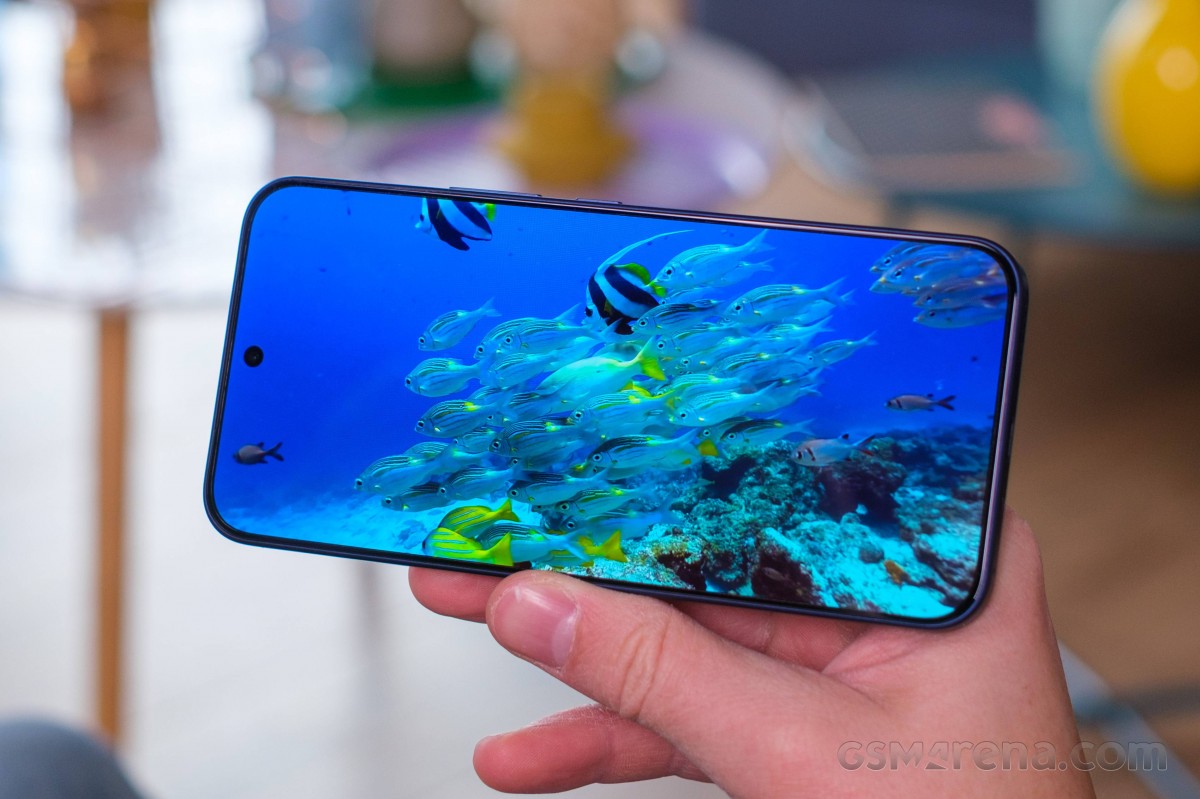
Interestingly enough, vivo advertises a 1,900-nit whole display max brightness figure for the V70 FE, which is a bit better than the 1,800 nits that the regular V70 is officially rated for. We did our standardized display testing, however, and in practice, the V70 FE manages slightly lower numbers than the regular V70.
We measured around 617 nits by maxing out the slider, which is definitely insufficient for comfortable outdoor use. Hence, you’d be better off leaving the auto brightness toggle on. That way, we measured around 1,890 nits in a 75% window.
Interestingly enough, due to how the phone handles its brightness output, we didn’t really measure higher brightness in a 10% patch; on the contrary, we measured lower brightness. But that’s just a quirk and is not indicative of how the display works under normal conditions anyway.
The vivo V70 offers a 120Hz refresh rate on its LTPS panel. While not as advanced as LTPO solutions with fully dynamic scaling, it still supports switching between 30Hz, 60Hz, 90Hz and 120Hz, which helps strike a reasonable balance between smoothness and efficiency.
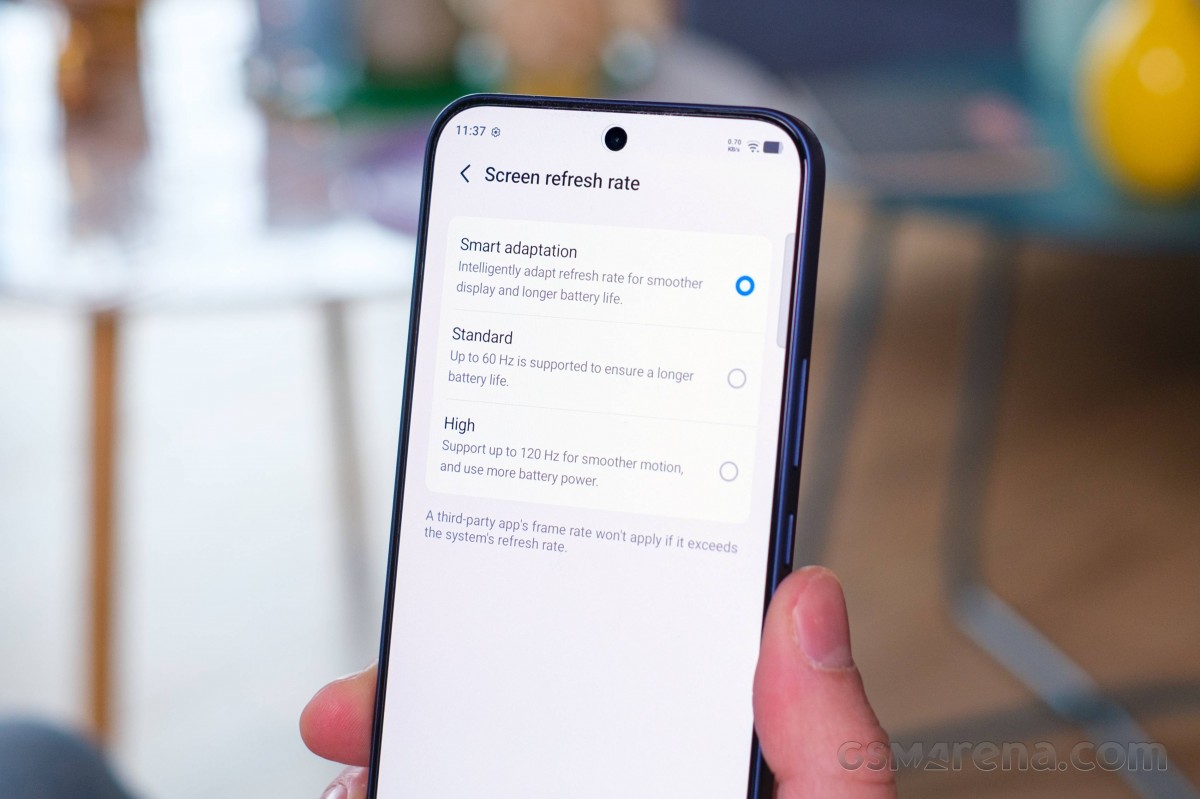
There are three refresh rate modes available in the settings. One enforces a strict 60Hz cap, while the other two rely on automatic switching. The default “Smart Adaptation” mode tends to be on the conservative side, favoring 90Hz over 120Hz in most scenarios.
The “High” mode adds a per-app control layer, allowing users to manually select which apps should run at 120Hz. While this is a welcome level of customization, it doesn’t always behave as expected. Some apps remain stuck at 60Hz despite being capable of higher frame rates. In our testing, even games known to support high refresh rates didn’t consistently benefit from the manual override, leading to somewhat unreliable results.
The 30Hz mode seems to be reserved for the Always On Display, but it is still cool; it is there for power savings.
While you might not be able to do high refresh rate gaming quite as consistently as you would like on the V70 FE, you can still make use of its excellent multimedia consumption chops. The phone supports the highest possible Google Widevine L1 DRM certification, allowing apps like Netflix to offer up FullHD streams.
Also, as mentioned, the display on the V70 FE is HDR10+ certified. On a decoder level, the phone can handle all the popular formats except for Dolby Vision. That includes HDR10, HDR10+ and HLG.
Given that it is a bigger device overall, it only makes sense that the V70 FE would have a bigger battery than its siblings. This is indeed the case – a large 7,000 mAh cell with modern Si/C chemistry. That is a whole 500 mAh bigger than the V70 and V70 Elite.
The V70 FE managed an excellent Active Use Score of 20:41 hours. Its call endurance and online video streaming runtime are particularly impressive.
Looking at the results next to those from the V70 with its 6,500 mAh battery, they do make sense overall. Still, it is important to note that the two phones use very different chipsets.
Just like its pricier siblings, the V70 FE uses vivo’s entirely proprietary FlashCharge tech. It requires both the appropriate charger and cable, so make sure you keep track of both.
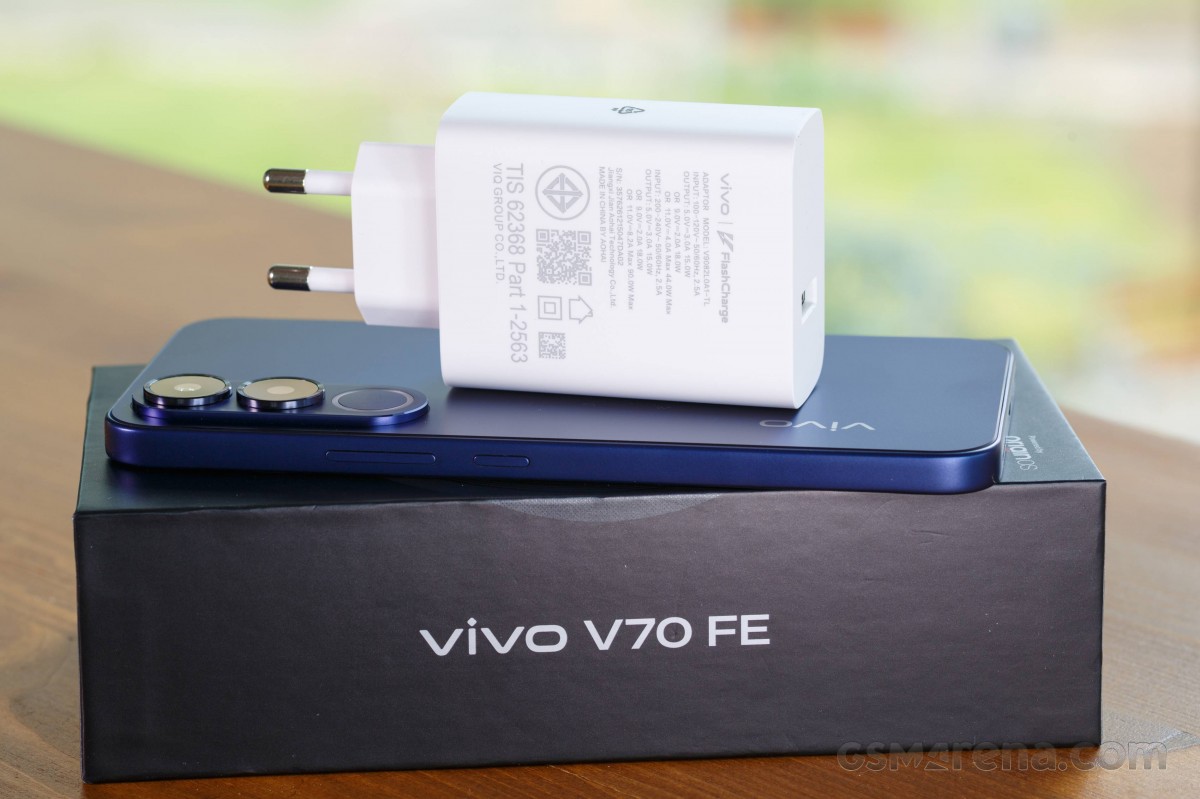
The V70 FE is not the fastest-charging device out there, but then again, it does have a pretty large battery to top up. Fifteen minutes on the charger resulted in the phone going from 1% to 25%. Thirty minutes took it up to 49%, and a full top-up took almost exactly 62 minutes on the dot.
Speakers – loudness and quality
The vivo V70 FE has a stereo speaker setup, but not like the one on the regular V70. In fact, this one is better. With more room to work with, vivo apparently managed to fit a second full-featured speaker inside the V70 FE, instead of relying on an amplified earpiece. The second speaker is top-firing, which makes for good symmetry and a more balanced overall output.
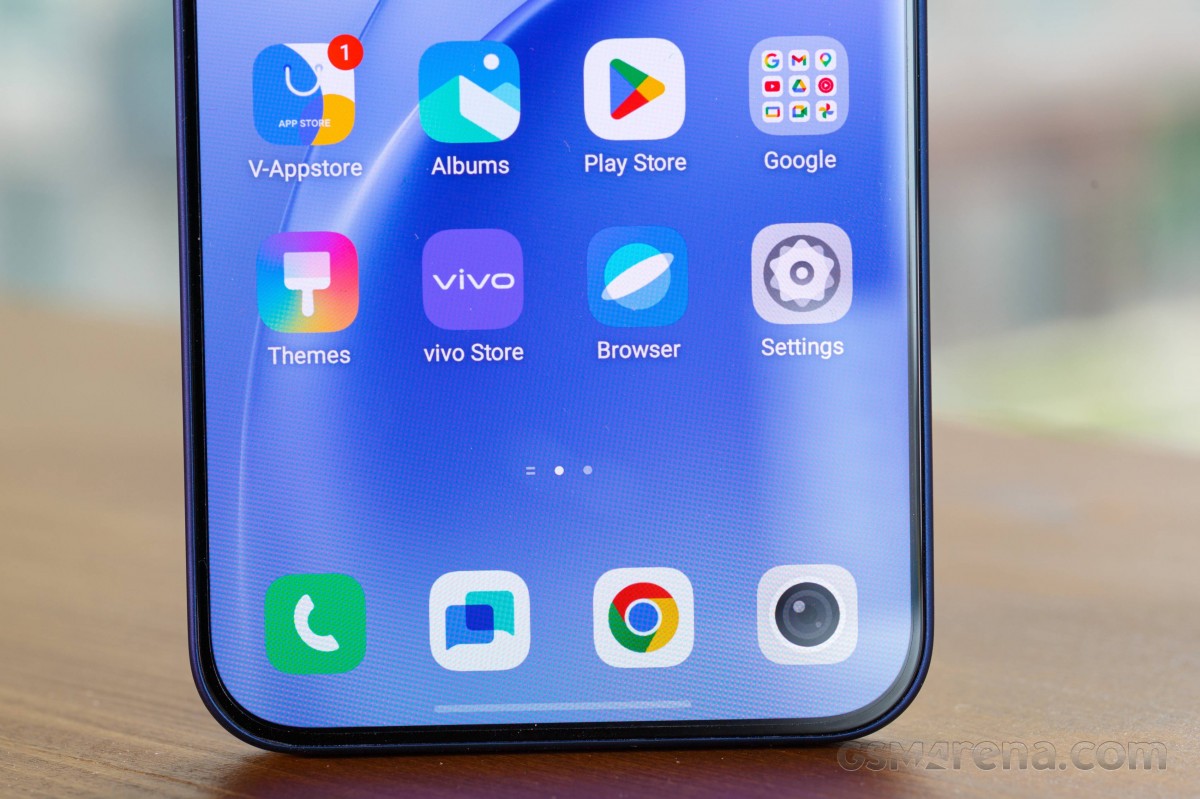
Having a proper second speaker and more room also contributed to the louder output on the V70 FE. It is noticeably louder than the regular V70.
Generally speaking, quality is great with a rich sound stage, clear mids and mostly undistorted highs. Well, if you stick to 100% max volume, that is. The V70 does allow you to boost the volume to 200%, which is how we got the impressive -22.5 LUFS loudness figure. Set to 100%, it puts out about -25.9 LUFS, but the highs don’t get distorted or tinny.
There are a few audio enhancements available to play around with. “Super Audio” is vivo’s take on an equalizer and sound booster, though it’s fairly limited in scope, offering only preset profiles rather than a full manual adjustment option.
Alongside it, you also get “Audio Super Resolution”, which attempts to upscale lower-quality audio automatically, as well as “Holographic audio,” a feature designed to simulate a more immersive, spatial sound experience.
Use the Playback controls to listen to the phone sample recordings (best use headphones). We measure the average loudness of the speakers in LUFS. A lower absolute value means a louder sound. A look at the frequency response chart will tell you how far off the ideal “0db” flat line is the reproduction of the bass, treble, and mid frequencies. You can add more phones to compare how they differ. The scores and ratings are not comparable with our older loudspeaker test. Learn more about how we test here.
Connectivity
The vivo V70 FE is a dual-SIM device with support for dual standby operation. Both Nano-SIM slots can handle Sub-6 5G connectivity, including simultaneous SA/NSA support, which is always nice to see. Unfortunately, our particular review unit lacks eSIM functionality, which feels like a bit of a missed opportunity at this point.
On the connectivity front, the vivo V70 FE supports a full suite of global positioning systems, including GPS, GALILEO, GLONASS, QZSS and BDS.
Local connectivity is handled by dual-band Wi-Fi 6 (802.11ac), though there’s no support for the newer 6GHz band, which would have been nice to see. On the plus side, Bluetooth is up to date with version 5.4, complete with LE support.
NFC and an IR blaster are part of the package.
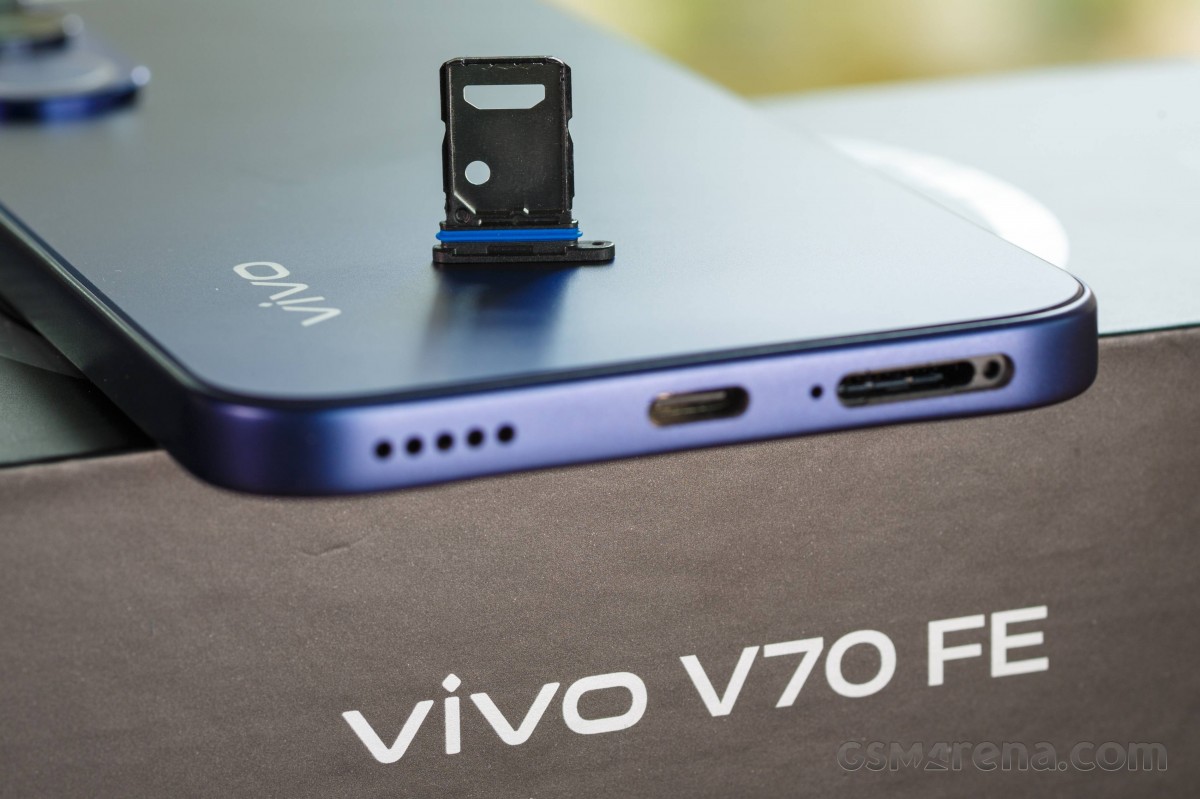
The USB Type-C port is limited to a USB 2.0 interface, meaning a theoretical maximum transfer rate of 480Mbps. There’s no support for DisplayPort Alt Mode or any form of video output. On the plus side, USB OTG/Host functionality is supported, allowing you to connect external peripherals.
There is a pretty decent set of onboard sensors: an ST lsm6dsve accelerometer and gyroscope combo, a Haechitech mxg4300 magnetometer and compass combo, a SensorTek stk63731 light sensor. There is no barometer.
The phone also seems to be equipped with a virtual proximity sensor. The latter does a decent job of turning off the display during calls.