
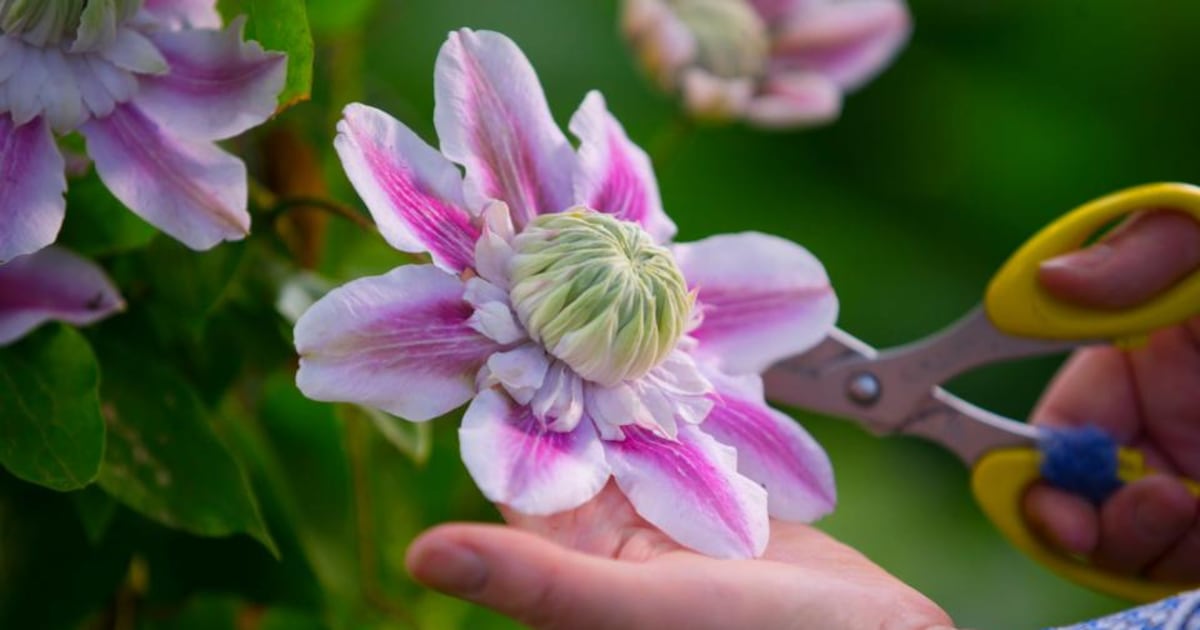
Unlike parents, gardeners are allowed to have favourites. One of mine is clematis, a genus of mostly climbing plants that’s as large and complex as it is beautiful, hardy and useful.
Looking, for example, for something to extend a climbing rose’s season of interest without outcompeting it for light, water and nutrients? Nothing is quite as versatile or as obliging as a clematis, from the restrained elegance of a classic variety such as the late summer-flowering Clematis viticella ‘Etoile Violette’ or Clematis viticella ‘Purpurea Plena Elegans’ to the showy early summer blooms of Clematis ‘Nelly Moser’. All of these varieties are also tolerant of partial shade, yet another valuable boon.
Or perhaps you need something to soften the imposing lines of a high wall or large outbuilding? In this case, consider the sprawling charms of spring-flowering Clematis montana, or, if your garden is a sheltered one, the very vigorous evergreen species known as Clematis armandii whose pale clusters of greenish-white flowers appear in late winter/early spring.
For other, more compact clematis that will light up the garden in spring, look at varieties of the ultra-elegant, shade-loving Clematis alpina, such as lavender-flowered Clematis ‘Bredon Blue’, or deep lavender- flowered Clematis ‘Helsingborg’, a refined version of the ever-popular Clematis ‘Frances Rivis’. Or consider the somewhat frou-frou charms of the pale-pink flower Clematis macropetala ‘Markham’s Pink’, whose fluffy, multi-petalled, pale-pink flowers are followed by ornamental seedheads. The evergreen white-flowering Clematis ‘Early Sensation’ is also spring-flowering and is a brilliant choice for chic, sheltered town gardens.
For summer interest, you can take your pick from a bamboozling array of garden-worthy plants. Drama queens will like Clematis ‘Niobe’, famed for its sumptuous, ruby-red, velvety flowers, and ideal for growing in a spot in light shade. Or the deep violet-blue flowering Clematis ‘Rooguchi’, a semi-herbaceous non-clinging type suited to growing in a summer flower border’.
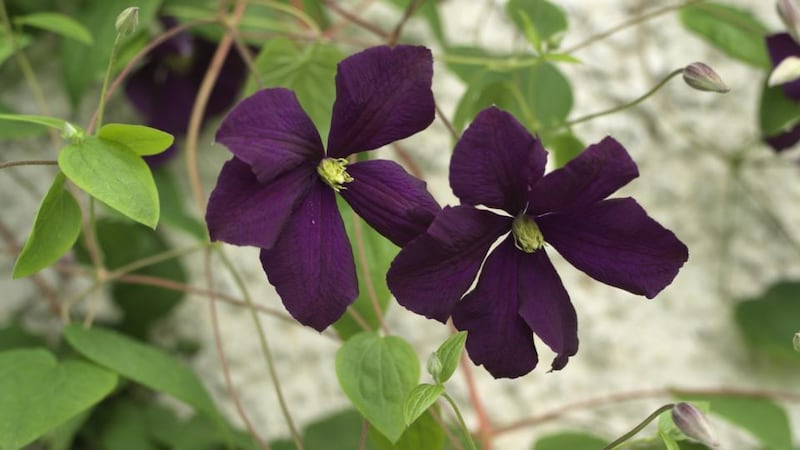 Purple-flowering Clematis viticella (Étoile Violette). Photograph: Richard Johnston
 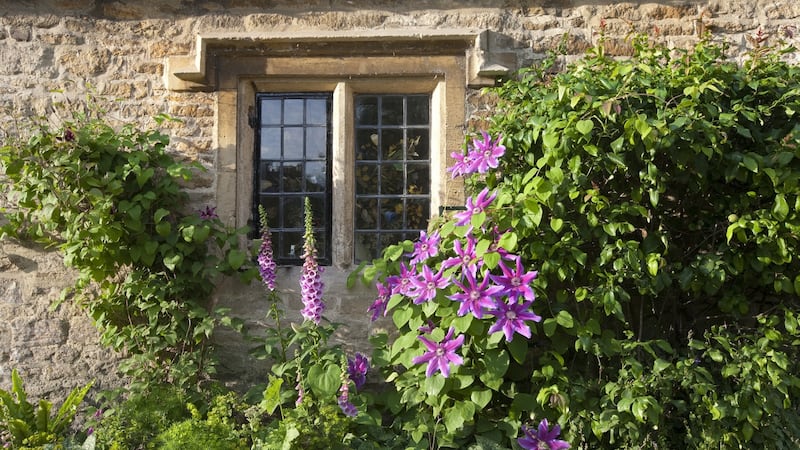 Clematis flowering around an idyllic cottage. Photograph: iStock
Romantics, meanwhile, will be seduced by the classic beauty of Clematis ‘Jackmanii’, an eternally popular variety famed for its large deep-purple flowers which appear from July-September, or by sky-blue Clematis Perle D’Azur’, or the ghostly beauty of Clematis ‘Henryi’. Alternatively, if scent is your thing, consider the dainty-flowered Clematis ‘Rubromarginata’, whose flowers smell of almonds, or the vanilla-perfumed, white flowered Clematis triternata. Or for varieties with an Irish connection, seek out Clematis ‘Lorcan O’Brien’ and Clematis ‘Glasnevin Dusk’.
For a plant guaranteed to add oodles of interest to the early autumn garden, you could use any of the numerous Clematis viticella hybrids, including those mentioned above as well as violet-flowered Clematis ‘Polish Spirit’, dark wine-flowered Clematis ‘Black Prince’ and dark-purple Clematis ‘Royal Velours’.
Varieties of the late-flowering species known as Clematis texensis are also ideal for this job, as are other late-flowering varieties such as Clematis ‘Ville de Lyon’ whose golden-eyed, dark pink flowers appear from July until October. Clematis tangutica is another great one for this time of year, with a multitude of golden, bell-shaped, long-lasting flowers followed by fluffy ornamental seedheads.
Most (but not all) species of clematis are self-clinging and will happily scramble their way up through the supporting branches of a tree, shrub, or climbing rose
For late winter, consider the delicate Clematis cirrhosa var purpurascens ‘Freckles’, an excellent candidate for a warm wall in sun or light shade, whose scented pink-and-white speckled flowers appear in January-February, as do those of the borderline-hardy, Clematis ‘Christmas Surprise’.
For gardeners with space only for container-growing, there are compact varieties of clematis bred specifically for growing in a pot, such as the award-winning Boulevard series. Just bear in mind that you’ll need to give these more care than their soil-grown equivalents as clematis need a fertile, moist but free-draining soil to flourish, and really hate their roots to dry out. But the reward for such efforts will be floriferous, long-lived, healthy plants that offer plenty of seasonal interest.
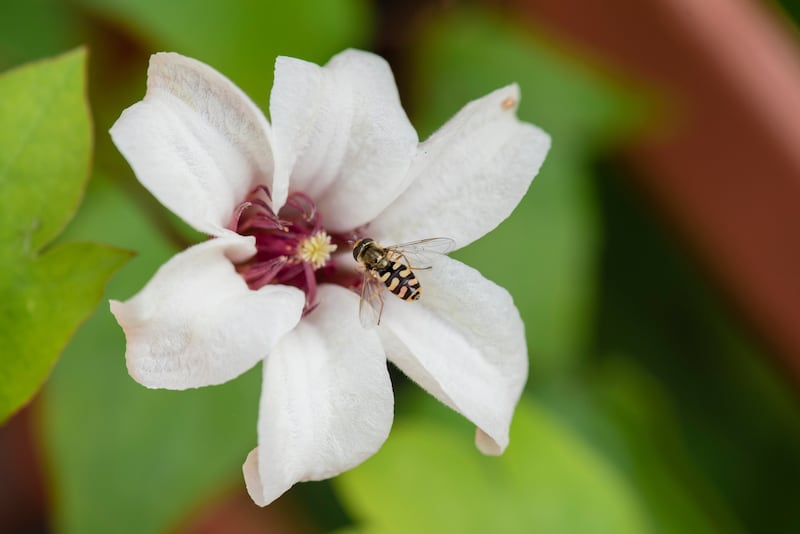 A hoverfly investigates a clematis flower. Photograph: Georgi Mabee/RHS/PA
 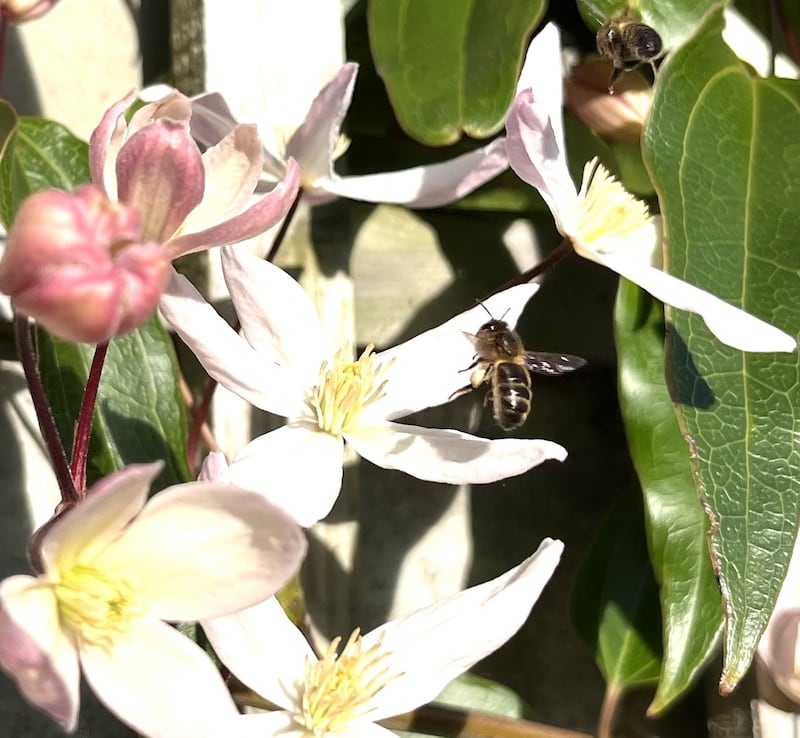 Honeybees, drawn to clematis in bloom. Photograph: Niamh Garvey
 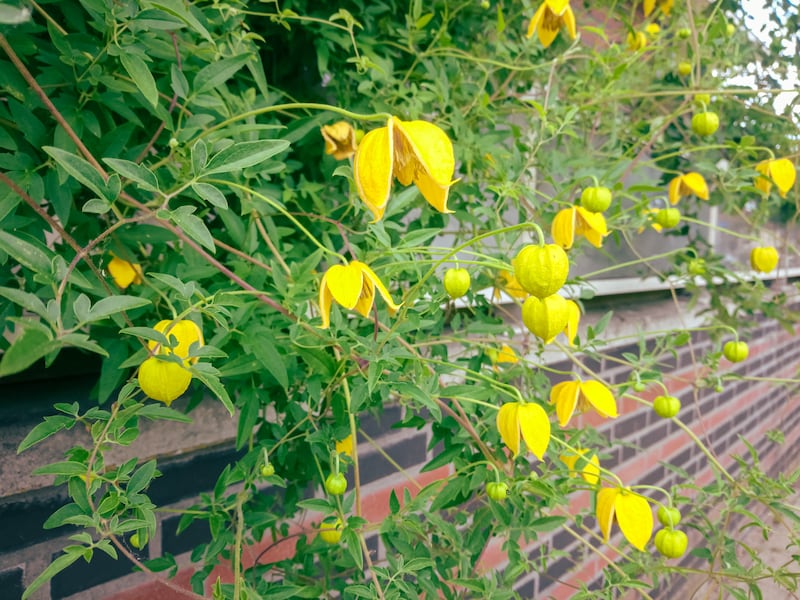 Clematis tangutica, also known as the golden clematis. Photograph: Getty Images/iStockphoto
April is a good time to plant all kinds of clematis as container-grown plants in the ground or in pots, making sure to give them a deep, cool, fertile, weed-free soil or John-Innes style compost (for containers), enriched with some well-rotted manure or home-made garden compost. If planting in the ground, try to make the planting hole 45cm-60cm away from the foundations of nearby walls as well as the trunks of well-established trees and shrubs.
If you already grow clematis in your garden, then mid-April is also a great time of year to encourage a great flowering display by spreading an organic mulch around the base of the plant followed by some generous sprinkles of an organic, slow-release pelleted organic fertiliser. Many but not all species also benefit from pruning in late winter, (see rhs.org.uk for a detailed guide), but it’s too late to do that this year without reducing the subsequent display of flowers.
Most (but not all) species of clematis are self-clinging and will happily scramble their way up through the supporting branches of a tree, shrub, or climbing rose. Even so, it’s well worth taking the time to train their fast-growing shoots over the coming weeks by gently spreading them out and then using some soft twine to tie them into position as they stretch upwards. If you’re growing clematis against a wall- and these are the perfect plants for making maximum decorative use of vertical growing space – you’ll also need to provide some sort of sturdy support in the shape of horizontal training wires. It’s also important to keep a watchful eye out for slugs and snail damage at this time of year and take suitable precautions.
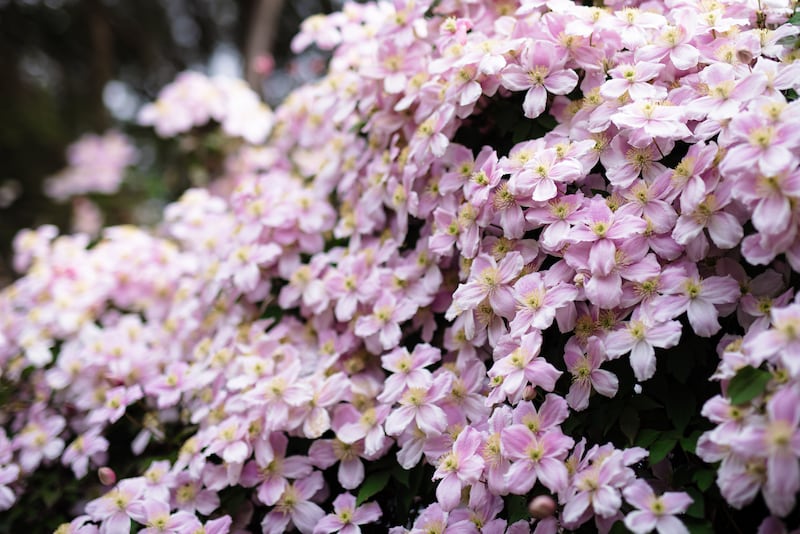 Clematis Montana (Pink Perfection). Photograph: Getty Images/iStockphoto
This Week in the Garden:
Sow seed of half-hardy annual varieties under cover in a bright, sheltered spot with gentle heat, for planting out into the garden at the end of May/ early June after all risk of frost has passed.Many common weeds such as nettle, dandelion, dock, chick weed and horsetail are packed full of valuable plant nutrients and can be put to good use at this time of year by placing them in a lidded container and covering them with water. After leaving this to rot down for several weeks (stir it occasionally), strain and dilute the resulting smelly liquid to use as a nutritious foliar feed, or ‘weed tea’ as it’s also known.
Dates For Your Diary:
Today, Saturday, April 18th (11am-2pm), Royal St George Yacht Club Carlisle Pier, Dún Laoghaire Harbour Co. Dublin, A96 AY77, the RHSI Major Annual Plant Sale takes place, see rhsi.ie ; To;, Sunday April 19th (11am-4pm), Spring Plant Fair, Fota House, Arboretum & Gardens, Fota, Cork, see fotahouse.com ; Saturday, April 25th (1.30pm-4pm), Cabinteely Community School, Johnstown Road, Cabinteely, Dublin 18, D18 VH72, the Alpine Garden Society’s Annual Plant Sale takes place, with many specialist nurseries in attendance, see alpinegardensociety.ie.