
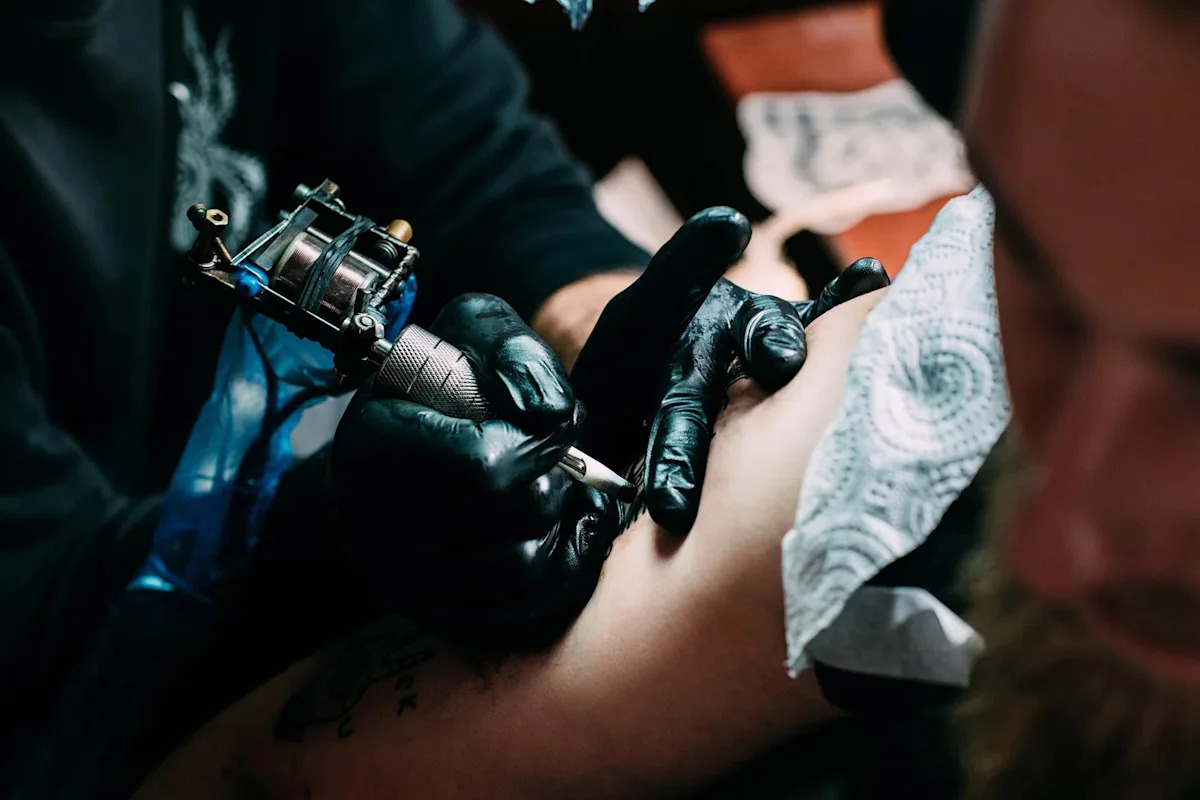
SINGAPORE – Veterinary technician Annie, in her 30s, got her first tattoo about seven years ago.
Having discovered this new form of expression, she progressively got more over the next two years, “on my thighs and chest”, she said.
Then in 2022, three years after her first tattoo was inked, she developed redness, pain and blurry vision in her right eye, then subsequently in her left eye.
A general practitioner (GP) she consulted prescribed her eyedrops, said Annie, who declined to give her full name or show her tattoos.
“I was on the eyedrops for a really long time before the symptoms went away. They returned a year later. I went back to the GP, but my eye didn’t get better,” she told The Straits Times.
Seeking a second opinion, Annie went to a polyclinic and was referred in 2023 to Dr Dawn Lim, who heads Ocular Immunology at the National University Hospital (NUH).
After Annie underwent a comprehensive series of eye checks and blood tests, Dr Lim diagnosed her with tattoo-associated uveitis (TAU), a rare but emerging eye inflammation linked to a delayed immune reaction against tattoo ink.
Caused by an immune reaction to tattoo pigments, the condition poses a high risk of causing permanent damage to vision.
The condition was recently highlighted by a 2025/2026 Australian study of 40 patients, published in Clinical and Experimental Ophthalmology, an official Royal Australian and New Zealand College of Ophthalmologists peer-reviewed journal.
The research found that this condition causes chronic inflammation, often linked to black ink and large tattoos, which can appear years after the tattoo is done. It also said with one in three Australians tattooed, cases are increasing in the country.
“Research has shown that black ink tattoos, especially if they span large areas of the skin and were placed over a relatively short period of time, are often implicated in tattoo-associated uveitis,” said Dr Lim, who is also an assistant professor with the Department of Ophthalmology at the Yong Loo Lin School of Medicine in the National University of Singapore. She has dual sub-speciality practices in the fields of uveitis and glaucoma.
According to Dr Lim, a case series published in the American Journal of Ophthalmology by a team from the Wilmer Eye Institute, Johns Hopkins University School of Medicine, showed that black tattoo ink is commonly made from soot.
And, research has shown that tiny particles in the ink, known as carbon black nanoparticles, can provoke immune reactions and cause cellular stress when the body is exposed to them over long periods.
NUH sees an average of one to three cases of TAU a year.
Unfortunately, there is no single definitive test to confirm TAU and the clinical diagnosis “requires a high index of suspicion”, Dr Lim said.
It is diagnosed by recognising a characteristic pattern of eye inflammation in temporal and clinical association with tattoo reactions, while excluding other causes of uveitis, the inflammation of the middle layer of tissue in the eye.
According to the American Journal of Ophthalmology, patients presenting with this condition tend to be younger, in their 20s to 30s, said Dr Lim.
She said: “For most people, tattoos remain immunologically silent after healing. However, in a small, genetically predisposed group of individuals, the immune system responds abnormally to certain environmental triggers, causing tattoo-associated inflammation.”
The immune system is the body’s “army”, designed to attack foreign invaders and when the threat is gone, it automatically “switches off”, explained Associate Professor Manjari Lahiri, a senior consultant with the Division of Rheumatology and Allergy at the Department of Medicine of NUH.
“However, in some genetically predisposed people, it can either be triggered abnormally from environmental or ‘self’ triggers; or remain persistently triggered without the ‘off switch’,” she said.
“In these patients, components of tattoo ink appear to act as persistent triggers of the immune system rather than inert pigments. Instead of being ignored by the immune system, the ink provoke an exaggerated immune response, leading to the release of certain chemicals called cytokines and formation of granulomas, which are areas of chronic inflammation in the body,” Prof Lahiri added.
“While the mechanisms that lead to ocular inflammation are poorly understood, studies have shared that once an immune response is systemically activated, inflammatory cells can localise to immune sensitive tissues in the eye. Tattoos may trigger the immune response where the eyes can potentially be involved,” Dr Lim said.
“The immune system may also start attacking other organs besides the eye, such as the lungs, heart, joints and skin in these patients,” added Dr Julian Lim, an associate consultant with the Division of Rheumatology and Allergy of the Department of Medicine at NUH.
In a study evaluating seven patients with tattoo-associated uveitis, none of them experienced abnormal skin reactions immediately after getting their tattoos – their symptoms developed only at least six months afterwards.
“This delayed onset suggests that tattoo-associated uveitis is not an immediate allergic or toxic reaction. Chronic long-term exposure to tattoo ink, especially when large amounts are introduced over a short period, in the form of new multiple tattoos, may eventually overwhelm immune tolerance and trigger the disease only after a critical threshold is reached,” Dr Dawn Lim said.
She added that while there have been cases where patients experienced an improvement in their symptoms following the removal of the tattoo, “it is not definitive whether (the) tattoo excision had a role in the resolution of the condition or simply coincided with spontaneous remission”.
“Once a systemic immune response is established, eliminating the original skin trigger may not fully extinguish the disease process,” she said.
Explaining it further, Prof Lahiri said: “Lymph nodes are the ‘catchment area’ of waste products, collected by the draining lymphatic system. Ink particles have been found in biopsies of lymph nodes. It is speculated that they may travel on from there, months or years later, to affect various parts of the body.”
For Annie, who has large swathes of black and colourful tattoos across her chest and on her thighs, receiving the diagnosis and appropriate treatment brought much relief.
“Dr (Dawn) Lim started me on a regimen of high-dose oral steroids and eyedrops. This dosage was tapered down gradually and carefully over time,” she said.
Today, Annie takes an extremely low-dose of oral steroids twice a week and administers subcutaneous adalimumab biosimilar injections through her abdomen twice a month to keep her chronic autoimmune condition under control.
She has follow-up appointments with Dr Lim and her team once every three to six months to monitor her condition, and is also seen in a multidisciplinary collaborative clinic co-run by Prof Lahiri and Dr Julian Lim.
Despite experiencing prolonged vision symptoms, Annie said she is glad that the impact on her work with animals has been minimal.
“I am relieved that things are under control now, but also hope that I will eventually be able to stop my medications altogether,” she said.
Source: The Straits Times © SPH Media Limited. Permission required for reproduction