
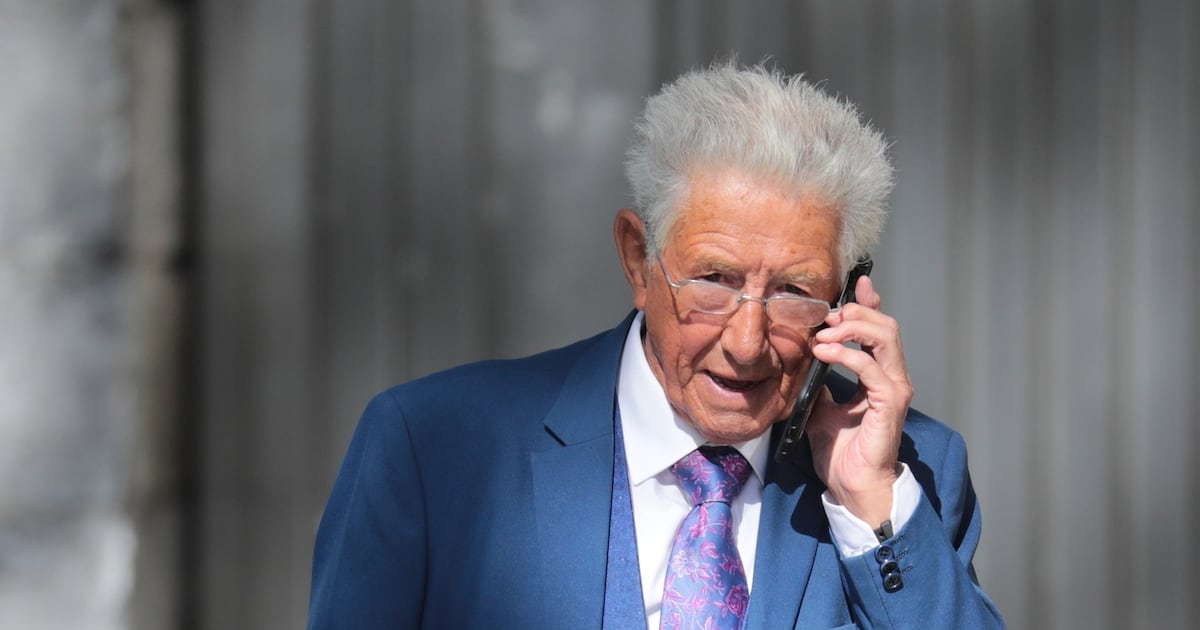
Veteran comedian Sil Fox has failed in a bid to have a jury hear his High Court claim for damages arising from a prosecution on a sexual assault charge which was judged in his favour six years ago.
Fox alleges the decision to prosecute him “destroyed” his reputation and standing, causing him emotional distress.
The performer is suing the Director of Public Prosecutions (DPP), the Commissioner of An Garda Síochána, the Minister for Justice, Ireland and the Attorney General.
Now 94 years old, Sylvester ‘Sil’ Fox, who lives in Templeogue, Dublin 6, claims the “reckless” decision to prosecute him over a sexual assault allegation breached his constitutional rights and his right to a good name. He also claims he suffered breaches of his human rights.
In May 2020, a District Court judge dismissed the charge against Fox due to inconsistencies between the complainant’s evidence and CCTV footage shown during the non-jury trial, clearing him of sexually assaulting the woman at a Dublin bar on December 17th, 2018.
Lawyers for Fox had asked High Court judge Judge Oisín Quinn to use his discretion to direct that a jury be convened for the hearing of Fox’s civil action for damages.
Only certain civil cases have an automatic entitlement to be tried by a jury, sitting with a judge.
While Fox’s lawyers accepted that their client was not entitled to have his case heard by a jury, there was still a discretion to order a jury to be empanelled under exceptional circumstances, it was submitted.
Lawyers for Fox submitted that there were no grounds for the failed criminal prosecution against his client and that the DPP was “guilty of a dereliction of duty”.
[ Racing tipster apologises over false claim his life was threatenedOpens in new window ]
His lawyers said that if the DPP and gardaí had fully examined all evidence available to them, they would have identified “inherent contradictions” in the complainant’s evidence and the case would never have been brought.
As a result of the publicity attached to the case, Fox submitted that the damage to his reputation “was done”, in respect of his career as a “much-loved and well-known” entertainer. His lawyers claim Fox’s popularity significantly “waned” following the case and offers of work radically diminished.
DPP barrister Conor McKenna submitted that the decision to prosecute Fox was made on the “reasonable” basis of the complainant’s witness statement, as well as CCTV footage which he argued was not inconsistent with her claims.
McKenna submitted there were complex matters of law arising in the case that were not suitable for a jury to decide.
Paul O’Higgins, barrister for the State, argued that the prospect of having the case heard by a jury was “legally preposterous”.
In his judgment on Friday, Quinn found the case was not suitable for a jury to hear.
[ Ammi and Martina Burke appeal criminal contempt of court findingOpens in new window ]
“When the relevant factors are considered, cumulatively, they point firmly against the exercise of the discretion sought,” he said.
“I am satisfied that it is not desirable or appropriate to direct these proceedings be set down for hearing before a judge sitting with a jury.”
He said his judgment was not a “rejection” of the proposition that civil juries have traditionally played an important role in the assessment of public reputation, “but rather it reflects the conclusion I have reached about the incompatibility of the legal architecture of this case”.
He said that while court rules provide for discretion for judges to fix a jury trial, it would not be appropriate to direct it in Fox’s case, and he refused the application.
Fox’s case has yet to receive a certificate of trial but will now be heard before a High Court judge only.