
Main pointsMacron: French soldier was killed in Lebanon
A French soldier who was part of international Forces stationed in southern Lebanon was killed, President Emmanuel Macron said on Saturday, adding that evidence suggests Iran-backed armed group Hezbollah was responsible for the attack.
Three other soldiers were wounded and have been evacuated, Macron said in a post on X, urging the Lebanese government to act against the alleged perpetrators.
The soldiers were part of the UN Interim Force in Lebanon (UNIFIL), a peacekeeping mission in the country’s south.
Two Iranian gunboats reportedly fired on tanker in Strait of Hormuz
Two Iranian Revolutionary Guard Corps (IRGC) gunboats have opened fire on a tanker in the Strait of Hormuz, according to the UK’s maritime security monitoring service.
On Saturday morning, the UK Maritime Trade Operations Centre (UKMTO) said the tanker and crew were reported safe.
Its map places the attack off the north-west coast of the United Arab Emirates.
The UKMTO, which provides the primary liaison between military authorities and merchant vessels, said authorities are investigating.
Earlier on Saturday, Iran announced it had re-imposed restrictions on the vital waterway after the US said reopening the strait would not end its blockade of Iran-linked shipping.
The UK warning said: “Master UKMTO has received a report of an incident 20nm (nautical miles) northeast of Oman.
“The Master of a tanker reports being approached by two IRGC gun boats, no VHF challenge, that then fired upon the tanker.
“Tanker and crew are reported safe. Authorities are investigating.” – PA
Iran says no date set for next round of negotiations with US
No date has been set for the next round of negotiations between Iran and the United States, Iran’s deputy foreign minister said on Saturday, adding that a framework of understanding must be agreed first.
The highest-level US-Iran talks since the 1979 Islamic Revolution ended in Islamabad without agreement last weekend.
US president Donald Trump has told Reuters there would probably be more direct talks this weekend, though some diplomats said that was unlikely given the logistics of convening in Islamabad, where the talks are expected to take place.
“We are now focusing on finalising the framework of understanding between two sides. We don’t want to enter into any negotiation or meeting which is doomed to fail and which can be a pretext for another round of escalation,” Saeed Khatibzadeh told reporters on the sidelines of a diplomacy forum in the southern Turkish province of Antalya.
“Until we agree the framework, we cannot set the date… There was significant progress made actually. But then the maximalist approach by the other side, trying to make Iran an exception from international law prevented us to reach an agreement,” he said, referring to US demands over Iran’s nuclear programme.
“I have to be very crystal clear that Iran would not accept to be an exception from the international law. Anything that we are going to be committed will be within the international regulations and international law.”
Asked about reports that Iran again closed the Strait of Hormuz on Saturday after its temporary reopening following a separate US-brokered 10-day ceasefire between Israel and Lebanon on Thursday, Khatibzadeh said Iran had announced it would allow the safe passage of commercial vessels in line with the terms of the truce.
“The other side, the American side, tried to sabotage that by saying that it is open except for Iranians. So that was the reason we said that ‘if you are going to violate the ceasefire terms and conditions, if Americans are not going to honour their words, there will be repercussions for them’,” he said. – Reuters
Tanker, merchant ships come under fire in Strait of Hormuz
A tanker attempting to cross the Strait of Hormuz has come under fire from two gunboats operated by Iran’s Islamic Revolutionary Guard Corps, the UK Maritime Trade Operations (UKMTO), has reported.
The incident took place 20 miles (32km) north-east of Oman.
No injuries have been reported and the vessels are said to have been unharmed.
Meanwhile, two merchant vessels have said they were hit by gunfire as they attempted to cross the Strait, Reuters is reporting.
Egypt working on peace plan with Pakistan
Egypt is working closely with Pakistan on a framework aimed at securing a lasting peace between the US and Iran, foreign minister Badr Abdelatty said today
He said Egypt, Turkey, Pakistan and Saudi Arabia were co-ordinating a broader regional effort focused on preventing renewed escalation and laying the groundwork for a post-war security arrangement.
He stressed the importance of protecting Gulf states and stabilising energy markets, supply chains and food security.
Israel using security pretext in land grab, says Turkish minister
Turkey’s foreign minister, Hakan Fidan, has told the Antalya Diplomacy Forum that Israel was using security as a pretext to acquire “more land”.
He said Israel was “not after its own security, Israel is after more land”.
He was speaking at the annual conference on international diplomacy in the Turkish resort city of Antalya, AFP reported.
“Security is being used by the Netanyahu government as an excuse to occupy more land,” he added..
“Israel has to know that the only way to live peacefully in the region … is to let the other countries enjoy their own security, and territorial integrity, and freedom, not to use power on those countries.”
Turkey, a Nato member bordering Iran, has positioned itself as a potential key mediator in the Middle East conflict, but its sometimes intense rhetoric against Israel has raised questions over its ability to remain neutral.
Iran closes Straits of Hormuz again, blaming US ‘piracy’
Iran has swiftly reversed course on reopening the Strait of Hormuz, reimposing restrictions on the critical waterway after the US said the reopening would not end its blockade.
Tehran’s joint military command said this morning that its “control of the Strait of Hormuz has returned to its previous state … under strict management and control of the armed forces”.
It warned it would continue to block transit through the strait as long as the US blockade of Iranian ports continued.
The Islamic Revolutionary Guard Corps statement accuses the US of “piracy”, saying that its “so-called blockade” amounts to maritime robbery.
In the statement carried by Iranian media, the Iranian military’s operational command, Khatam Al-Anbiya, described the ongoing US blockade as “piracy”, saying: “For this reason, control of the Strait of Hormuz has reverted to its previous state, and this strategic waterway is under the strict management and control of the armed forces.
“Until the US restores the complete freedom of navigation for vessels from an Iranian origin to a destination, and from a destination back to Iran, the situation in the strait of Hormuz will remain strictly controlled and in its previous state.”
The statement adds to the confusion over the status of the key waterway that carried a fifth of global oil supplies before the war.
Yesterday Iran and Donald Trump announced the strait had reopened to shipping, but the US president said the US blockade “will remain in full force” until Tehran reaches a deal with Washington, including over its nuclear programme.
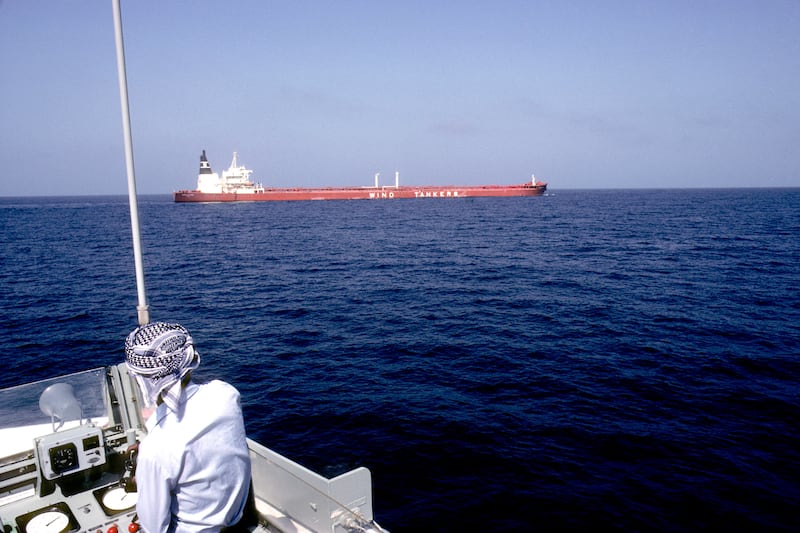 An Omani navy patrol keeps an eye on oil tanker traffic in the Strait of Hormuz. Photograph: Alamy/PA Pakistan envoys continue mediation efforts
The head of Pakistan’s army has finished a three-day trip to Iran.
Asim Munir led a Pakistani delegation to Tehran on Wednesday while working to arrange a second round of US-Iranian ceasefire negotiations after last weekend’s in Islamabad failed to reach a deal.
Meanwhile, the Pakistani prime minister, Shehbaz Sharif, and foreign minister Ishaq Dar also concluded a trip to the Middle East after visiting Saudi Arabia, Qatar and Turkey for talks.
“We have just concluded the last leg of our engagements following productive and fruitful visits … where we held meaningful bilateral discussions aimed at strengthening co-operation across key areas,” Dar said on X.
Fresh waiver issued by US for Russian oil
The Trump administration has issued a waiver permitting countries to buy sanctioned Russian oil and petroleum products.
The move is an extension of an earlier sanctions waiver that expired on April 11th.
Following turmoil in energy markets triggered by the Middle East conflict, the Trump administration has attempted to reduce global oil prices by allowing countries to purchase vast quantities of crude oil that had earlier been prohibited under US restrictions.
In a Telegram post this morning, the Russian presidential special envoy, Kirill Dmitriev, said the waiver “will affect over 100m barrels of oil currently in transit”. That brings the total volume affected by both waivers to 200m barrels, Reuters has reported.
World watches nervously as tankers start crossing key strait
All eyes will be on the Strait of Hormuz today, and there are conflicting reports as to what has been happening there so far this morning.
Reuters is reporting that vessel-tracking data showed a convoy of tankers has departed the Gulf and transiting the Strait of Hormuz.
The group comprised four liquefied petroleum gas carriers and several oil product and chemical tankers, with more tankers following from the Gulf, according to MarineTraffic data.
A separate report from Bloomberg, meanwhile, suggests that several oil tankers have U-turned in the Gulf after appearing to try to transit the Strait of Hormuz, as shipowners and oil traders remain in a state of disarray as they try to figure out whether Iran will stick to its promise to keep the strait open for all.
The halted journeys of five Greek and Indian tankers early Saturday paint the first picture of how traffic is navigating through the energy artery, after Iran’s foreign minister said on Friday that it was completely open.
Iran’s semi-official Fars news agency reported that the passage will still be closed if a US naval blockade was still in effect.
The Greek and Indian tankers had all made their journeys northeast toward Hormuz from waters off Dubai, filled with crude, before they began turning around on Saturday morning.
Some are now idled in locations not far from where they U-turned, next to Iran’s Qeshm island, while a sixth has not sent a geolocation signal for several hours.
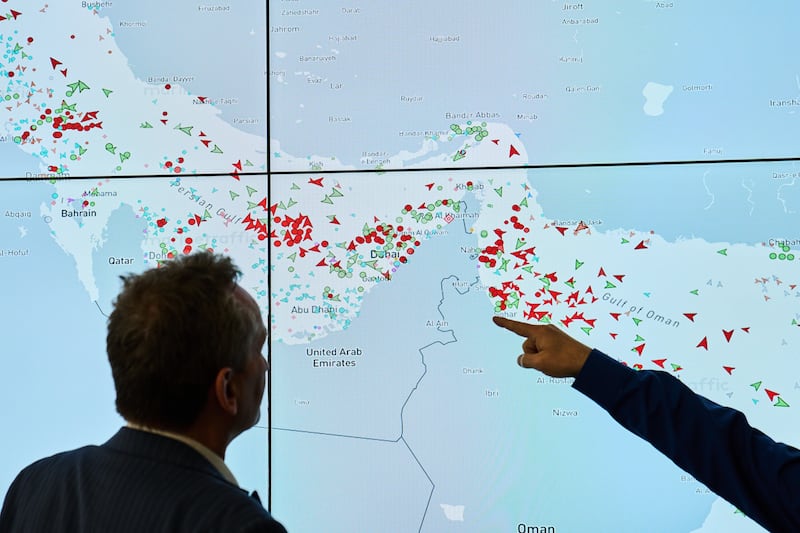 There is confusion over whether the Strait of Hormuz has reopened or not. Photograph: Ebrahim Noroozi/AP