
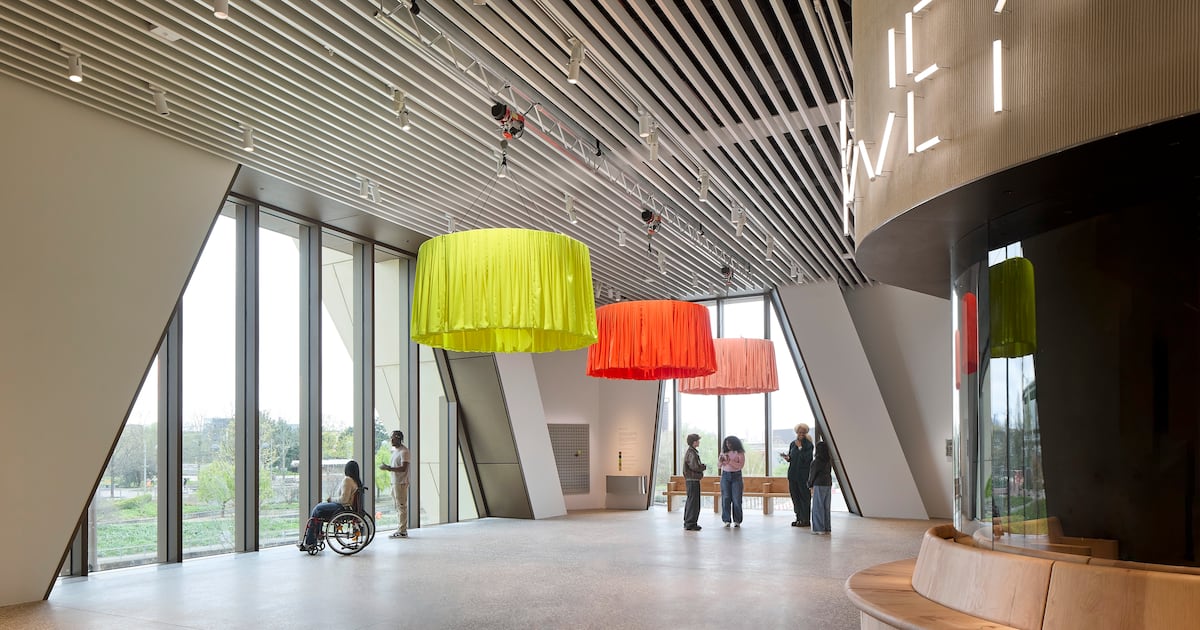
“You can be modern or you can be a museum, but you can’t be both,” Gertrude Stein is said to have remarked a century ago, in the late 1920s.
She was talking about the founding of the Museum of Modern Art in New York, but as the august Victoria and Albert Museum, in London, opens its new, Irish-designed branch in the east of the city, it is an idea that still has weight. What can a museum do in today’s uncertain world, and what should it look like?
The V&A, the world’s largest museum of applied arts, was founded in 1852, beginning life as the “Museum of Manufactures”. Today it celebrates design and making from across the globe, its oldest holding being a Shang-dynasty blade dating to between 1250 BC and 1050 BC. A more recent acquisition is the first video uploaded to YouTube – on December 8th, 2006 – the gently tame “Me at the Zoo”.
At the Victoria and Albert mother ship, across the city in South Kensington, the building, if not the intent of its contemporary curators, leaves you in no doubt about the legacies of empire. It opened during an era of museum creation across Europe that included the Altes Museum in Berlin and the Prado in Madrid; the buildings were temples to both knowledge and power. These now tainted concepts have led to a rethink in the design of museum exhibitions, as well as of museum buildings, and V&A East is no exception.
Back in 2015 the Irish architectural practice O’Donnell+Tuomey had teamed up with Allies & Morrison to win the international design competition that would reimagine the former Olympic Park in east London.
Boris Johnson, the city’s mayor at the time, was calling it Olympicopolis. That name has since been ditched, and the new East Bank quarter includes residential blocks, commerce and a waterfront strip of cultural buildings in which London College of Fashion and BBC Music are book ended by Sadler’s Wells dance theatre and V&A East, both designed by O’Donnell+Tuomey.
Once the development is complete, V&A East will stand at a crossroads in a mile-long stretch running all the way down to Hackney Wick.
The redbrick Sadler’s Wells building is, externally at least, visually more typical of an O’Donnell+Tuomey design, such as the Lyric Theatre in Belfast and the Saw See Hock student centre at the London School of Economics, which has won a slew of awards.
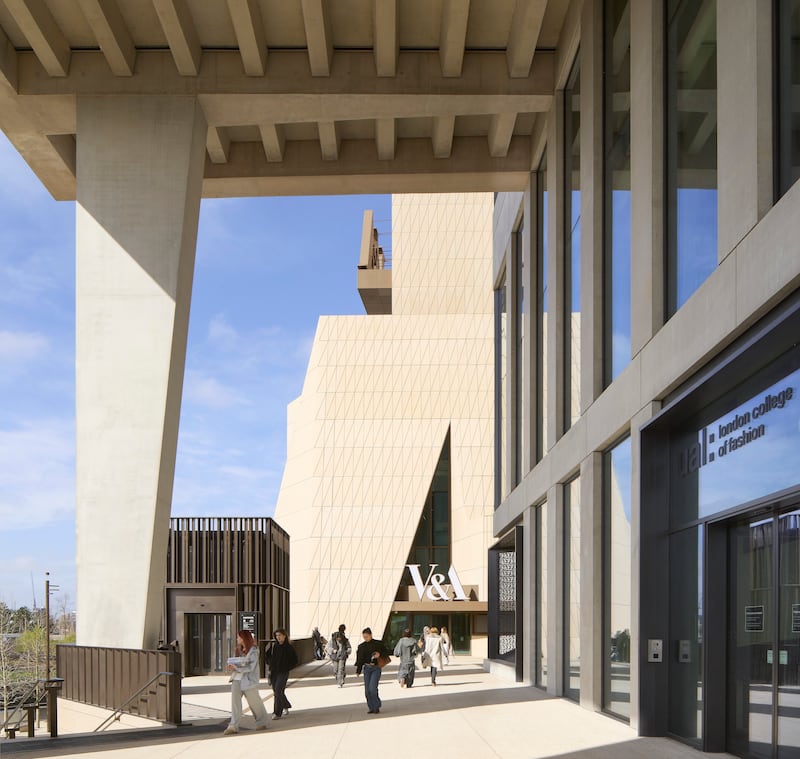 V&A East Museum in London, designed by Irish architects O’Donnell+Tuomey. Photograph: Hufton+Crow
There are echoes of the latter in the new building’s angular facades, although for V&A East the practice was asked for, in the words of Tim Reeve, the deputy director of the Victoria and Albert, “a point of architectural distinction”.
Asking for a bold architectural statement can be a risky business, and London’s skyline is already cluttered with failed experiments – Rafael Viñoly’s “Walkie Talkie” at Fenchurch Street is a case in point.
“I can’t imagine being asked a better question than do something you never did before,” John Tuomey says. “There are two thoughts: one is that the building should be adaptable enough to whatever curatorial programme is in place. And the other is that the building should have a legible identity, to be visible right across the park, from any distance.
“So the thought was, in order to communicate both those driving ideas, you put a jacket on it. Between the jacket and the body of the museum is all the movement space for the people.”
He cites the work of the late Spanish fashion designer Cristóbal Balenciaga in shaping the facade, which is clad with almost 500 sand-coloured precast-concrete panels, each individually shaped and scored with lines to echo the V&A’s logo. They were cut with such precision that there was no building waste, Tuomey says.
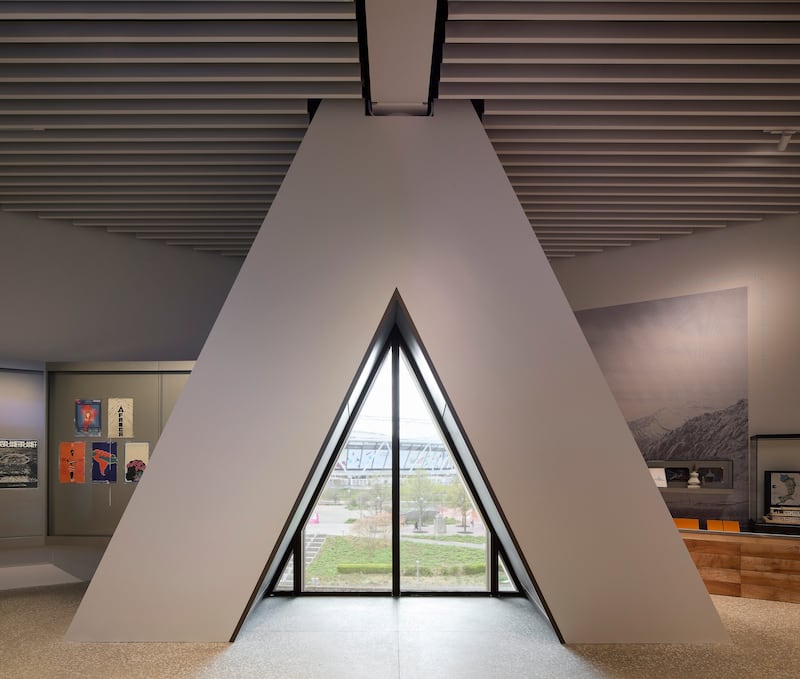 V&A East Museum. Photograph: Hufton+Crow
 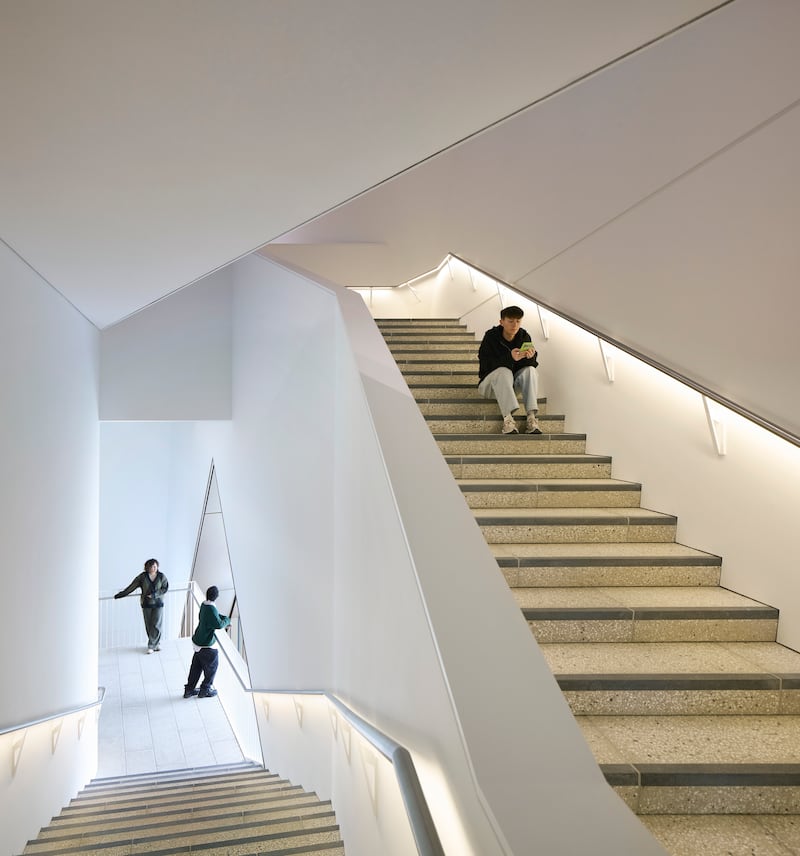 V&A East Museum. Photograph: Hufton+Crow
“My first drawings for this are drawings of Balenciaga costumes,” he continues as we soak up the spring sunshine outside the building. “I think his early costumery was inspired by his altar-boy days: everything drops for the shoulder. It’s very beautiful.”
He also references pattern-cutting darts in the triangular entryways, which makes sense given that we are next door to the college of fashion.
A Place Beyond, Thomas J Price’s huge sculpture of a young girl, stands outside, and even though it has not yet opened to the public, people are sitting on the museum’s ledges.
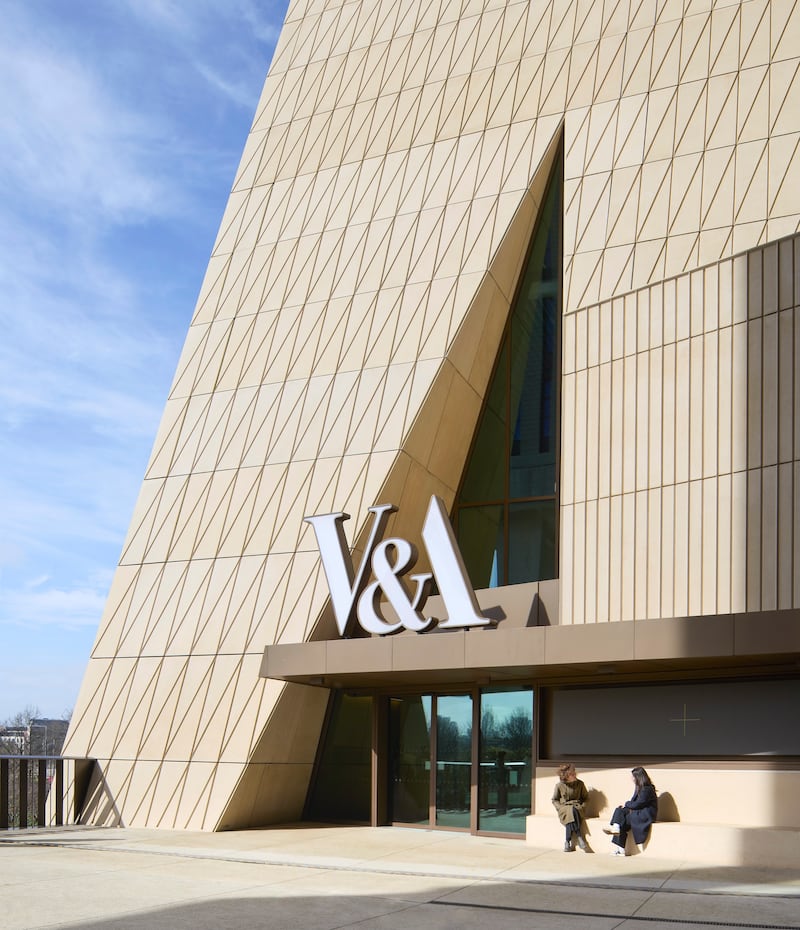 Architects O’Donnell & Tuomey integrated benches into the façade to bring people closer to the building and extend its threshold into the public realm. Photograph: Hufton+Crow
 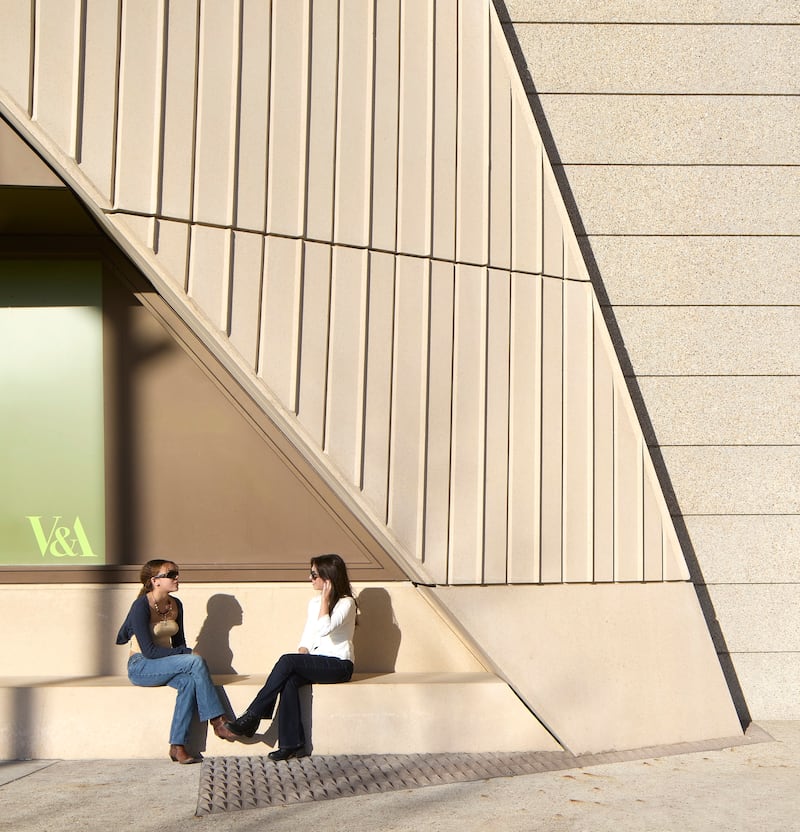 Entrance, V&A East Museum. Photograph: Hufton+Crow
“The foyers of all the buildings are a perfect communal livingroom,” says Tuomey, to whom everything should be an invitation to come in, explore and enjoy.
Inside, there are windows and openings, internal and external, gifting views. He points out a wide platform in a niche. “I was in Wexford, at the Hook lighthouse, and they had sleeping stations for the monks at the half-landings. I thought it would be nice to just stretch out at the window.”
The building wraps around a service core that contains lifts, toilets and the like, leaving large open spaces for the galleries and halls. At a total of 6,420sq m over five public levels, V&A East has two permanent galleries and a 900sq m temporary gallery, plus an event space and terrace, learning rooms and a cafe.
Stairs that echo the upper flights at O’Donnell+Tuomey’s Glucksman gallery, at University College Cork, invite you to follow on up. The attention to detail is phenomenal: Tuomey points out how the floor tiles have been laid so that lines guide you forward.
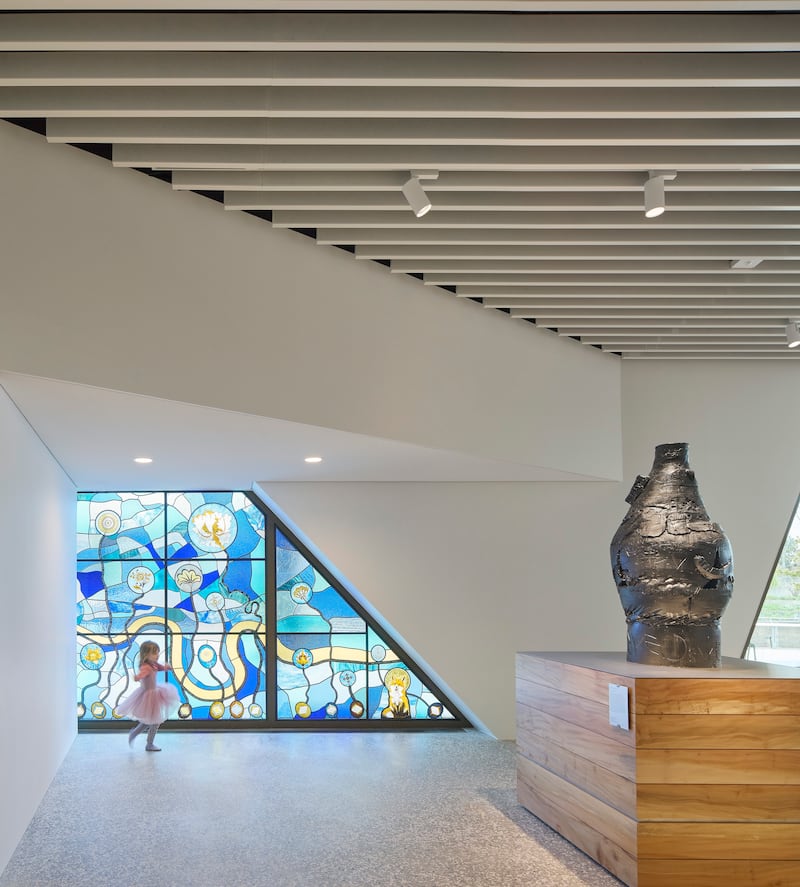 V&A East Museum. Photograph: Hufton+Crow
 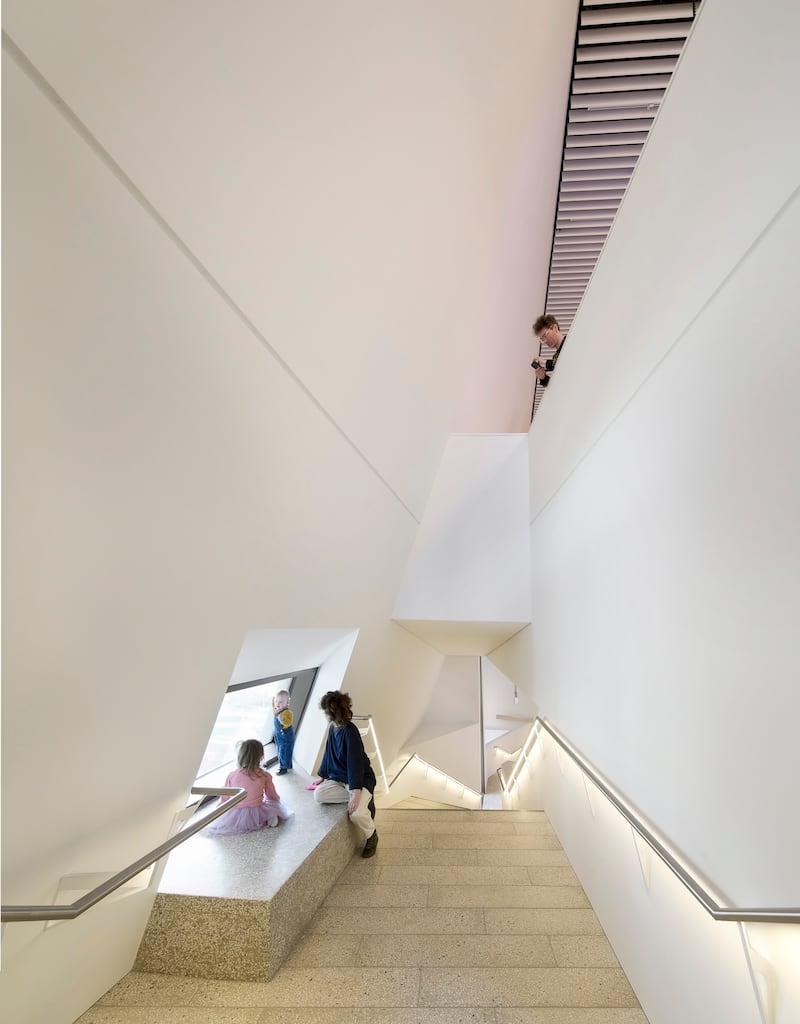 V&A East Museum. Photograph: Hufton+Crow
The permanent Why We Make galleries have been exhibition-designed by JA Projects, with evolving presentations exploring global culture through the lens of self-expression in making, performance, protest and utility; temporary commissions dot the circulation areas.
The building has no reception desk and as few internal doors as possible. For someone raised on exhibitions that shape a narrative of cause and effect, even if that narrative happens to be false, the initial effect is diffuse. I am expecting to be told things, but I am being asked to look and think. Give it time: it works.
[ Dublin’s Stephen’s Green is getting a bold new look. But not a great oneOpens in new window ]
Upstairs, an admission charge applies for The Music Is Black, which runs until the end of the year. Here, windows have been covered to create an immersive space for icons of black British music to shine.
“We’re trying to avoid conventional windows,” Tuomey says. “These are like eyelids that open.”
Architects of galleries love windows; exhibition designers tend to need to get rid of them.
Tuomey speaks about the building as if it were alive – and, oddly, it does appear to be. Not as in a floating couture gown, but perhaps as a skittering crab or, in a gentle way, Thing from The Addams Family.
A building with as much personality as this will surely attract a nickname. Whatever it ends up being called, the moniker seems bound to be bestowed with love and pride.
A short walk from V&A East is the extraordinary V&A East Storehouse. Designed by the US firm Diller Scofidio + Renfro (of New York High Line fame), it takes the growing museum trend of “visible storage” to what may well be its ultimate conclusion.
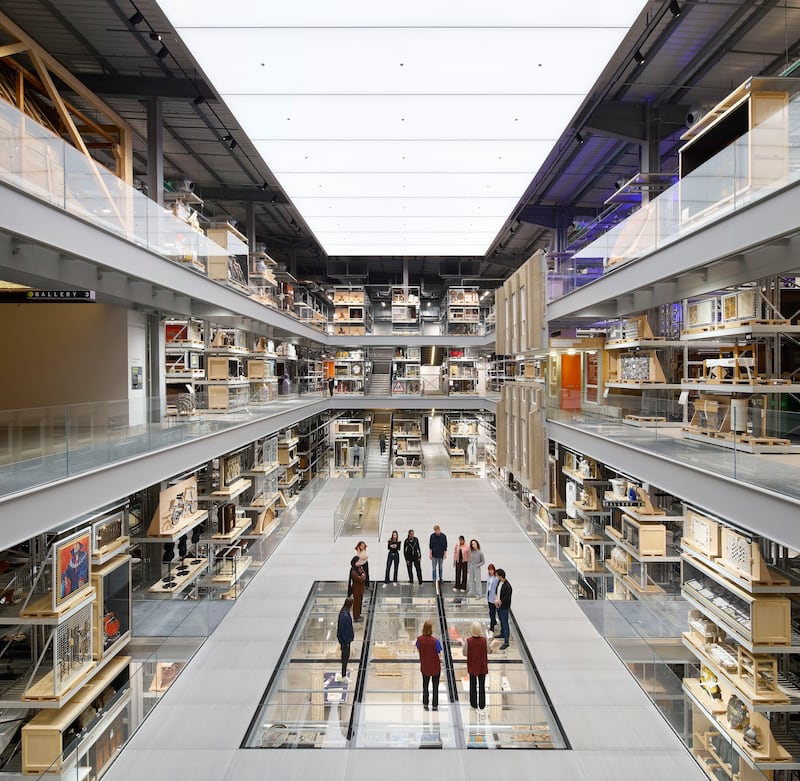 V&A East Storehouse. designed by Diller Scofidio + Renfro. Photograph: Hufton+Crow
Members of the public, curators, scholars and experts alike are invited to wander the levels and catwalks of this purpose-built storage facility, and with more than 2.8 million objects in the V&A collection it’s quite the experience.
What’s more, you can order up to five objects from the collection to view, up close and personal. Anyone can do it, and it doesn’t cost a penny.
Walk in past an open crate containing a trio of bronze busts from the 16th century, cross the metal-grid flooring and out on to a glass floor, through which you can see a colonnade built at the behest of Shah Jahan, the Taj Mahal creator, in the 1630s.
Throughout the Storehouse (which is also a permanent home for the V&A’s David Bowie archive), mini-collections have been put together by staff members, local groups, artists and activists, showing how porous objects of art and design are to story. A display on “decolonising museum practices” sits beside another on “protecting objects at risk”, pillars of the opposing arguments in restitution today.
The stories are frequently both troubled and troubling. The V&A now has a webpage dedicated to exploring the origins of its objects, including items on “glass beads and the transatlantic slave trade” and on the gold looted from the Asante people of what is now Ghana, in 1874.
The UK’s National Heritage Act of 1983 prevents museum artefacts being deaccessioned unless they meet certain criteria, none of which yet includes dubious provenance.
Still, it was people who made these objects, and people who loved them, protected or looted them (sometimes all three). It is what people do next that will shape the next chapter in their – and our – futures, and surely opening them up to full public scrutiny is, at least, a step in the right direction.
V&A East opens on Saturday, April 18th; general admission is free. You can order objects online to view at V&A East Storehouse. The second volume of John Tuomey’s series of memoirs, Middle Quarter, is published by the Lilliput Press on April 30th