

Does Co Monaghan need a private airport? Businessman John Lennon hopes so and applied last month for retention permission for a 600m “grass runway”, a 250m “taxi/stopway” and for the provision of a 280sq m “hanger building” at Kednagullion near Castleblayney.
A planning report written on his behalf estimates “60 movements” per month (a daily departure and arrival) involving a Piper PA-28-236 Dakota or similar aircraft. It says these would be restricted to daytime hours, there would be no flying in “adverse weather conditions” and “no commercial operations” are planned.
“The applicant will continue to use the field for agricultural purposes save for during take-off and landing,” the report notes.
Monaghan County Council received several objections to the application from locals, visitors to the area and an environmental group. Their concerns relate to privacy, tranquillity loss, “the risk of accidents or emergency landings”, the potential spooking of wildlife, and “luminous orange windsocks” being an eyesore.
“The constant noise pollution would make everyday life stressful and uncomfortable, affecting sleep, concentration, and overall wellbeing,” argued Tom McArdle of nearby Tullynahinera.
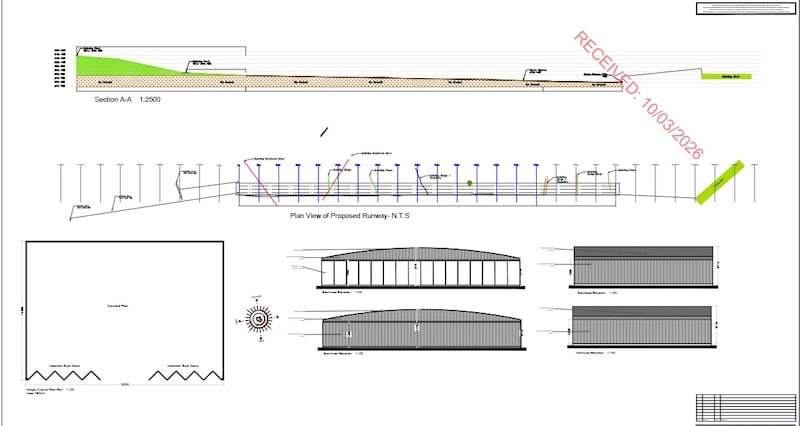 Drawings of a runway and hanger included with the planning application by John Lennon for a private aerodrome near Castleblayney, Co Monaghan
Tony Lowes, of Friends of the Irish Environment, argued that granting permission would facilitate a “carbon‑intensive form of transport” at a time of climate emergency.
“The fact that the aviation use proposed is private and discretionary does not operate as a mitigating factor; rather, it places the proposed development at the most emissions‑intensive end of the transport spectrum,” he wrote.
The council’s decision is due next month.
St Thérèse of Lisieux devotees lose out due to fuel protests
The loudest groans during Tuesday’s Dáil confidence motion arguably came while Tánaiste Simon Harris listed cases of disruption related to the fuel protests.
The transcript records about 20 cases of “interruptions” from TDs during a speech in which Harris said chemotherapy, maternity and dialysis appointments were missed as a result.
He did not mention the disappointment of devotees to St Thérèse of Lisieux, who were due at Whitefriar Street Church in Dublin last weekend to mark the 25th anniversary of a visit of her remains to Ireland.
 Pope Francis prays beside the relics of St Thérese of Lisieux at St Peter’s Square in June 2023. Photograph: Andreas Solaro/AFP/Getty
“In light of the current national situation, the organiser of the 25th anniversary celebrations regretfully must postpone this event until further notice,” an email from the church stated.
St Thérèse died of tuberculosis in 1897 when aged just 24. In 1907, Pope Pius X described her as “the greatest saint of our time”. She was beatified in 1923 and canonised in 1925. Her rapid rise is largely attributed to her only book, The Story of a Soul, which taught that holiness is for all and lived through the ups and downs of life rather than by extraordinary methods.
 A blockade by fuel protesters on the N4 at Lucan last weekend. Photograph: Colin Keegan/Collins
Back in 2009, St Thérèse prompted debate on the letters page of The Irish Times, with Belfast-based John Hunter saying the bearing of her reliquary by Defence Forces members was “an embarrassingly sectarian confusion of Church and State”.
In response, Michael Walsh from Dublin 5 said the relics were “well worthy of an Army escort” given St Thérèse’s writing “influenced the world”.
“Many lesser lights in the field of global influence have received Army escorts down the years, so let us try to rise above petty complaints on this issue.” Touché.
A sad case plays out before the Residential Tenancies Board
Most reports on Residential Tenancies Board (RTB) hearings involve mean landlords, bad tenants or some kind of wrongdoing.
A recently published decision in an overholding case involving a Co Kerry property shows two parties who tried and failed to work things out to mutual benefit. Overholding is when a tenant stays on in rented accommodation after the termination date on the tenancy.
The RTB’s report notes that the landlord moved to the UK and was unable to sell what was his family home due to negative equity, which is where the property is worth less than the mortgage debt owing on it. In 2012, he rented it to the respondents, a couple, who were made aware of his financial situation.
 Rents have risen by 8.2% over the past year, according to the latest Residential Tenancies Board data
The landlord later gave the tenants a chance to purchase the dwelling at “below market price” due to his desire “to get out of debt personally”. His financial situation had become worse and something was needed “to rectify the position”.
He spent almost a year trying to facilitate a purchase by the tenants. They were unable to get a big enough mortgage and were knocked back in a tenant-in-situ scheme application, a decision later upheld after an appeal to the Ombudsman.
Their income exceeded the local authority housing limit and they were searching for a lower-priced house to buy, but saving for a deposit as rents increased caused them “difficulties”.
A notice of termination, delivered in January 2024, asked that they depart by that September. The landlord extended the notice period and waited until the following April to bring an application to the RTB about overholding.
“He stated that he had a good relationship with the respondent tenants but that he was also in a bad position and had a family he was responsible for,” the report notes.
“The respondent tenant accepted that everything the applicant landlord had said was true.”
The tribunal found the landlord was “entitled to enforcement” of the valid termination notice. Given the length the tenants had overheld for, it could allow no more than 56 days for them to vacate.
Irish software could be a perfect match for commissioner McGrath
In most cases, a lobbyist or business representative does the chasing when it comes to meeting a senior politician. But sometimes the hunter becomes the hunted.
Emails released by the European Commission show EU justice commissioner Michael McGrath seeking an audience with Irish businesswoman Rena Maycock.
 EU Commissioner for Democracy, Justice, the Rule of Law and Consumer Protection Michael McGrath. Photograph: Thierry Monasse/Getty
Along with her husband Feargal Harrington, Maycock owns Intro Matchmaking, a dating agency offering a “stress free alternative to online dating websites”, and is rolling out an alcoholic kombucha drink, Kombeara, brewed in McGrath’s native Co Cork.
[ McGrath wades into politically fraught tax watersOpens in new window ]
But the commissioner wanted to meet the entrepreneur about another of her ventures, Chirp, a software that monitors a child’s phone for offensive and harmful content, after being informed it aims “to be the global machine standard parental control on all devices”.
McGrath told Maycock that former EU commissioner Phil Hogan, who runs a political consultancy business, had “passed on your email” and he would be “delighted” to meet to discuss the software. Maycock replied saying she would be happy to.
However, one of McGrath’s advisers flagged that Chirp was not registered on the EU’s transparency register and asked Maycock if it would be possible to “initiate that process” and get back to them. Chirp signed up to the register soon afterwards.
 Chirp founder Rena Maycock
McGrath and Maycock finally met on January 12th. She demonstrated the company’s child protection software and the commissioner outlined ongoing EU work to protect minors online. A match made in heaven.
The former Fianna Fáil minister plans to propose legislation later this year, the Digital Fairness Act, to regulate the addictive designs of social media platforms better.