
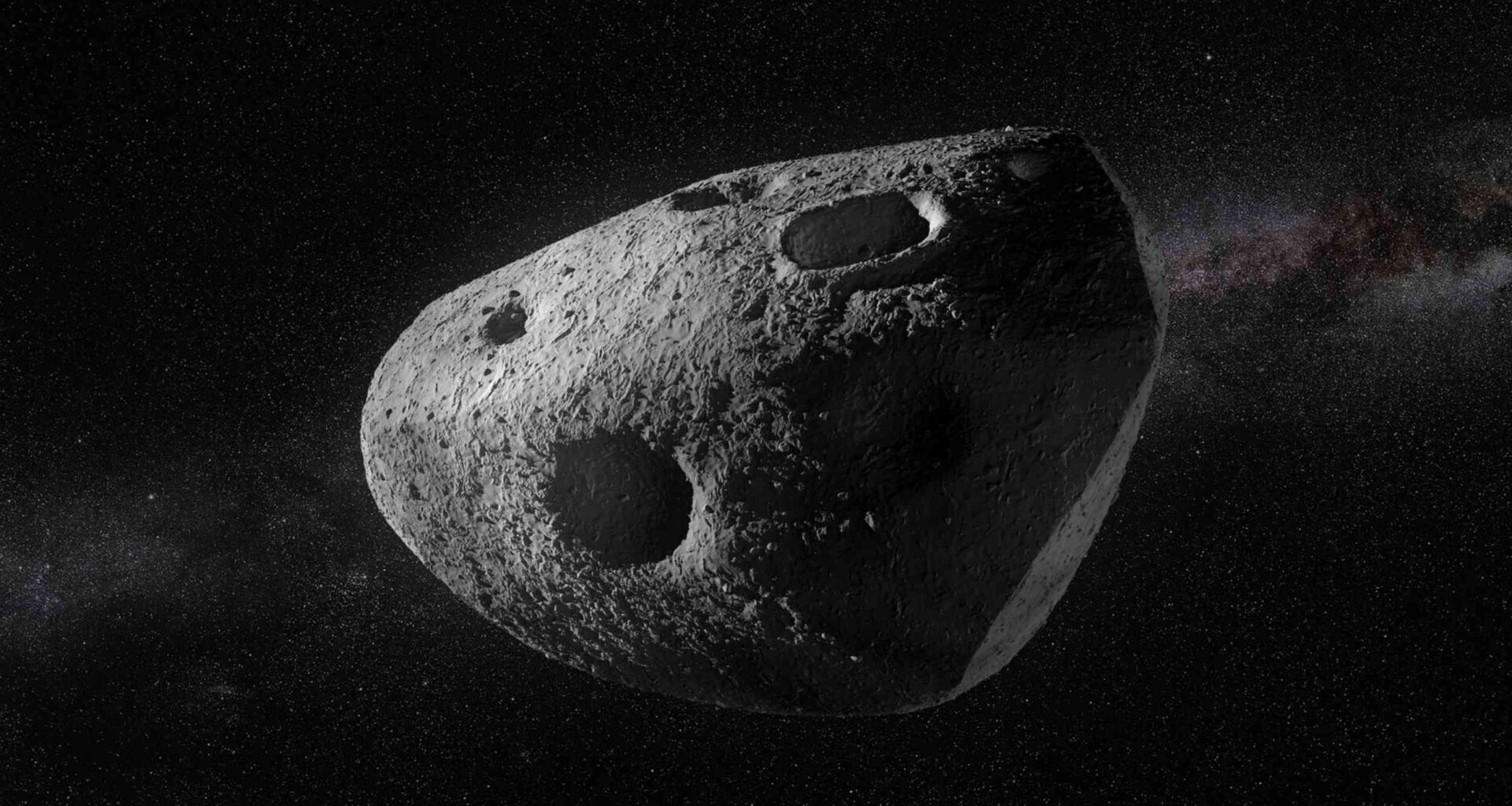
Researchers have found that Earth’s gravity will actively reshape the asteroid Apophis during its 2029 flyby, altering its spin and disturbing its surface in measurable ways.
That close pass turns a once-feared object into a rare chance to watch an asteroid physically change as it moves through a powerful gravitational field.
A rare encounter with Earth

On April 13, 2029, the 1,230-foot asteroid called Apophis will pass within about 20,000 miles of Earth, entering a zone where our planet’s gravity can directly distort its structure.
Tracking that passage, the European Space Agency, (ESA) has shown that Earth’s pull will unevenly stretch the asteroid, producing forces strong enough to affect its motion and surface.
As the near side experiences a stronger tug than the far side, that imbalance is expected to shift its rotation and trigger movement across loosely bound material.
Those changes will unfold over a brief window. At the closest approach, scientists must capture them in real time before the asteroid moves beyond direct observation.
Early warnings have waned
Back in 2004, Apophis, named for an ancient Egyptian god of chaos, became one of astronomy’s most watched objects.
Early calculations pushed its 2029 impact odds to 2.7%, giving it the highest asteroid danger rating ever recorded.
Sunlight also nudged the asteroid through the Yarkovsky effect, a tiny push from uneven heat release, complicating older forecasts.
Radar tracking in 2021 fixed that drift and erased every impact path for at least the next 100 years.
Uneven gravity creates powerful strain
During the flyby, Earth’s gravity will pull harder on Apophis’s near side, creating tidal forces and uneven gravitational stretching.
Such an imbalance can twist the asteroid, change the way it tumbles, and shake loose material on slopes already close to moving.
Models and radar work suggest the strongest disturbances will happen within hours of closest approach, not long before or after.
That window matters because fresh scars, slides, or spin changes could reveal what the asteroid is like underneath.
Landslides reveal new material
One detailed model predicts the close pass will refresh small patches, not strip or rebuild the whole surface.
In that study, researchers found that about 1% of Apophis could be resurfaced roughly 30 minutes before its closest approach.
The likely motion involves regolith, the blanket of loose rock and dust, sliding downslope and exposing cleaner material below.
Even a small patch matters, because spacecraft and ground observers may spot color or texture changes that were previously hidden.
A rewritten orbit
The encounter will also rewrite Apophis’s path around the Sun, stretching its orbital period from eleven months to about 14.
Long before 2029, astronomers used precise predictions for Apophis to show Earth’s gravity would bend the trajectory without sending it back into collision.
After the pass, Apophis will still cross Earth’s orbit, but its timing and geometry will no longer look the same.
That is why scientists will treat the flyby as both an observation target and a test case.
A rare naked-eye opportunity
Across the Eastern Hemisphere, people under clear skies will have the best chance to follow the event.
From parts of Europe, Africa, and Asia, clear dark skies should put Apophis within naked-eye reach, just briefly.
Brightness and timing will vary with location and weather, so some people will have better views than others.
Once Apophis swings too near the Sun in the sky, ground-based optical telescopes will lose sight of the aftermath.
Capturing the asteroid before it’s arrival
ESA’s Ramses aims to reach Apophis before the encounter, while NASA’s OSIRIS-APEX arrives shortly after the closest pass.
Ramses would catch the before-and-after changes, and NASA’s satellite called OSIRIS-APEX could fire thrusters to uncover material just below the surface.
“For the first time ever, nature is bringing one to us and conducting the experiment itself,” said Patrick Michel, director of research at the Observatoire de la Cote d’Azur in Nice, France.
Putting spacecraft there matters because ground telescopes will miss the first hours when fresh movement could be easiest to spot.
Lessons from a safe encounter
The flyby also works as a rehearsal for planetary defense, the effort to find and stop dangerous asteroids before impact.
Teams can practice warning, tracking, international coordination, and mission planning across agencies such as NASA and ESA without an actual emergency.
“All we need to do is watch as Apophis is stretched and squeezed by strong tidal forces that may trigger landslides and other disturbances and reveal new material from beneath the surface,” Michel said.
That lesson has limits, because Apophis is a stony asteroid and future threats may differ in size, makeup, or spin.
Science meets public spectacle
Events like this seem common because space headlines are frequent, but rarely does an object this large passes this close.
ESA estimates a rock this size comes this close to Earth only once every 5,000 to 10,000 years.
For many people, Apophis will be their first close look at an asteroid.
That broad audience is useful, because a safe flyby can show how real asteroid warnings differ from panic often portrayed in films or books.
A milestone for asteroid science
Apophis has gone from being a feared impactor to a highly anticipated scheduled encounter, providing scientists with a bright, well-timed look at asteroid change.
If Ramses, OSIRIS-APEX, and ground observers catch the predicted motion, they will turn one safe pass into sharper future defenses.
This study is published by the European Space Agency.
—–
Like what you read? Subscribe to our newsletter for engaging articles, exclusive content, and the latest updates.
Check us out on EarthSnap, a free app brought to you by Eric Ralls and Earth.com.
—–