
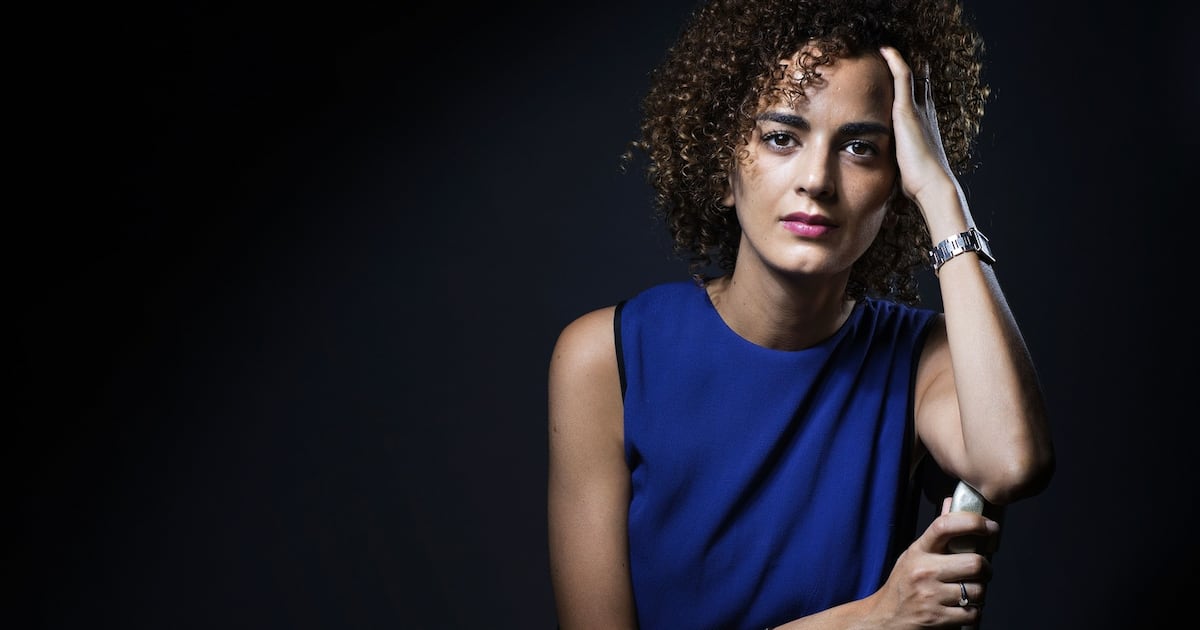
“Success can make you stupid,” the French-Moroccan writer Leïla Slimani says. She is talking on Zoom from her home in Portugal – her English is impeccable – and the subject is the success she had with her controversial early novels. But we’ll come back to those.
The main topic for our conversation is Slimani’s new novel, I’ll Take the Fire. It’s the third book in a trilogy based on the lives of her family. Her family is from Morocco, which was a French colony until 1956, and the books cover not just family history but the changes in Morocco and France over recent decades.
The first two books in the trilogy, The Country of Others (2020) and Watch Us Dance (2022), covered Slimani’s grandparents and her parents’ generations. I’ll Take the Fire brings the story up to date, with characters inspired by Slimani’s mother and the author herself. The title – from a quote by the avant-garde artist Jean Cocteau: “If your house was burning down, what would you take with you?” “I’d take the fire” – reveals a certain headstrong quality, which is backed up by Slimani’s responses in the interview.
I ask Slimani whether it was easier to write about the times she herself lived through, compared to the earlier books, or more difficult?
“It was more difficult, much more difficult. I experienced a very deep depression when I was writing it. When I was writing the first and second one about colonialisation and the Sixties, even though these were things I’d never experienced, I felt a lot of things were very close to me. But when I was writing about the Nineties, that I lived in, I felt, ‘This time is dead’.”
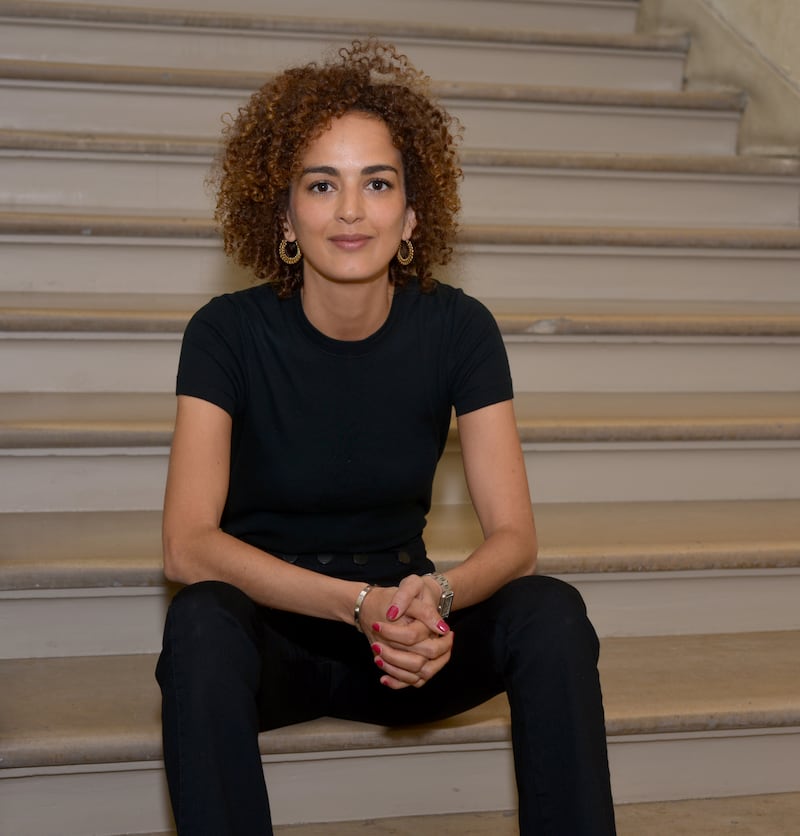 The sense of being torn between two cultures is central to Leïla Slimani’s I’ll Take the Fire. Photograph: Catherine Hélie/Editions Gallimard
Is this a protective mechanism, I wonder, because those times we remember feel much easier in retrospect than the times we now live in? “I think it has to do with the way we used to imagine the future. My grandparents’ generation had a certain way of imagining the future. My own parents were hippies, Marxists. And then my own generation. I think what made me sad is to see how much illusion we had about the future after the fall of the Berlin Wall.
“We believed so much in democracy, in progress. We believed that everything was going to be dealt with by capitalism and liberalism. And maybe we were very, very naive; now we see what is happening.”
There must also be a sense of release or relief when finishing a trilogy, though? “There was a sense of relief but also of pressure because what I wanted to say was quite complex and I wanted to write it with nuance. About identity, about immigration, about the desire to belong, and the fear of betraying the place you came from. And it’s difficult to work with the idea of nuance and to live in a world where everything is so black and white. People push you to choose one side, and the more I was writing about this the more lonely I was feeling. I was also understanding that I will not find a satisfying answer to the question of identity. I will not find a side where I feel good and at peace.”
This sense of being torn between two cultures is central to the book, and to the experience of the character Mia – who seems closest to Slimani herself. Slimani moved from Morocco to France in her young adulthood just as Mia does. Because of Mia’s middle-class upbringing, in the novel she is seen as a bourgeois French woman, but in France she’s seen as an Arab. Is that what it was like for Slimani?
“Yeah and it still is. Very often my identity depends on the way people look at me. Even as a writer when I have interviews they want me to embody a certain role, to be the Arab immigrant who was brave or a victim of her culture. They want me to be a victim saved by the West.
“And on the other side, in Morocco and Arab countries, they consider that I betrayed my identity, that I write for Western people, that I don’t give a good image of my country because I criticise it. So it’s impossible. And it would be a lie to say that it doesn’t hurt me.”
Slimani’s trilogy is different from the earlier books that made her name. Her first book, Adèle, was about a woman’s sexual addiction, and her second, Lullaby, about a nanny who kills the children in her care. They gained her a reputation for bold, shocking fiction. Were they received differently from the later trilogy?
“I think with my first book, there was a surprise that an Arab woman who is a Muslim can write about a character who isn’t a Muslim and doesn’t really care about religion and identity. And as a Muslim, she can write about sex. It was quite funny to witness this because it’s a big misunderstanding of what being an Arab means.”
Those early novels gave Slimani instant success. How did she find that? “It was fabulous. I was very aware of how lucky I was. But an artist should always be very cautious when it comes to success. Success can make you stupid. Success can make you vain. What is dangerous is wanting to capitalise on your success. I’m lucky because I have a husband and children who don’t care about any of this. My daughter is always making fun of me. They keep you down to earth.”
Europe is in decline, and the way people look at it today is not the same as for my generation
One of the things in I’ll Take the Fire that comes across strongly is how Morocco changed with computerisation and satellite television, and the ensuing cultural changes. Does Slimani remember this herself?
“I remember it very vividly. When I was a child, Morocco was like an island. When someone was going to travel [to the West], you would always ask, ‘Can you bring me a pair of jeans, a pair of sneakers?’. But what was nice was, [because it was rarer], when we watched a movie it was an event. We would listen to an album from the first song to the last one. I knew some movies by heart. With my sister, we could watch a movie so much that the tape was completely unusable. My children never do that. They watch one movie and forget about it.”
In the book there’s a sense of division between the French and Moroccans in Morocco – the descendants of the colonialists look down on the Moroccans. Has that changed?
“Yes, I think it has changed. [Before] there was the idea that they were superior to us. And I love it when I see young people in Morocco and they don’t think like that. They’re much more aware that for countries like Morocco, the future is maybe brighter than the future in Europe. Europe is in decline, and the way people look at it today is not the same as for my generation. They feel that Europe is much more Islamophobic and racist. Now when you talk to young people in Morocco they say, ‘Maybe I will go to study in Brazil or China’.”
Near the end of I’ll Take the Fire, Mia’s mother complains about the fact that Mia’s writing a book based on her mother’s life. Does this reflect Slimani’s own mother’s position?
“I think so. I think for her it’s very difficult. She loves me and she wants me to be happy and to write the best book I can write. So I’m pretty sure she feels this, but she’s never told me. It’s weird, but because I have a mother who’s not selfish I can be selfish enough to write about this.” The book includes details, for example, of Slimani’s father and the false accusations of financial wrongdoing which led to him being jailed. “I think one should always believe that at the end the book will be beautiful enough to be accepted by those you betrayed.”
Does your mother read your books? “She does. It’s funny – she’s always the first one to read [them], but then she doesn’t answer for weeks. And we have these weird conversations – ‘How are you?’, ‘What are you doing?’ – and I just want to ask, ‘Have you read the book?’, but I never do.”
Slimani’s father was important too in her love of literature. “He used to give me books when he was unable to answer a question or express a feeling, which I think was very difficult for him. But it also gave me the opportunity to focus on something else. So [reading] is something that helps you fight your own ego and put yourself in the shoes of someone else. I think that’s why populists and dictators hate literature, because it gives you the sense that something else is possible.”
It relates, she says, to “this idea of otherness, that someone who was described to you as an enemy, when you read the book you understand that you are sharing the same feelings, that this person who lives in a country you’ve never been to, you share something with this person. And, of course, someone like [Donald] Trump, he hates that. I don’t think he can even understand it.”
Finally, I ask, given that Slimani has spent much of the last 10 years on this trilogy, is there another book calling her? “So many books,” she says. “And this morning I’m very depressed because I woke up very early and I have five files opened, five possible novels.
“And I don’t know what to do. So I just want to get drunk and forget about those five files, but I feel it’s too early to start drinking.”
I’ll Take the Fire, translated by Sam Taylor, is published on Thursday by Faber & Faber