
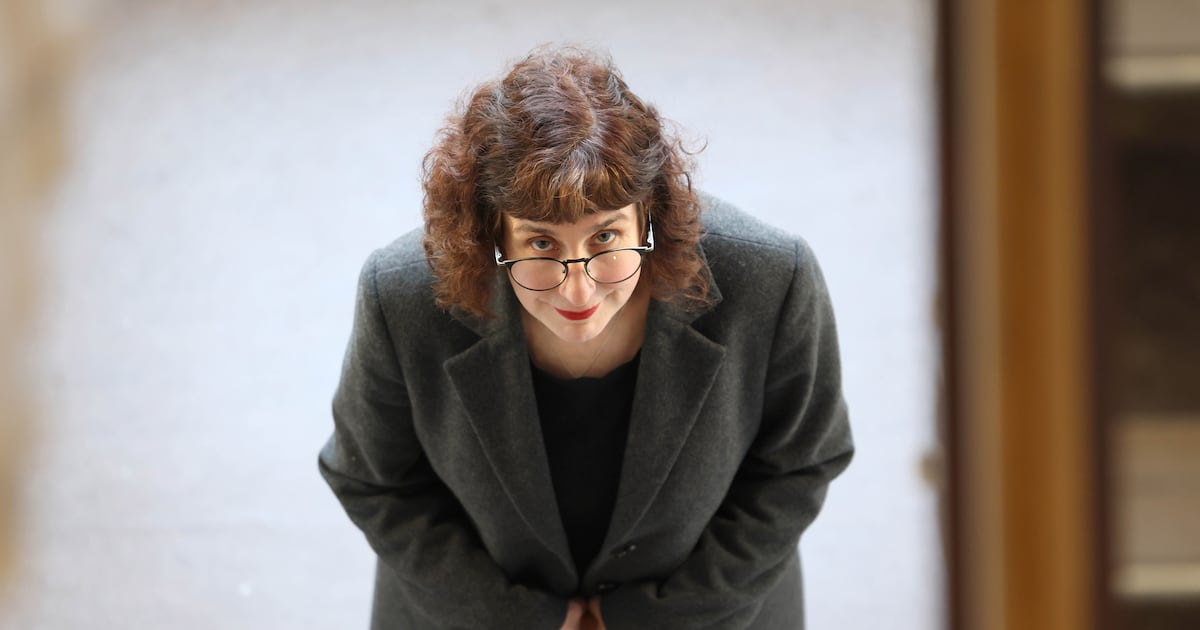
Acclaimed Belfast poet Sinéad Morrissey lived in four different houses growing up in Northern Ireland, but mostly she lived inside an idea.
That idea, propagated by her parents at home and by their tiny community of comrades in smoke-filled meeting rooms of the 1970s and 1980s, was Western Communism. “It was the idea that the value and riches of society should be equally shared, and that people didn’t have to suffer from the systemic inequalities that capitalism produced,” Morrissey says.
The Troubles may have been raging outside the poet’s various front doors, but thanks to her ideologically inclined, gloriously eccentric parents, teenage Morrissey was more preoccupied with the cold war, East Germany and the promised “utopia” of the USSR.
When the Berlin Wall fell in 1989, Morrissey’s family crumbled with it and her compelling memoir, Among Communists, charts these events against the backdrop of the Troubles.
We’re sitting in the Crescent Arts Centre in Belfast as she looks back on her childhood. Morrissey knew, even as a small girl living on what is now the University of Ulster campus at Jordanstown, that other children her age were not living in a family like hers. Her Saturday mornings were spent at Communist Party meetings or protest marches or helping out at party bazaars or listening to rousing talks in those smoky “upper rooms” of Belfast hostelries.
At home, she and her older brother Conor were treated more like “comrades-in-arms” than children, granted independence early and expected to pull their weight washing the dishes for hours after parties thrown by their parents. When their schoolfriends were tucking into meat and two veg, the Morrisseys were eating vegetarian feasts of Hungarian goulash, Japanese vegetable fritters and eggs Florentine and dreaming of a workers’ revolution.
She lived something of a double life? “It was a total double life on so many interesting levels,” she agrees. “There was a double life between the family and the Communist Party and school. I went to state schools that were all Protestant by default and pretty middle class. Everybody voted Unionist and none of the parents of the kids in my school wanted a revolution. So when I went to school it was like swapping universes, you had to code switch.”
The Morrissey family home was a place of radical ideas and raucous laughter. She felt fully “at home” there, but it was far from the ordinary childhood she observed in other people’s houses. “I wanted to be ordinary,” Morrissey says, smiling. Her father Mike, a lecturer, has some of the best lines in the book: “The Revolution nearly happened today, Sinéad, but JP forgot to bring the guns,” she remembers him telling her when she was eight. And: “God doesn’t exist. The Capitalists made God up.”
The family links to communism were strong. Her paternal grandfather, Sean Morrissey, had been interned in Northern Ireland during the second World War as a suspected member of the IRA. He became a communist in prison and was a leading activist in the party, invited twice on speaking tours of the USSR as an “honoured guest” of the Soviet leadership.
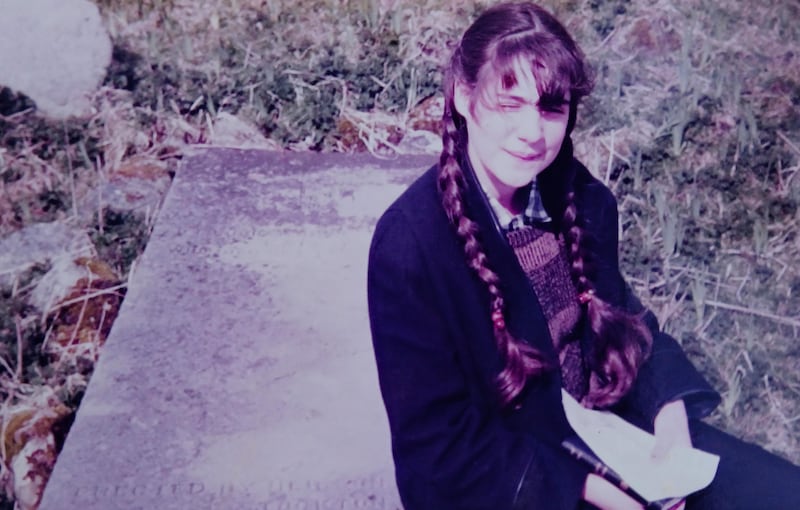 Sinéad Morrissey as a young girl
Morrissey’s father chaired the Connolly Youth Movement and met her mother at a Communist Party meeting in Belfast in 1968. Her mother, Hazel, an English woman, had travelled over on a “Communist holiday” from Sheffield. Morrissey’s girlhood was characterised by “radical political activity, Marxist Lenin philosophy and unquestioning loyalty to the Soviet Union”.
Morrissey, who was named the first poet laureate of Belfast in 2014, has published several collections of award-winning poetry including her first book, There Was Fire in Vancouver, and Parallax, which won the TS Eliot prize. She is now professor of creative writing at Newcastle University.
How did she come to write the memoir? She says a British Council and Northern Ireland Arts Council-funded trip to Moscow was key to the book. While in Moscow, Morrissey retraced her grandparents’ steps through the city, discovering Soviet files held on her family. “That trip was mindblowing, I knew I had to write about it.”
Originally she envisaged a book of essays relating to her grandfather’s tours of the USSR, but when she showed some trusted colleagues the first draft they told her that the parts they cared about involved 16-year-old Morrissey on a Campaign for Nuclear Disarmament protest.
“I got very good advice not to tell it retrospectively but to try as much as possible to inhabit the younger consciousness, so the reader is allowed into something recreated rather than relayed. It became much more personal, and the engine of the book becomes irony because the reader knows what’s going to happen next but I didn’t know, in terms of that total collapse in 1989.”
Though hugely influenced by her parents’ ideas, she oscillated in terms of how much she believed in the communist vision. “Sometimes I was in it and sometimes I was not. Sometimes I thought my parents were crazy and sometimes I thought they were actually right.”
I still think Marx was right about capitalism. I think he was incredibly prescient about how capitalism worked and who its victims were
— Sinéad Morrissey
She has a standout memory, aged 13, of a man from the then Soviet Union talking upstairs at the Duke of York pub in Belfast. “I thought he was very handsome, so hormones had a lot to do with it. He spoke English with a Russian twang, which kind of melted my heart. There was this mystique, he was from another world. He gave this, in retrospect, totally ridiculous speech and in that moment I just thought, ‘This is it, everything my parents have told me is true.’”
The memoir is filled with vivid, often richly comic, detail, enhanced by her poet’s eye. The family acquired things that sounded like the family name. There was a cat called Morrissey and a Morris Minor, which only her mother could drive. And this entertaining coming-of-age story is as much about the origins and evolution of a major poet as it is about her communist childhood. On hearing her dad recite, “Once upon a midnight dreary, while I pondered, weak and weary,” she becomes “electrocuted” and learns Edgar Allen Poe’s The Raven off by heart. It’s “better than Brecht”, she tells us. She was 11 at the time.
At 18, the gifted Morrissey, who studied at Trinity College Dublin, would go on to win the Patrick Kavanagh poetry award. Obsessed with Sylvia Plath from a young age, she answered “poet” when playing a game where each family member had to describe themselves in one word. (Her father, not surprisingly, offered “communist”.)
Her unusual background was difficult to explain to her peers in a place obsessed with identity. Raised as an atheist, she was mistaken as Catholic or Protestant and struggled to explain to classmates that she was “neither”. Class identity was more tangible, her father describing them as “engaged intelligentsia, middle class without means”.
Morrissey says she never felt “anchored” in Northern Ireland, more preoccupied with international affairs than with the politics and strife happening in her home city. She writes in the book that she was “a busy fourteen-year-old with a demanding school life who’d abdicated from the Troubles as effectively as if I’d packed my bag and defected to the USSR”.
“I didn’t feel I could locate myself there very easily. What I knew all about were the concerns of the left, about Greenham Common and the cold war. I knew all about Gorbachev, my absolute hero. I would follow all the press conferences. I was totally invested in the miners’ strike. It was an abdication, in a way, and I think a lot of people abdicated in different ways because that’s the only way you’re going to survive. For me it was a mostly ideological abdication.”
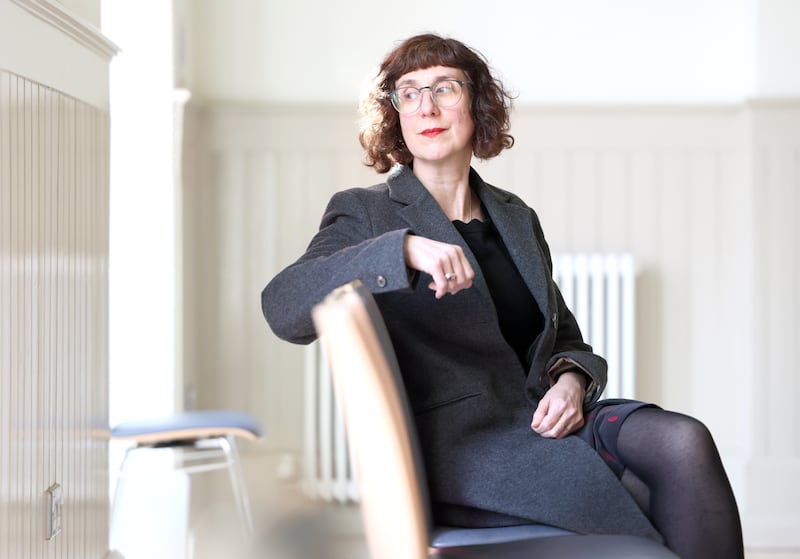 Sinéad Morrissey is grateful for so much that came from her bohemian childhood. ‘On balance, I think I was enriched beyond measure by the very idiosyncratic childhood that I had.’ Photograph: Stephen Davison
There’s a darkly comic moment in the memoir where a soldier knocks on her front door when she is 12 to warn about a suspected explosive device under a neighbour’s car. “But I’m inside reading Rebecca and I don’t believe him so I go back inside the house and continue reading. It’s a drama that has nothing to do with me, I’m off in Manderley.”
The soldier saw her through the window and demanded she vacate the house. While the search continued for the device, Morrissey was outside, more annoyed at having left her book behind in the house than by any impending danger.
The most moving passage describes how the ideological universe in which she was raised falls away with the Berlin Wall. “I’m interested in the connection between sudden endings and the aestheticisation of history. Because once something is finished and sealed, which absolutely for me 1989 did that, then it becomes symbolic or totemic in a way that it never was when it was simply part of the time continuum.”
As the Soviet Union collapsed, so did her parents’ marriage. Disillusioned with the communist dream, her mother drifted towards New Age spirituality. The woman who once painted her daughter tantalising pictures of a utopian East Germany, where all children were treated equally, gradually comes to believe that the Marxist ideal is flawed.
Morrissey remembers her mother describing her own spirit, a part of herself she was discovering through studying yoga, as being “like a candle, a little pilot light hidden in the dark. She said, ‘That’s the part of human beings Marxism ignores and it’s part of me I can’t go on denying any more.’” How did Morrissey feel about this at the time? “It was alarming.” What does she think now? “I think my mother was right.”
Morrissey felt a deep grief at this change in her mother’s beliefs. “What I found really difficult was when it ended. It went on for a bit after 1991, but not much longer. It had been the ideological glue that held the marriage together. When that fell apart and my mum went away and the house was sold … that was so much more difficult for me than when I was in it.”
Her own beliefs have changed too. She is now attracted to “the middle”, which is fascinating given that she was very much brought up on the fringes. “I would probably vote Labour, I might vote Green next, I am hugely passionate about the climate crisis,” she says.
“I still think Marx was right about capitalism. I think he was incredibly prescient about how capitalism worked and who its victims were. But I think the solution was flawed. So I don’t have faith that you just need to give it another go and it will be better.”
She says there is an “ethical dilemma” at the heart of Western Communism. “For all that it might be a really useful and progressive and positive thing in a local context … it was this progressive space on the left where everybody was welcome and that was valuable in Northern Ireland at the time. But however valuable and contextually important it might have been on the ground … you were tied by a kind of ideological umbilical cord to a rotten system.”
Morrissey is grateful for so much that came from her radical and bohemian childhood. “The book is elegiac to a very rich kind of culture. They had wonderful ideas. They valorised culture and reading and poetry and that exposed me to the most fantastic ideas at an early age. On balance, I think I was enriched beyond measure by the very idiosyncratic childhood that I had.”
Written during a time of personal crisis – her marriage broke down in 2021 – the memoir is a valuable and unique addition to Troubles literature. It’s full of Belfast wit and engaging descriptions of ordinary life against a backdrop of local and international struggles.
I tell Morrissey that I think someone like Lisa McGee could create something magical from this book adapting it for television, a sort of cold war-infused Derry Girls. Morrissey laughs when I suggest it, but stranger things have happened.
The poet’s mother and brother were at her launch in the Crescent Arts Centre, sitting front row, watching proudly as she read from the book. The family remain close and connected. Both parents were, she says, “gracious” about her sharing of their story.
Morrissey lives in England now with her two grown-up children. Her latest collection of poetry will deal with her more recent personal struggles and revisit some of the themes in the memoir. “I’ve written again about vanishing acts and sudden endings and art as a kind of act of salvage.”
More than anything the memoir, I suggest, feels like an honouring of her childhood. “Yes, that was my intention. To honour it in all its complexity. Of course nobody’s childhood is perfect but I wanted to honour the brilliant things about it. I would not change anything.”
Among Communists by Sinéad Morrissey is published by Dubray Books