
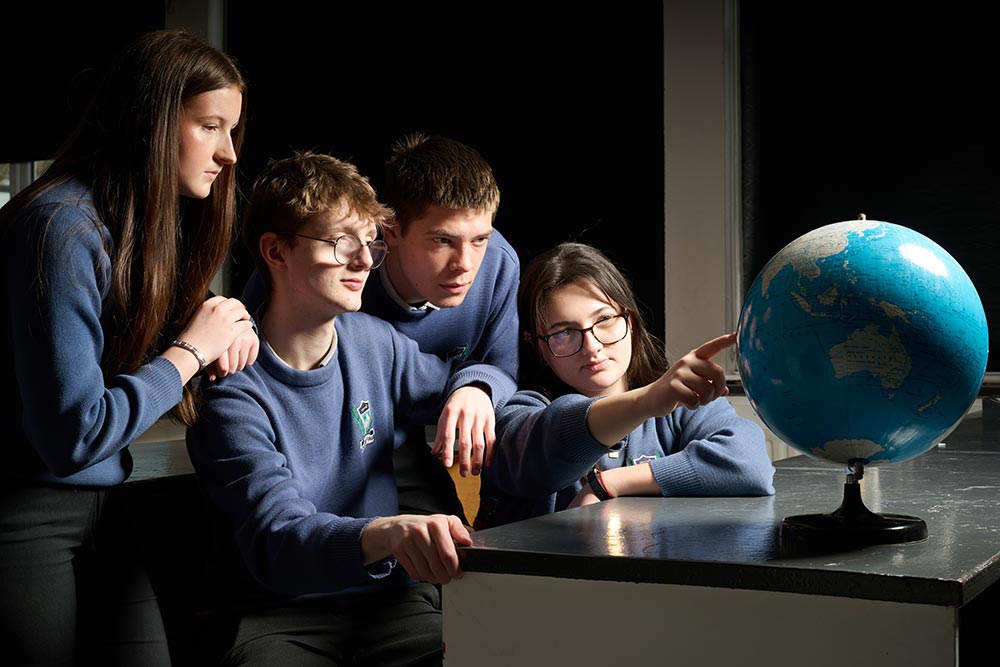
An out of this world design for a human settlement on a moon of Jupiter, including asteroid mining and a space elevator, has resulted in a team of Ennis students achieving international success in a prestigious competition founded by NASA.
The students from St Flannan’s College are now hoping to blast off to the US to present their ideas at the International Space Development Conference, with a fundraising campaign to get them there launching off.
The Ennis team in collaboration with students from St Dominic’s College in Dublin won second prize in the NSS/NASA Ames Gerard K O’Neill Space Settlement Design Contest 2026 for their design.
The St Flannan’s College students are Alyah Maguire, Emma Mahoney, Ben Zarza-De Courcey and Domas Kasparavicius.
Their award-winning project, Fómhar, was recognised in a year when more than 29,000 students submitted over 4,900 entries to the competition from 31 countries worldwide.
The project, named after the Irish word for “harvest” proposed a permanent human space settlement for up to 10,000 people.
They designed a rotating torus-shaped habitat located in the Jupiter-Callisto system.
The project’s major focus is on how future space communities could live safely, generate power, produce food, and build harvest systems civilisation far Earth.
Physics teacher at St Flannan’s College Teresa Considine explains the project proposed the settlement as a one-g (Earth gravity) habitat with residential villages, transport systems, central hubs, agricultural systems, industrial areas, and advanced life-support infrastructure.
The students examined why Jupiter’s moon Callisto could be a practical base for long-term human activity, with its low radiation environment and useful natural resources.
Their design included asteroid mining for construction materials, a space elevator linking Callisto to an orbital industrial station, and even the possible use of helium-3 fusion to provide power for the settlement.
The project also placed emphasis on food production and self-sufficiency, which is reflected in its name. The Fómhar design included controlled-environment agriculture, vertical farming, water recycling, duckweed-based purification systems, oxygen production through plant growth, and the use of biotechnology to help sustain life in deep space.
Ms Considine said, “Their success is a remarkable achievement for the school, for Ennis, and for Clare, particularly given the international standard of the competition. Fómhar is an example of what can be achieved when imagination, scientific knowledge and hard work come together.
“This success is especially significant at a time when global interest in space exploration is rising sharply with the Artemis missions, NASA’s programme to return humans to the Moon and prepare for deeper space exploration.”
The students are now hoping to travel to present their project at the International Space Development Conference (ISDC) 2026 in McLean, Virginia, from June 4 to 7, where the global space community will gather for discussions on spaceflight, space settlement and humanity’s future beyond Earth.
Organised by the National Space Society, the conference brings together astronauts, researchers, engineers, educators and students from around the world.
To make that possible, the students will need to fundraise for travel, accommodation and conference costs.
Anyone who wants to support the fundraising efforts can contact Ms Considine at St Flannan’s College, Ennis, 065 6828019 or [email protected].