

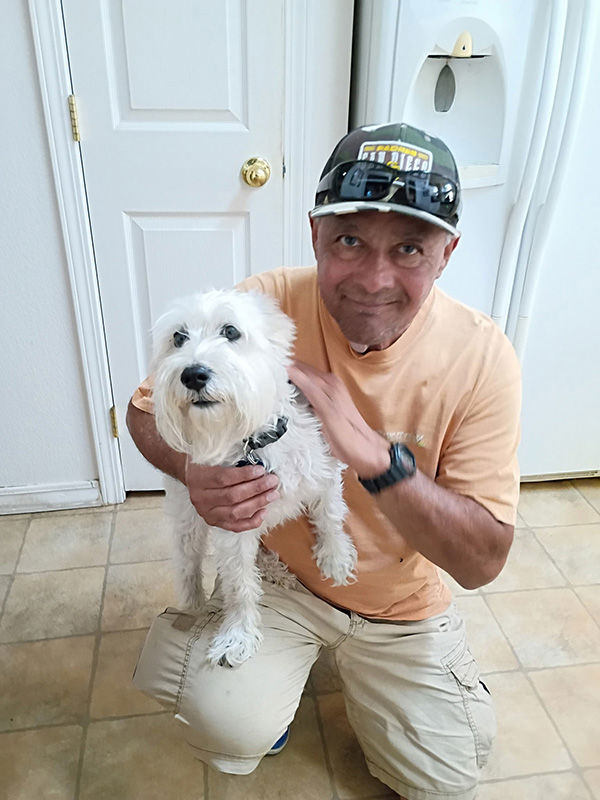
Mark and his dog Sammy. Photo credit: Mark Montoya
For months after his surgery, Montoya relied on a chalkboard to communicate and, later, an electrolarynx — a handheld device that produces a mechanical voice, when pressed against the throat. It was a difficult period in Montoya’s life as he struggled to recover and learn new skills.
Finally, five months after his laryngectomy surgery, Montoya received a tracheoesophageal prosthesis (TEP), a small valve implanted by Guo in the stoma, a permanent opening in his neck, that allowed him to produce his voice by covering the opening and directing air through the esophagus.
His rehabilitation was intensive and ongoing. His speech-language pathology team including Blumenfeld and Kristen Linnemeyer-Risser, worked with him tirelessly — teaching him the mechanics of his device, managing complications, and replacing the prosthesis when needed, typically several times a year.
“My speech therapists worked with me day and night,” Montoya said. “They must have seen something in me and knew I could do it.”
It took nearly a year, but Montoya learned to talk again. He still sometimes reaches for the electrolarynx as a backup when he’s tired. And the stoma remains a visible, permanent reminder of what he’s been through.
The Return of Incurable Disease
As the new year began in 2023, updated imaging delivered the worst news yet. Montoya’s cancer had returned in his lymph nodes — a new tumor in the neck and concern that it had spread to his chest. His cancer was officially considered incurable, meaning no further surgery or radiation would be offered.
“I was really scared then,” Montoya said. “I did a lot of soul searching and had to prepare to meet my maker. The hardest part for me was telling my mom.”
Montoya returned to see Sacco, the medical oncologist who had been by his side through his entire journey, to discuss his options.