
Planets usually start small. Tiny grains of dust and ice bump into each other, stick, and slowly grow. Over time, they build into rocks, then worlds, and sometimes into gas giants like Jupiter. It’s a simple idea, but it gets tricky when the planet in question is huge.
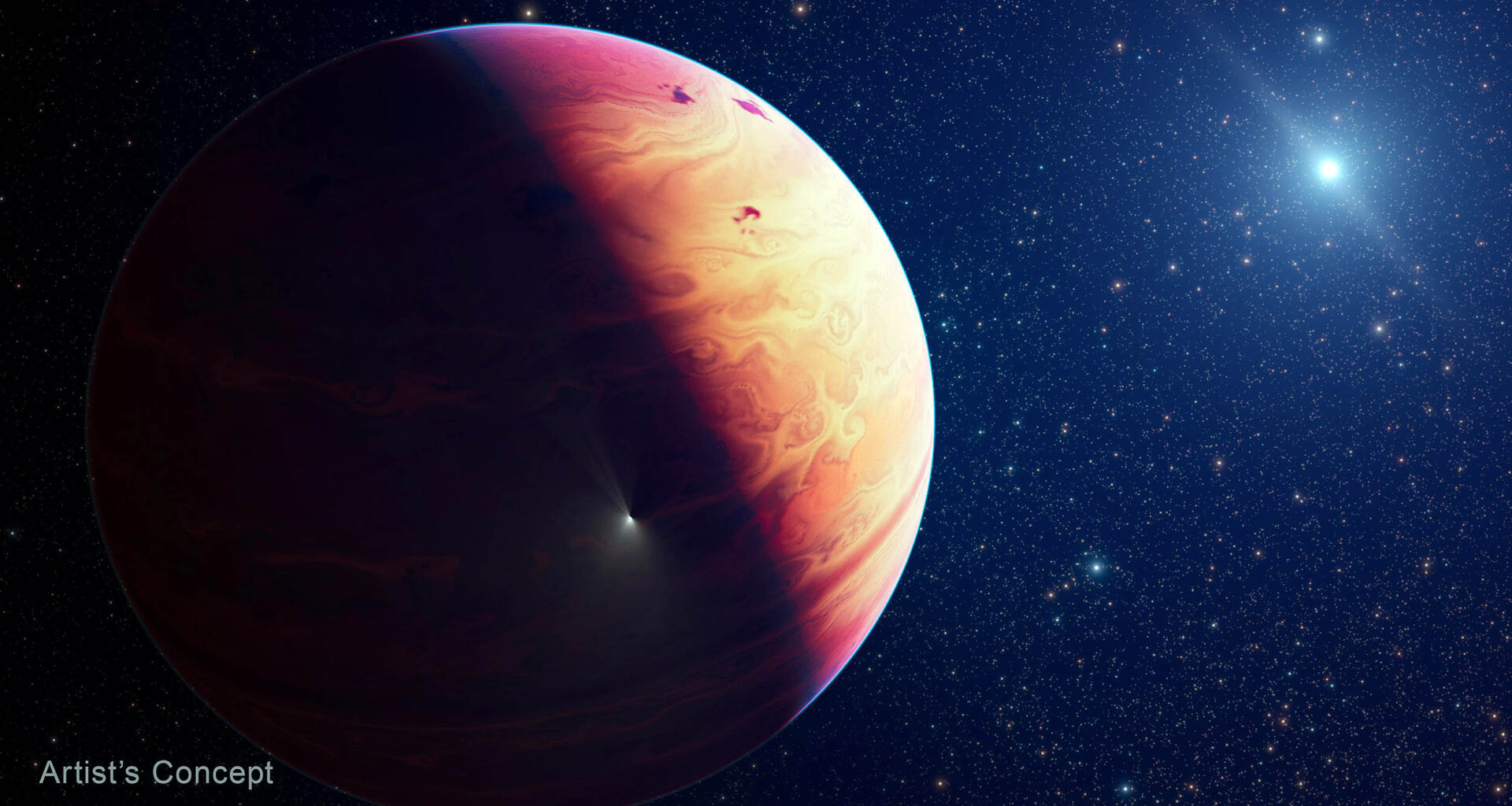
Now astronomers have taken a close look at an object called 29 Cygni b. It’s about 15 times as massive as Jupiter and sits roughly 1.5 billion miles from its star.

That puts it in a strange spot. It’s big enough to raise doubts about how it formed, yet not quite big enough to clearly belong in another category.
How planets like 29 Cygni b form
There are two main ways scientists think objects like this can form. One is the slow, steady buildup inside a disk of gas and dust around a young star.
This process is called accretion. It’s how Earth formed, and how Jupiter likely came together, gathering gas after its core grew large enough.
The other way is faster and more dramatic. A cloud of gas can break apart into chunks, and each chunk collapses under its own gravity. That’s how stars form.
Some scientists think this same kind of breakup could happen in the disks around stars, creating large objects quickly.
Categorizing 29 Cygni b exoplanet
29 Cygni b sits right on the edge between these two ideas. It’s massive, but not quite massive enough to clearly form like a star. It also orbits at a distance where building a planet through slow growth should be difficult.
That’s why a team led by William Balmer studied it using NASA’s James Webb Space Telescope. They wanted to know which story fits better.
Balmer, who works at Johns Hopkins University and the Space Telescope Science Institute, summed up the puzzle clearly: “In computer models, it’s very easy for fragmentation in a disk to run away to much higher masses than 29 Cygni b.”
“This is the lowest mass you could plausibly get. But at the same time, it’s about the highest mass you could get from accretion.”
Reading a planet’s chemical fingerprints
To figure this out, the team used Webb’s near-infrared camera to directly image the planet. They looked at how its atmosphere absorbs light, focusing on gases like carbon dioxide and carbon monoxide.
These gases help reveal how many heavy elements, often called metals in astronomy, are present.
The results told a clear story. The planet contains a large amount of heavy material, roughly equal to about 150 Earths. That kind of enrichment usually points to a planet that formed by gathering solid material first, then pulling in gas later.
This matters because stars don’t typically show that same pattern. They form mostly from gas, without the heavy buildup of solids.
The importance of alignment
The team didn’t stop at chemistry. They also studied how the planet moves. Using a ground-based telescope array called CHARA, they measured the tilt of the planet’s orbit and compared it to the spin of its host star.
They found that the planet’s orbit closely matches the star’s rotation, a pattern often seen in systems that form from a disk.
“We were able to update the planet’s orbit, and also observed the host star to determine its orientation with respect to that orbit,” said Ash Messier, a graduate student at Johns Hopkins and co-author of the study.
“We showed that the inclination of the planet is well-aligned with the spin axis of the star, which is similar to what we see for the planets of our solar system.”
A clear answer, for now
When the chemical clues and orbital data come together, they point in the same direction. 29 Cygni b likely formed through accretion, even though it pushes that process close to its limits.
“Put together, this evidence strongly suggests that 29 Cygni b formed within a protoplanetary disk through rapid accretion of metal-rich material, rather than through gas fragmentation,” said Balmer.
In other words, it formed like a planet and not like a star.
Lessons from 29 Cygni b
This finding fills in an important gap. It shows that even very massive planets can grow through the same bottom-up process that forms smaller worlds. That helps explain how diverse planetary systems can be.
The team is now studying three more objects with similar masses. By comparing them, they hope to see whether smaller and larger giants follow the same rules or start to split into different formation paths.
For now, 29 Cygni b stands as a reminder that nature doesn’t always draw clean lines. Sometimes, the most interesting answers sit right in the middle.
The full study was published in the Astrophysical Journal Letters.
—–
Like what you read? Subscribe to our newsletter for engaging articles, exclusive content, and the latest updates.
Check us out on EarthSnap, a free app brought to you by Eric Ralls and Earth.com.
—–