
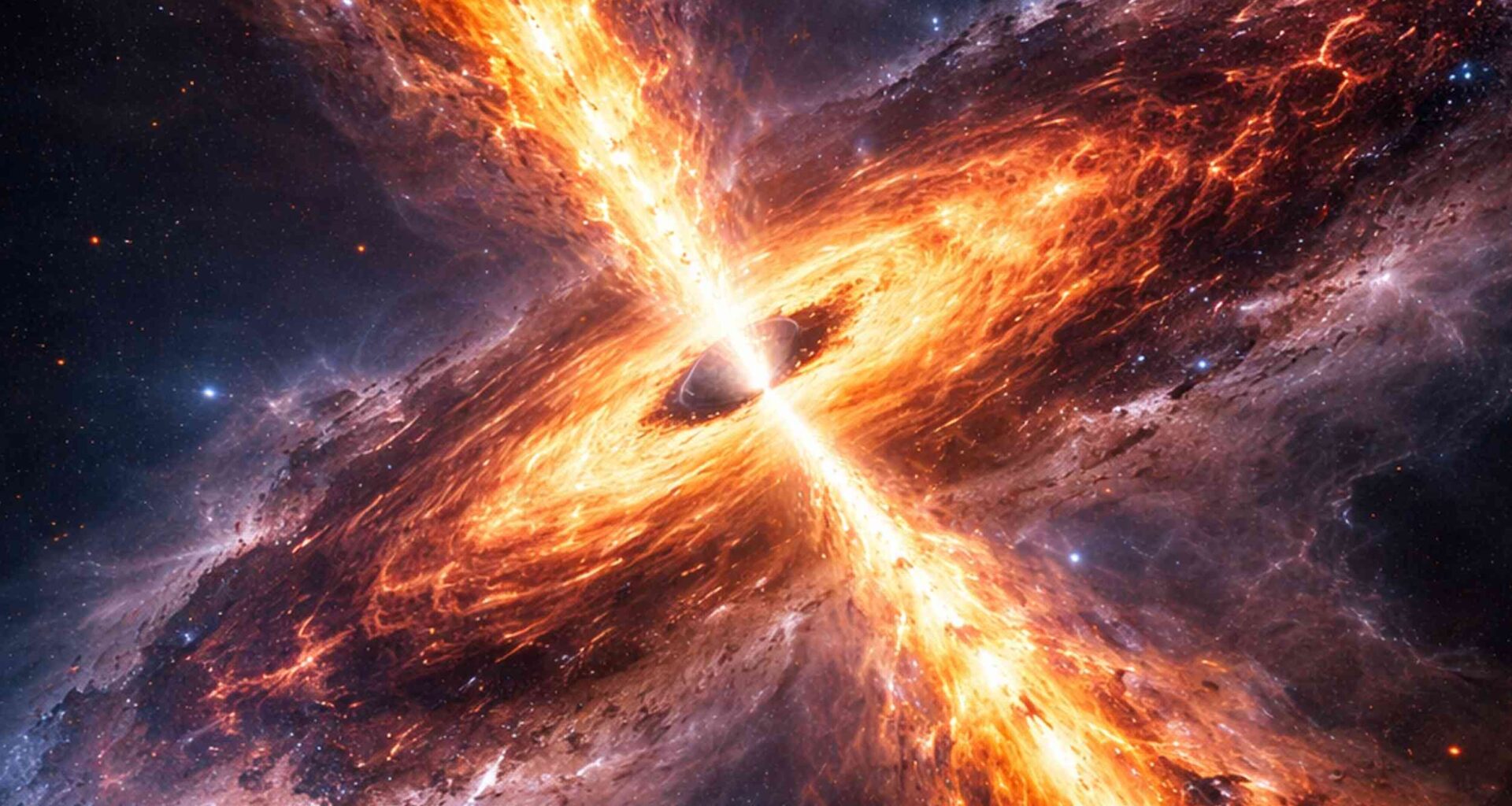
Researchers have found that a supermassive black hole in a distant galaxy called J1007+3540 has restarted powerful jets after nearly 100 million years of inactivity.
The renewed outburst shows that galaxies can be reshaped not by a single event, but by repeated eruptions colliding with their surroundings.
Fresh layers return

In radio images of J1007+3540, a bright inner streak sits inside older, dimmer debris, showing two eruptive episodes.
By tracing those nested layers, Shobha Kumari at Midnapore City College identified a central engine that had switched back on.
Her team found the newer jet had not erased older wreckage, which stayed visible as a fading outer cocoon.
That layering preserved earlier history and exposed how the surrounding cluster kept shaping the eruption.
Pressure bends the jets
Around the galaxy, hot gas pressed so hard that the revived jets bent instead of traveling in straight lines.
That pressure squeezed the northern lobe and forced plasma, gas whose particles carry electric charge, to curl sideways toward the source.
A report showed the team tying that distortion to the surrounding cluster and a restarting active galactic nucleus (AGN), the bright, energetic region around a supermassive black hole that forms when it actively pulls in matter.
“J1007+3540 is one of the clearest and most spectacular examples of episodic AGN with jet-cluster interaction, where the surrounding hot gas bends, compresses, and distorts the jets,” said Dr. Sabyasachi Pal of Midnapore City College.
Old eruptions linger
The clearest sign of a restart came from the age gap between the newer inner lobes and the older northern one.
Using radiative age, an estimate of how long emitting particles have been cooling, the team dated the inner lobes to 140 million years.
Older still, the outer north lobe reached roughly 240 million years, preserving a record of an earlier eruption that outlasted the shutdown.
That pattern marks a black hole feeding cycle that keeps an AGN turning bright, then quiet, over immense spans of time.
A long broken tail
Southwest of the core, a faint tail stretches away, then breaks before continuing as thinner emission.
Just before that bend, the radio glow looks crushed, while farther out the signal becomes unexpectedly flatter and brighter.
That contrast hints at re-acceleration, when worn-out particles gain energy again instead of simply fading with age.
Rather than tracing one clean plume, the tail suggests the cluster may redirect and partly revive debris from older blasts.
Why the clocks disagree
One result stood out because the long tail looked younger on paper than the newer inner structure.
Its estimated age was about 100 million years, even though the tail appears far more weathered and displaced.
Cluster turbulence or weak shocks could boost old electrons, making the radio signal look younger than the particles truly are.
Because the team had only two radio frequencies, that age puzzle remains provisional even as it sharpens the mystery.
A hidden fuel source
Far from inert, the host galaxy appears old, dusty, and still capable of feeding stars and its core.
Infrared modeling pointed to about 106 solar masses of new stars each year, far above the optical estimate.
That mismatch implies thick dust hiding fresh gas, the kind of material that can also feed a black hole.
Instead of a fully spent galaxy, J1007+3540 seems to hold the ingredients for another restart in the future.
Radio waves reveal history
Low-frequency radio light was crucial because ancient jet debris keeps glowing there long after sharper, higher-frequency views fade.
LOFAR and India’s upgraded Giant Metrewave Radio Telescope compared younger inner features with dim outer material from earlier activity.
Those measurements exposed structures that older, coarser surveys largely missed, especially the faint tail and compressed northern region.
The case shows why sensitive radio maps can preserve parts of a galaxy’s history that ordinary images miss.
More than a spectacle
Kumari described the revived system plainly after publication, using language that ordinary readers could grasp.
“It’s like watching a cosmic volcano erupt again after ages of calm – except this one is big enough to carve out structures stretching nearly a million light-years across space,” said Kumari.
The phrase works because the inner jet sits inside older wreckage, placing different ages in one frame.
Few systems seem to combine a restarted AGN, a broken tail, and such forceful environmental distortion in one place.
Sharper tests ahead
Higher-resolution radio observations should track the core more closely and show how the newest jet pushes through crowded surroundings.
Deeper X-ray imaging could map the hot gas directly and test whether shocks or cavities are helping bend the flow.
Broader radio coverage would also pin down particle ages better, because two frequencies leave too much room for interpretation.
Those added views should reveal whether the southern tail is a revived relic, a redirected jet, or both.
Why this finding matters
J1007+3540 shows that black hole activity can pause for eons, restart, and then be rewritten by the space around it.
Better maps of similar galaxies should reveal how often repeated eruptions, hidden fuel, and cluster pressure remake the same system.
The study is published in Monthly Notices of the Royal Astronomical Society.
—–
Like what you read? Subscribe to our newsletter for engaging articles, exclusive content, and the latest updates.
Check us out on EarthSnap, a free app brought to you by Eric Ralls and Earth.com.
—–