
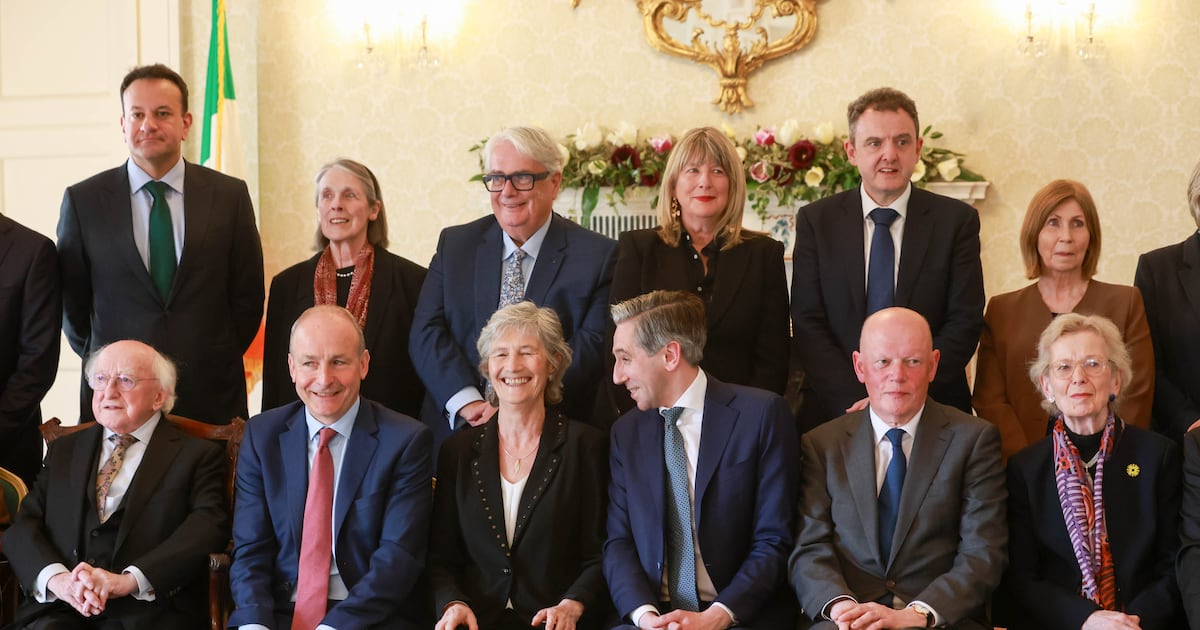
President Catherine Connolly will decide whether to refer the International Protection Bill to the Supreme Court to test its constitutionality before Wednesday evening, Áras an Uachtaráin said following a meeting of the Council of State on Monday.
After a lengthy meeting of the council, which acts as an advisory body for the President for some of her functions, the Áras issued a brief statement: “The President will now consider the views of the members of the Council before making a decision as to whether to sign the Bill or to refer it to the Supreme Court for a decision on the question as to whether the Bill or any specified provision or provisions thereof are repugnant to the Constitution or to any provision thereof.”
Reports of the meeting circulating around Government on Monday night suggested that the exchanges were “intense”.
Under article 26 of the Constitution, the President has the power to refer any Bill to the Supreme Court for an adjudication on its constitutionality. Before she does so, however, she must first consult the Council of State. But the council is merely an advisory body – the decision is then the President’s to make.
If the court decides the Bill is in conflict with any of the rights, procedures or principles in the Constitution, it falls and the Government will have to begin the legislative process again.
If the challenge fails, however, and the court decides it is not unconstitutional, the legislation is immune from further challenge.
This is one of the reasons why presidents have been reluctant to refer Bills under article 26, preferring to let the law be enacted and any future challenge to be grounded in its practical application.
Former president Michael D Higgins convened the council on four occasions to discuss a possible article 26 referral, but only actually referred one Bill – which was subsequently found by the court to be constitutional.
The International Protection Bill was passed by the Oireachtas last week and adopts many of the provisions of the EU migration pact, which the Government signed up to in 2024.
Opposition parties objected to aspects of it for different reasons, but also to the speed with which it was pushed through the legislative process. Groups such as the Irish Human Rights and Equality Commission have also raised questions about the Bill.
Essentially, the law is intended to tighten up and restrict asylum processes, reacting to public concerns about migration which have inflamed politics in some EU countries in recent years.
These, however, are policy issues – the only question for the Supreme Court is whether how the Bill seeks to achieve these goals is compatible with the Constitution.
The 25-strong council is comprised of three broad groups. There are political and judicial office holders including the Taoiseach, Tánaiste, Ceann Comhairle, Cathaoirleach, the Attorney General and the three heads of the superior courts.
There are retired office holders – all former taoisigh, presidents and chief justices are members –and there are the seven recently appointed nominees of the President – mostly academics with backgrounds in human rights and related fields.