
When imagining a thunderstorm rolling over a forest, most people think of rain, thunder, and the occasional lightning bolt.
What we don’t picture is a soft glow shimmering across the tops of the trees -so faint that the human eye can barely catch it.

Yet these electrical discharges are significant enough to change the air we breathe.
Treetops glowing in thunderstorms
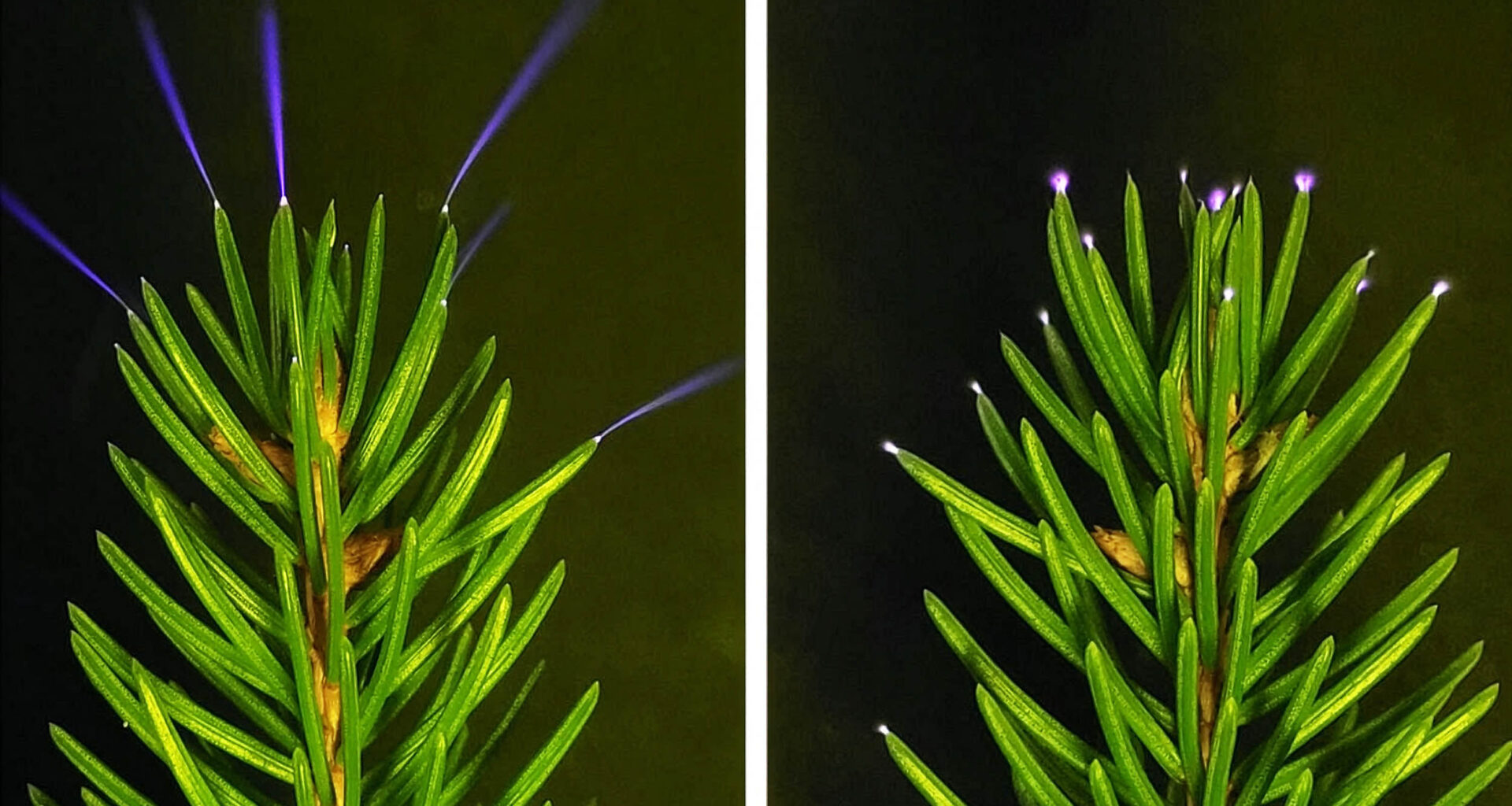
Scientists have suspected for nearly 100 years that this glow exists. It’s called a corona discharge – a weak electrical spark that forms on the tips of leaves when a thunderstorm’s electric field builds up overhead.
Until now, nobody had actually seen this type of discharge on a tree in the wild. A team from Penn State just changed that.
“This just goes to show that there’s still discovery science being done. For more than half a century, scientists have theorized that corona exists, but this proves it,” said P. J. McFarland, lead author of the study.
What is a corona?
Think of a corona as lightning’s much shyer cousin. Lightning is violent, blindingly hot, and over in a flash.
A corona is the opposite. It is a gentle, cool electrical leak. It is barely warmer than the air around it.
Coronas seep quietly out of sharp points, like the tips of pine needles or jagged leaf edges, whenever the nearby electric field gets strong enough.
Because coronas give off mostly ultraviolet light (UV), they are nearly invisible to us. But they are powerful enough to scramble the chemistry of the air around them.
They produce huge amounts of a molecule called the hydroxyl radical. This molecule helps clean pollutants out of the atmosphere.
New instrument sees glowing treetops
The Penn State team built a special instrument mounted on a research vehicle. It can spot UV light so faint that sunlight would normally drown it out.
The heart of the setup is a telescope paired with a UV camera. The camera only “sees” a narrow sliver of light between 255 and 273 nanometers.
Sunlight in that range never reaches the ground, thanks to the ozone layer. That means if this camera detects UV, it almost has to be coming from an electrical discharge.
The team then chased thunderstorms. They parked their vehicle near trees and pointed the telescope at the treetops as storms rolled in.
Sweetgum tree during a thunderstorm
Recently, in Pembroke, North Carolina, everything came together. The researchers aimed their instrument first at a sweetgum tree, then at a loblolly pine.
A thunderstorm passed directly overhead. Over the next couple of hours, the camera caught hundreds of tiny UV flashes dancing along the branches.
The coronas did not stay in one place. They hopped from leaf to leaf. Sometimes they followed a single branch as the wind pushed it around.
Each flicker lasted anywhere from a fraction of a second to a few seconds.
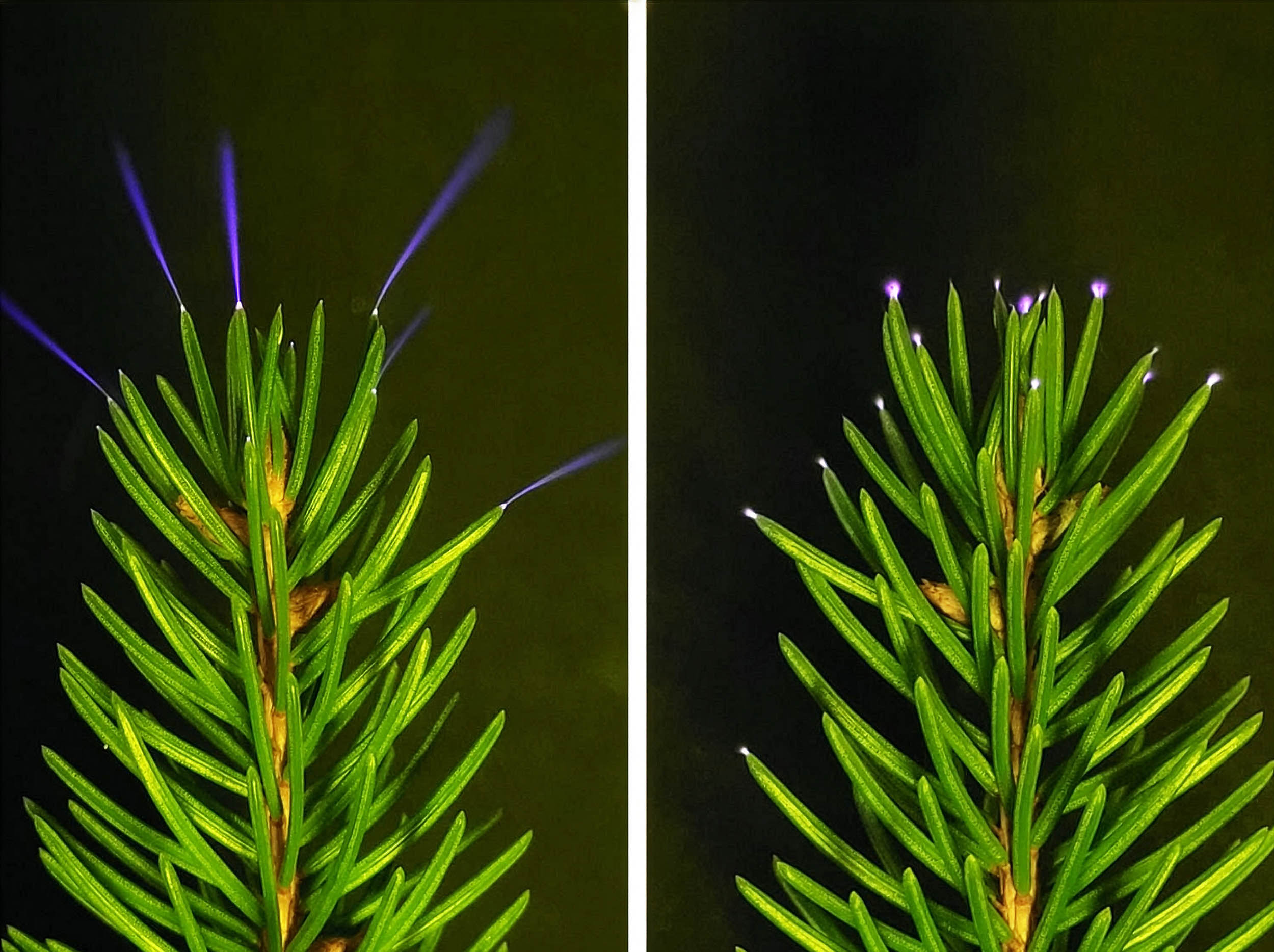 The positive, left, and negative corona discharges from a storm are shown on a spruce tree branch in a nearly pitch-black environment of a meteorology and atmospheric sciences lab at Penn State. Credit: William Brune / Penn State. Click image to enlarge.Every treetop branch was glowing
One of the biggest surprises was how evenly the glow was spread out. Wherever the scientists pointed their telescope, they found coronas.
Every branch they examined had them. Both trees had them, and at roughly similar rates.
The team also recorded the same kind of activity under four other storms, from Florida all the way up to Pennsylvania, on completely different types of trees.
This suggests something striking. Whenever a thunderstorm rolls over a forest, basically every treetop underneath it is quietly shimmering with these little sparks.
“It’s nearly invisible to the naked eye, but our instruments give rise to a vision of swaths of scintillating corona glowing as thunderstorms pass overhead,” said McFarland.
Measuring the invisible
By counting the UV photons hitting their camera, the team could estimate how much electricity was actually flowing through the trees.
Each corona was pushing roughly one microamp of current. It was a tiny trickle. But it was happening on leaf after leaf, tree after tree.
Separate lab experiments with potted spruce and maple trees confirmed the link.
The brightness of the UV glow matches up neatly with the electrical current running through the plant.
For the first time, researchers have a reliable way to turn “how bright is the glow” into “how much current is flowing.”
Why this matters
At first glance, a faint glow on some leaves might sound like a curiosity. It is actually a big deal for three reasons.
First, coronas produce enormous amounts of hydroxyl radicals. These scrub hydrocarbons and pollutants from forest air. Forests might be cleaning themselves during storms in ways we never accounted for.
Second, the coronas can slowly burn the fine tips of leaves. That causes damage that adds up over many storms. This is especially true in places where thunderstorms are frequent.
Third, the charged particles released by coronas might feed energy back up into the thunderstorm itself. That could subtly influence how the storm behaves.
“Such widespread coronae have implications for the removal of hydrocarbons emitted by trees, subtle tree leaf damage and could have broader implications for the health of trees, forests and the atmosphere,” noted McFarland.
More research on glowing treetops
For centuries, people have stood under thunderstorms and seen only rain, lightning, and dark clouds.
Now we know that something more is happening just above our heads. The forest canopy is quietly putting on its own light show. It may be shaping the air, the trees, and maybe even the storms themselves.
And as climate change drives more thunderstorms, that shimmer is only going to get brighter.
The study is published in the journal Geophysical Research Letters.
—–
Like what you read? Subscribe to our newsletter for engaging articles, exclusive content, and the latest updates.
Check us out on EarthSnap, a free app brought to you by Eric Ralls and Earth.com.
—–