
Financial penalties of more than €17 million were applied to the operators of State-subsidised bus, rail and Luas services in 2024, figures provided by the National Transport Authority (NTA) and the Department of Transport show.
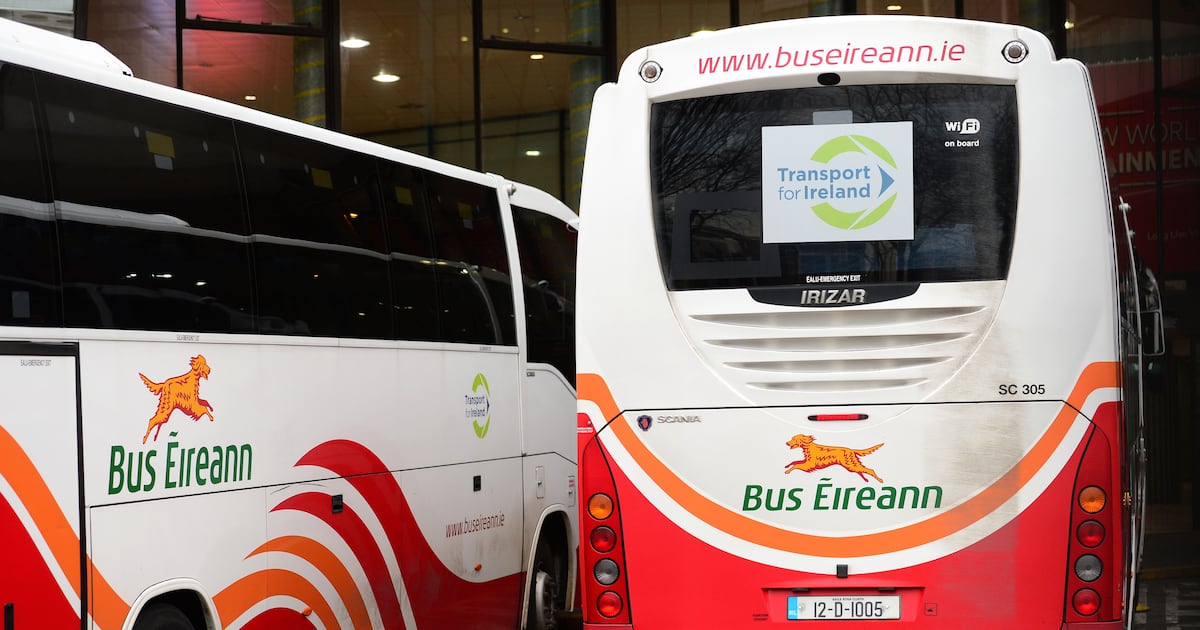
Bus Éireann lost close to €5 million under performance-related deductions, while Dublin Bus had penalties of €4.6 million imposed.
The figures show that Irish Rail had deductions of €3.7 million imposed, while Luas had penalties of €2.1 million and Go-Ahead more than €1.3 million.
Under NTA contracts for the public service obligation routes – those services with a State subsidy – performance-related deductions can be made where an operator fails to meet minimum standards. There are also incentive payments included for operators who exceed minimum standards.
The Department of Transport also said in a letter to the Dáil Public Accounts Committee (PAC) that passenger numbers were continuing to surge across public transport services, up more than five per cent in the first part of this year.
It said punctuality was also better among operators of State transport contracts, with Bus Éireann in particular achieving significant improvements.
The department said the NTA closely monitored the performance of all public transport operators.
“Where performance declines, penalties are applied rigorously unless the underlying cause is outside the operator’s control. For example, if a bus service fails to operate due to reasons within the operator’s control, a deduction is applied equivalent to the cost of the cancelled service.”
The Department of Transport said the minimum performance standards included reliability – determined using a metric called lost kilometre rate – which outlines the percentage of services that failed to operate for reasons within the control of the operator, and regularity – which is measured by excess wait time.
The department told the PAC that punctuality was another key performance indicator, while other factors such as bus vehicle performance, bus driver performance, bus cleanliness, bus equipment performance and customer care were also measured.
“It is important to note regarding reliability and frequency that the Department of Transport, the NTA and the operators acknowledge there have been recent challenges across the bus sector – often due to traffic congestion, driver or mechanic shortages, or unforeseen incidents.
“The department is working closely with the National Transport Authority to try to address these issues through initiatives such as the public transport workforce taskforce, which aims to address recruitment challenges for drivers and mechanics; and planned improvements to the vehicle location system.”
The department said a planned next-generation system also aimed to enhance the accuracy of real-time passenger information.
The Department of Transport said Minister Darragh O’Brien had in March convened a meeting to consider the issue of congestion in the Greater Dublin Area in conjunction with key agencies, operators and local authorities. It said this meeting considered options for alleviating immediate pressures on the system, particularly the M50.
The department also said it had recently published a strategic framework for improving the efficiency of the transport system over the medium to long term.
The department said there were a record 363.5 million passenger journeys on services operated by Bus Éireann, Dublin Bus, Irish Rail, Luas, Go-Ahead Ireland, and TFI Local Link in 2025.
It said the most recent data provided by the NTA showed a further growth of 5.33 per cent in the first part of 2026 across the main operators with public service obligation contracts.