
In a quiet lab filled with fossil cabinets, a broken skull began to tell a powerful story. What looked like a ruined piece of bone turned into a rare window into early dinosaur life.
The work came not from a senior scientist, but from an undergraduate who spent two years piecing together a puzzle that most would have ignored.

“You want to stick your finger in a dinosaur brain?” asked Simba Srivastava, a geosciences student and researcher at Virginia Tech who led the study.
That question set the tone for a project driven by curiosity, patience, and careful reconstruction.
A rare Triassic fossil
Srivastava first encountered the fossil as a rough and damaged specimen. Its surface looked uneven and deeply pitted.
“This is a uniquely sucky specimen,” said Srivastava. “It’s so bad. Like, if you saw a human skull in this way, you’d throw up.”
Despite its condition, the fossil carried rare scientific value. It came from Ghost Ranch in New Mexico, a site known for preserving life from the very end of the Triassic period.
Scientists have long struggled to find well-preserved fossils from this narrow window in time.
Many specimens from this period are fragmentary or missing key features, which makes it difficult to understand how dinosaurs evolved during this transition.
Details inside of a crushed skull
The fossil itself had been discovered decades ago and stored away. It took a fresh perspective to recognize its importance.
Srivastava used modern tools such as CT scanning to look inside the rock without breaking it apart. He digitally separated bone from surrounding material and built a three-dimensional model.
This allowed him to study details that would otherwise remain hidden inside the crushed skull.
Features of Ptychotherates bucculentus
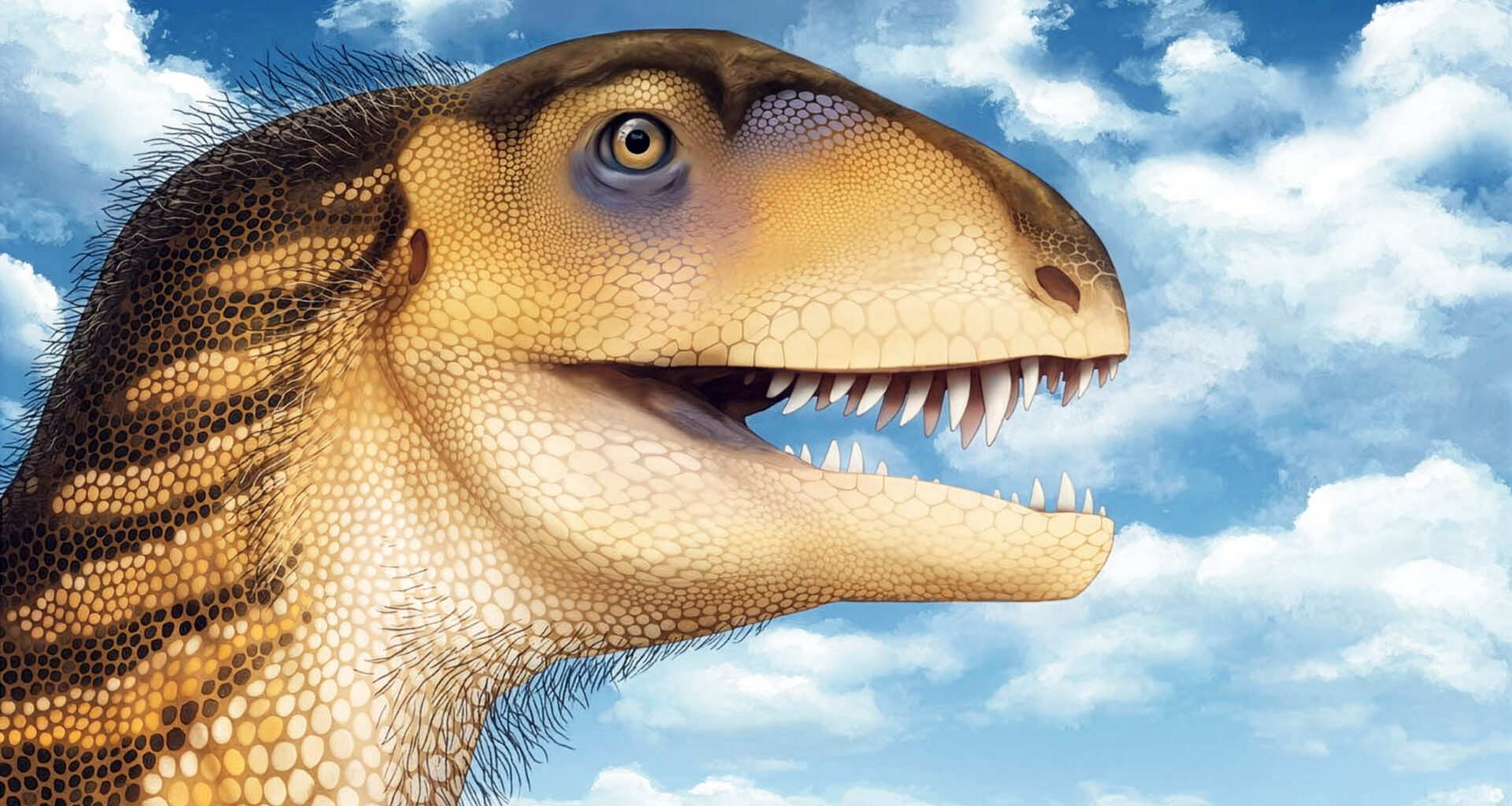
The skull belonged to a newly identified dinosaur species called Ptychotherates bucculentus.
It lived more than 200 million years ago, during the late Triassic period, long before famous predators like Tyrannosaurus Rex appeared.
Even though the skull was damaged, it preserved several unusual features. One of the most striking was its deep cheek bone, which gave the skull a tall and compact shape.
This feature stands out because most early dinosaurs had more slender skulls. The depth of this bone suggests strong jaw muscles and a powerful bite.
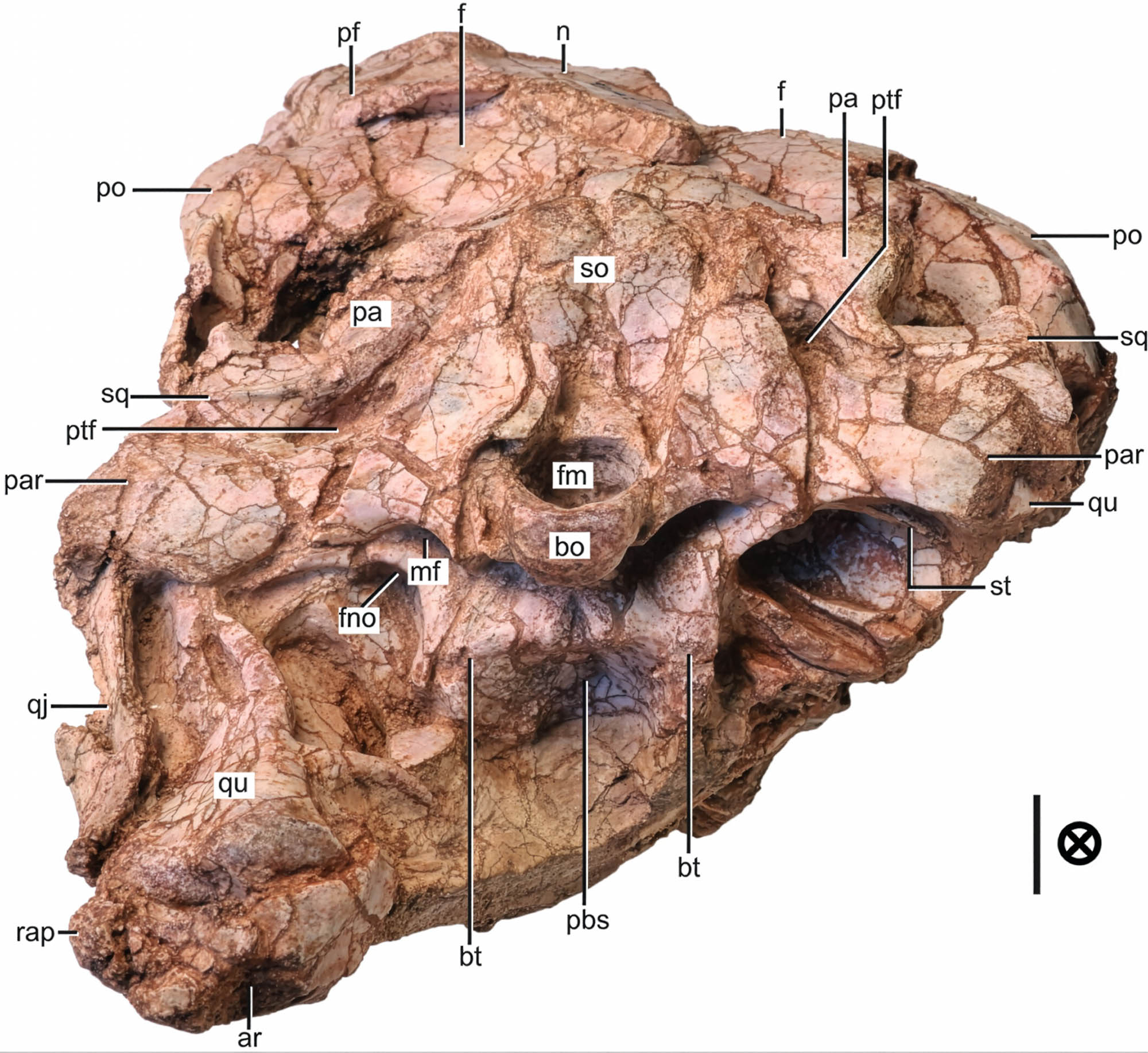 The posterior portion of the skull Ptychotherates bucculentus, meat-eating dinosaur, in posterior view. Crossed circle indicates posterior direction out of page. Scale bar represents 1 cm. Credit: Virginia Tech. Click image to enlarge.Unusual skull features
The teeth add to this picture. They were curved and finely serrated, built for slicing through flesh. These details confirm that the animal was a carnivore.
At the same time, the skull shows a mix of traits seen in different dinosaur groups. Some features resemble early carnivorous dinosaurs, while others hint at more advanced forms that would appear later.
This combination shows that early dinosaurs were not simple or uniform. They were already experimenting with different shapes and feeding strategies.
Evolution was not a straight path but a branching process with many variations.
Dinosaurs gain dominance
During the Triassic period, dinosaurs were not yet the dominant animals on land.
They lived alongside other reptiles, including early relatives of crocodiles, as well as distant ancestors of mammals. These groups competed for food and space in the same ecosystems.
Then came a major turning point. At the end of the Triassic, a mass extinction event wiped out many species.
The exact cause is still debated, but the effects were clear. Many of the dominant competitors disappeared, leaving ecological gaps.
“Dinosaurs go from being co-stars to the headliner,” Srivastava said.
Life after extinction
This shift allowed dinosaurs to expand rapidly in the following Jurassic period. They became the main large animals on land, evolving into a wide range of forms.
However, fossils that capture this transition are rare. That is why this skull matters so much. It comes from rocks formed very close to that extinction event, offering a snapshot of life just before the change.
Naming the new species reflected both its structure and its unusual condition.
“We landed on Ptychotherates bucculentus, which means ‘folded hunter with full cheeks’ in Latin,” said Srivastava. “One paleo-artist said that it looked like a murder muppet.”
Behind the playful nickname lies an important scientific insight. The dinosaur belongs to an early group of carnivorous dinosaurs related to species like Tawa.
These animals sit near the base of the dinosaur family tree. They help scientists trace how major dinosaur groups evolved over time.
Survival at low latitudes
The study also suggests that this group survived longer than previously thought. Most fossils of similar dinosaurs come from earlier periods.
Finding one in these later rocks means that some early lineages continued to exist even as new groups emerged.
The location of the fossil adds another layer to the story. Most early dinosaur fossils come from different parts of ancient Earth, especially regions that were once located at higher latitudes.
This specimen comes from what was once a lower latitude environment. It suggests that certain regions may have acted as refuges where older lineages survived longer than elsewhere.
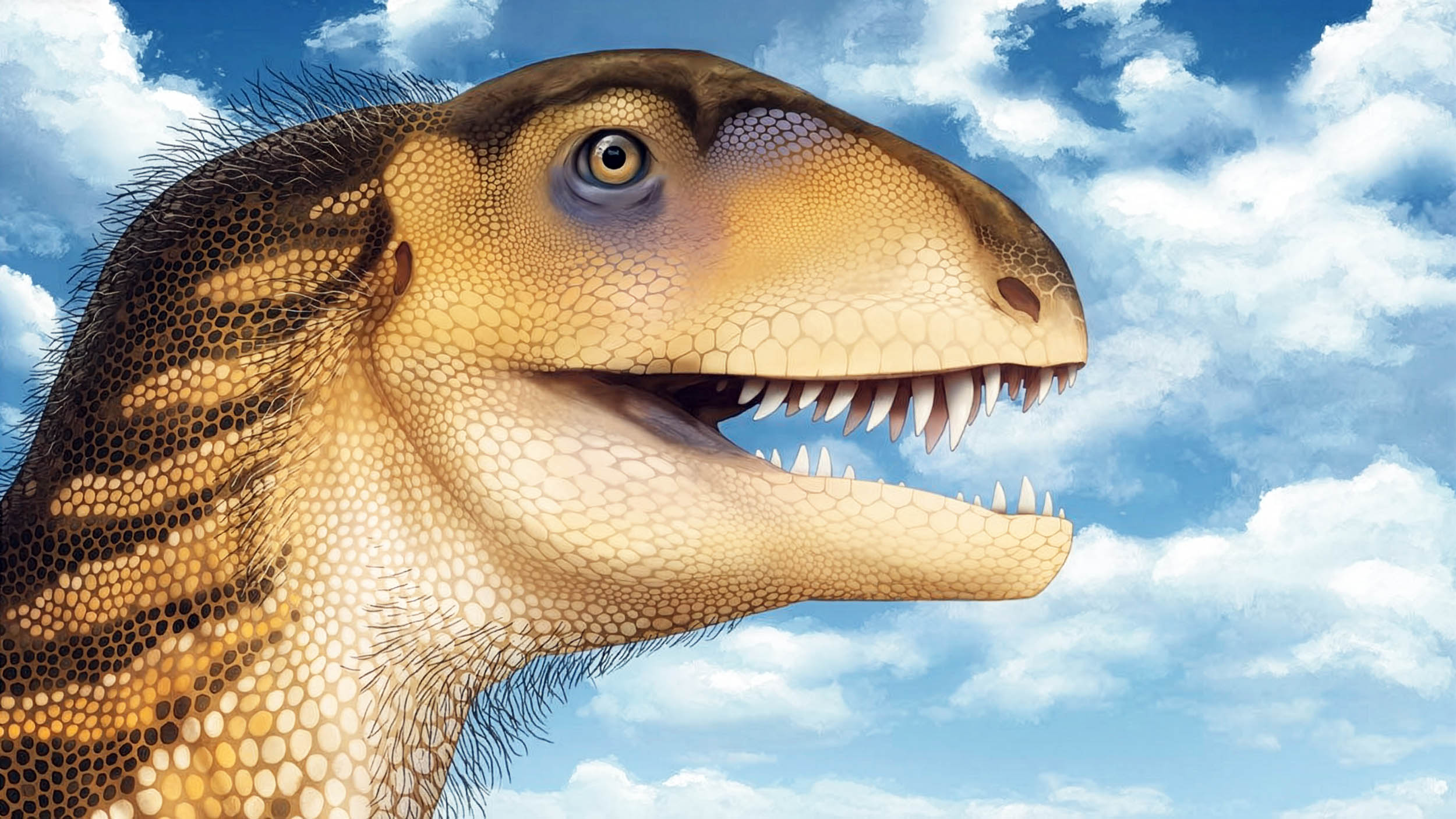 Artistic rendition of Ptychotherates bucculentus, a meat-eating dinosaur 3x older than T. Rex. Illustration by Megan Sodano for Virginia Tech. Click image to enlarge.Rethinking a mass extinction event
The discovery of Ptychotherates bucculentus changes how scientists view the end Triassic extinction.
The study suggests that the event did not only remove the competitors of dinosaurs. It may also have affected dinosaurs themselves, including some of their earliest branches.
“This forces us to reconsider the impact of the end-Triassic extinction as something that wiped out not just the competitors to dinosaurs, but some long-standing dinosaur lineages themselves,” Srivastava said.
The last surviving lineage
The fossil may represent one of the last members of its group. It hints that these early carnivorous dinosaurs survived in certain regions until the very end, before finally disappearing.
“This specimen, it fits in my hands, but it is the only proof that any of these dinosaurs lived this long, lived in these latitudes, the only proof that they evolved to have this skull shape,” said Srivastava.
“All these billions of individuals that existed through time are spoken for by this one specimen.”
From a crushed and overlooked skull to a key piece of evolutionary history, this discovery shows how even imperfect fossils can reshape our understanding of life on Earth.
The study is published in the journal Papers in Palaeontology.
—–
Like what you read? Subscribe to our newsletter for engaging articles, exclusive content, and the latest updates.
Check us out on EarthSnap, a free app brought to you by Eric Ralls and Earth.com.
—–