
Topline
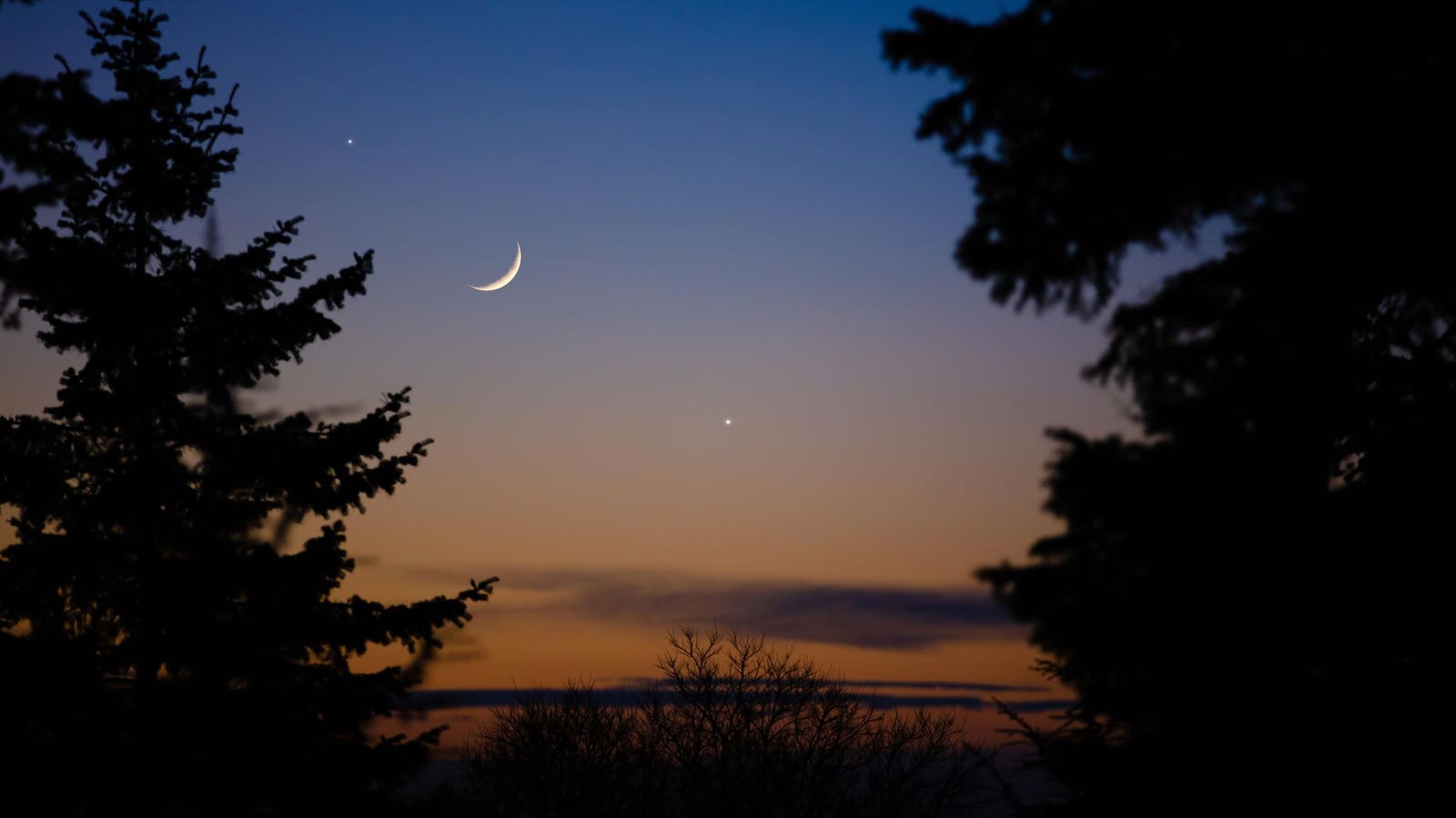
Skywatchers who look high in the western sky after dark on Tuesday, April 22, will see a beautiful waxing crescent moon just a few degrees above giant planet Jupiter, forming a beautiful conjunction easily visible to the naked eye. The pairing will shine among the “twin” stars of the constellation Gemini in one of April’s most accessible sky events.
Crescent Moon with stars, planets and tree silhouettes on evening sky.
gettyKey Facts
The moon, about 38%-lit, will appear roughly three degrees above Jupiter in the west shortly after sunset.
Jupiter shines at magnitude -1.9, outshining every star in the sky and visible even from light-polluted cities. Light pollution has almost no effect on the viability of planets and the moon.
Bright stars Castor and Pollux in the surrounding constellation Gemini will sit above the moon, framing the conjunction in a wider celestial tableau.
After sunset in the west on Tuesday, April 22, a waxing crescent moon will hang between Jupiter and the twin stars of Gemini, Castor and Pollux.
StellariumMoon-Jupiter Conjunction Explained
A conjunction occurs when two objects appear close together in the sky from our perspective on Earth. Tonight’s meeting is purely a line-of-sight effect — Jupiter is over five times the Earth-sun distance away, while the moon is just over 226,000 miles (365,000 kilometers) distant. Jupiter has dominated the evening sky for months following its opposition on January 10. Although it is now gradually sinking toward the western horizon each week, it remains bright and unmistakable. Through binoculars, Jupiter’s four largest moons — Io, Europa, Ganymede and Callisto — may be visible as tiny points of light beside the planet.
Get To Know The Gemini Constellation
The conjunction takes place in Gemini, one of the easiest constellations to recognize. Its two brightest stars, Castor and Pollux, mark the heads of the mythological twins. Pollux, 34 light-years from the sun, is the brighter of the pair and lies closer to Jupiter tonight, while Castor, at 51 light-years distant, sits slightly above. Gemini straddles the ecliptic — the plane of the solar system — which is why the moon and planets frequently pass through it.
What’s Next In The Night Sky
A good time to see “shooting stars“ from the peak of the annual Lyrid meteor shower will be between about 2 a.m. and dawn local time on Thursday, April 23, when your location on Earth is firmly on the night side and rotating into debris left in the inner solar system in 1861 by Comet Thatcher (C/1861 G1). Jupiter will continue drifting closer to the horizon through May, gradually fading into twilight. Meanwhile, Venus is blazing low in the west after sunset and will remain dominant as the “Evening Star” through October, reaching greatest distance above the horizon in August and peak brightness in September as it undertakes Earth on its 225-day orbit of the sun.
Further ReadingForbesLyrid Meteor Shower Begins Tonight — When To Get The Best ViewBy Jamie CarterForbesNASA Artemis 2 Moon Mission Delayed To April After Rocket IssueBy Jamie CarterForbesYour Ultimate Guide To Stargazing And Astronomy In 2026By Jamie CarterForbesYour Full Moon Guide For 2026 — All 13 Dates For Your DiaryBy Jamie Carter