
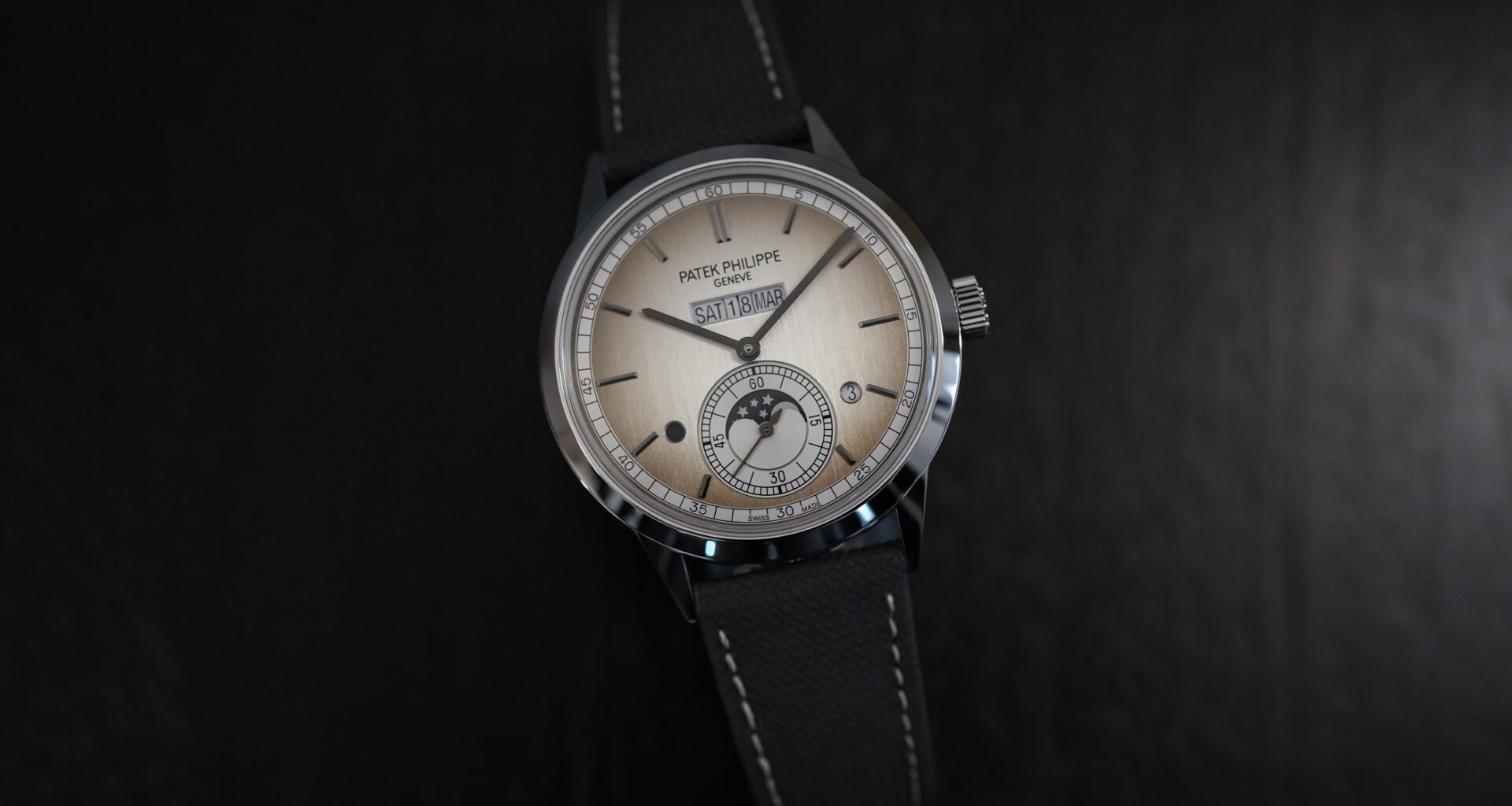
Widely regarded as a technical and aesthetic masterpiece, Patek Philippe’s In-Line Perpetual Calendar returned in grand form at Watches & Wonders this year, alongside dozens of other new watches, in platinum with a silver dial. Displaying the day, date and month on a single line in a panoramic aperture at noon, few perpetual calendars can beat the impeccable legibility of this model, not counting the complexity of such a display. Replacing the now-discontinued blue dial reference of 2021 and the salmon dial of 2024, Patek’s latest In-Line Perpetual Calendar 5236P-011 is a lesson in sobriety and technical brilliance.
Patek Philippe’s experience with technically demanding perpetual calendars dates to 1864. Following the brand’s 1925 perpetual calendar wristwatch, Patek introduced the Ref. 3448 in 1962, a self-winding perpetual calendar wristwatch. Although the invention of the perpetual calendar is generally attributed to Thomas Mudge, Patek was one of the earliest brands to develop, popularise, and define the complication in wristwatch form.
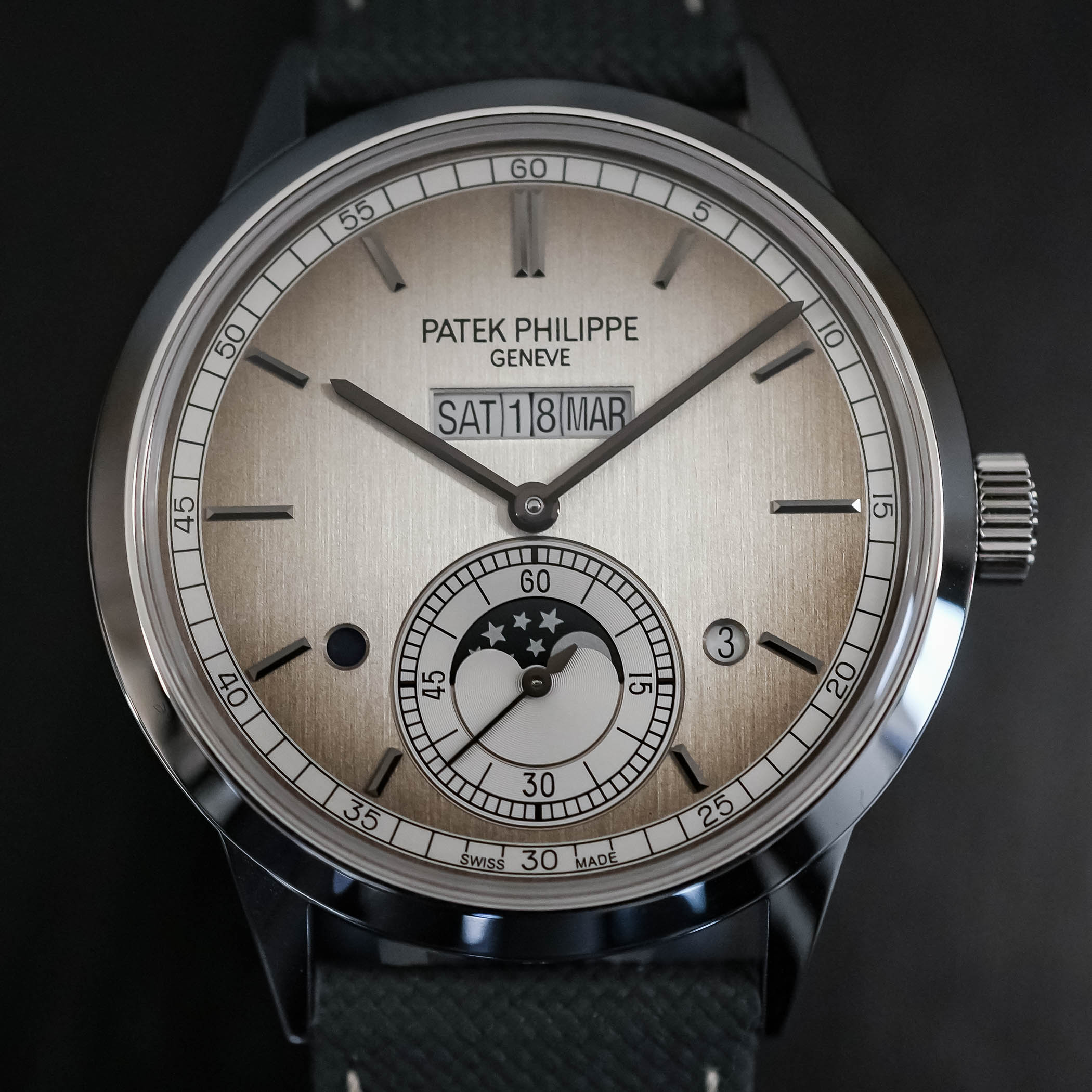
Exploring new ways to display the calendar information, Patek Philippe’s Ref. 5236P-001 of 2021 featured an in-line display of the day, date and month in a single rectangular window at noon. While it might look like a contemporary solution, the 5236 draws its design cues from historical linear QP models, in particular the Ref. 725/4 Lépine pocket watch of 1972 created for the American market. A rare 46mm gold model with an American-style calendar display (month, date and day) arranged in a linear format, the Ref. 725/4 can be regarded as the ancestor of the 5236P’s in-line display. However, downsizing this feature to fit inside a 41mm wristwatch was a technical challenge. Using four rotating discs – one for the day, two for the date and one for the month – all perfectly aligned in the same plane, the mechanism for the discs alone required 118 additional parts.
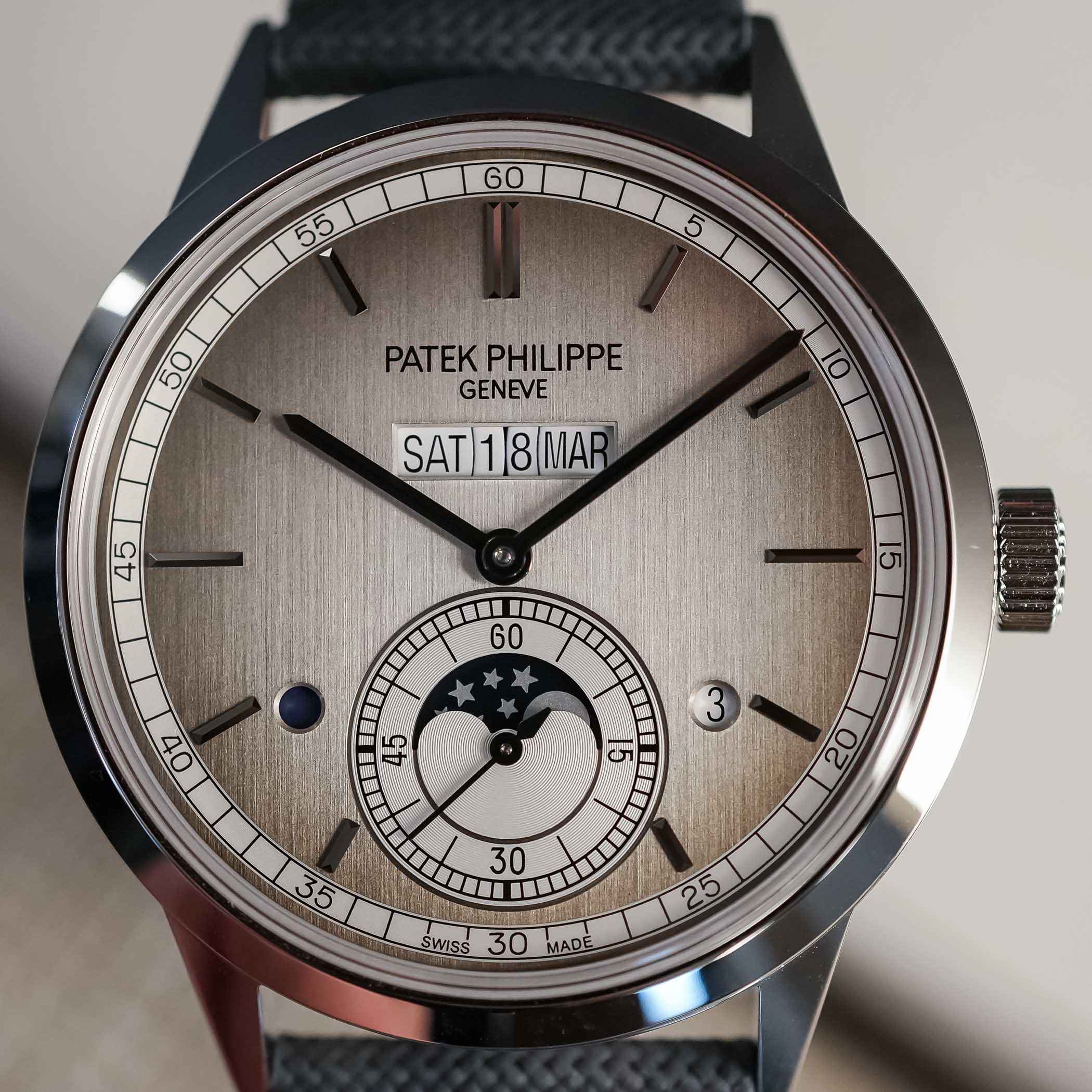
By consolidating the principal calendar displays into a single aperture, legibility improves, and the dial is spared the clutter of multiple sub-dials, creating more breathing space. Following the classic blue dial of 2021 and the warmer, more expressive salmon dial of 2024, both now out of the collection, the new silvery grey face of the watch is by far the most restrained, or so it seems. Decorated with a vertical brushed finish, the dial’s gradient effect produces a darker grey tone at the periphery.
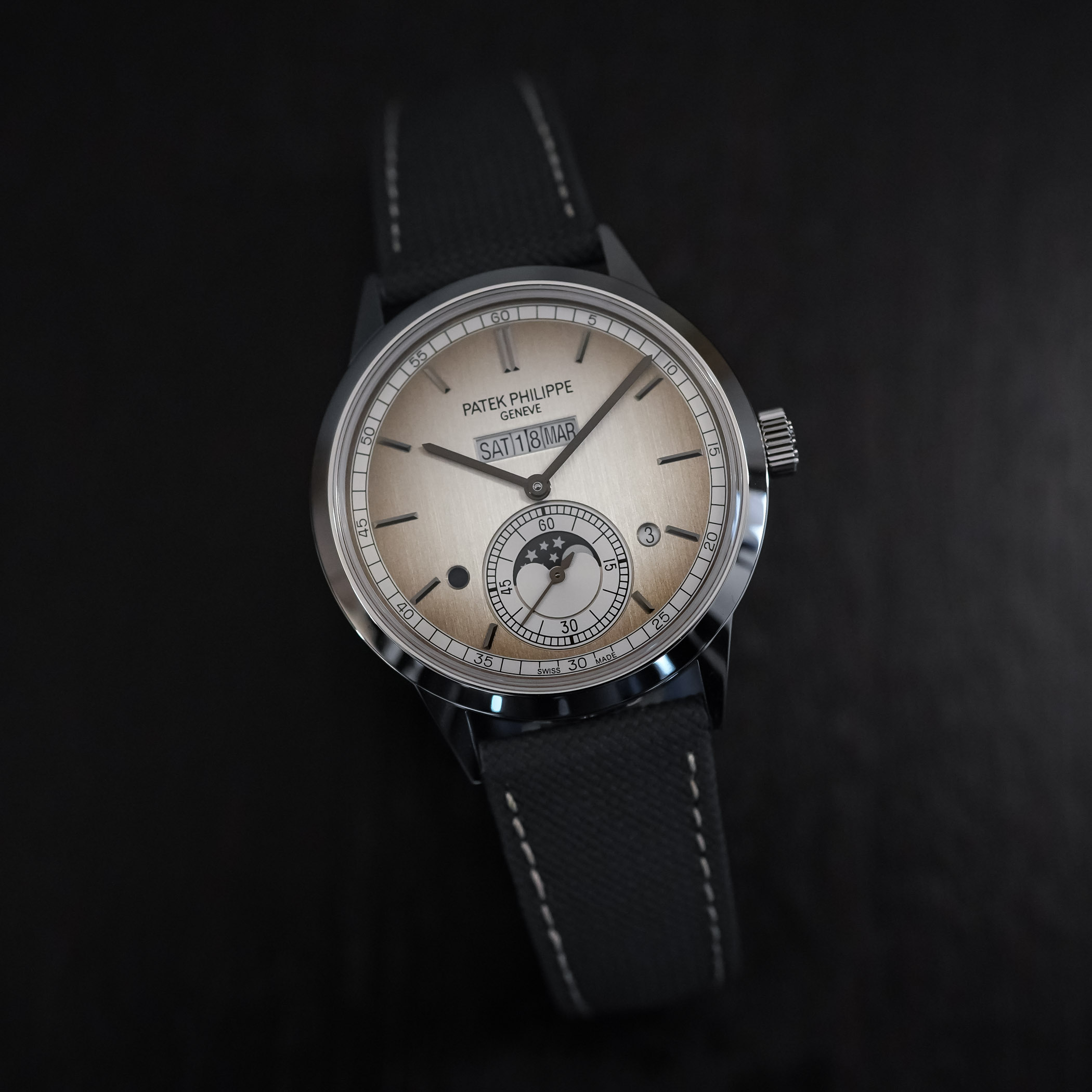
The minimalist white gold baton-style hour markers and hands are faceted and coated in charcoal grey to match the dial’s grey tonalities. Two round apertures flanking the snailed small seconds counter with a precision moon phase indicator indicate the leap year at 4 o’clock and the day/night indicator at 8 o’clock. The railway-style minutes track on the periphery is also snailed and features the same off-white colour as the small seconds counter, the background of the leap year display and the linear day, date and month aperture.
While sobriety and discretion are the operative words here, the dial has multiple personalities. Depending on the angle, the dial shifts from a cold silvery tone to more intense grey tones with a dash of brownish-yellow thrown in. The closest analogy might be the colour found in vintage sepia photographs. This is due to the metallic effect of the silver base, which produces iridescent reflections.
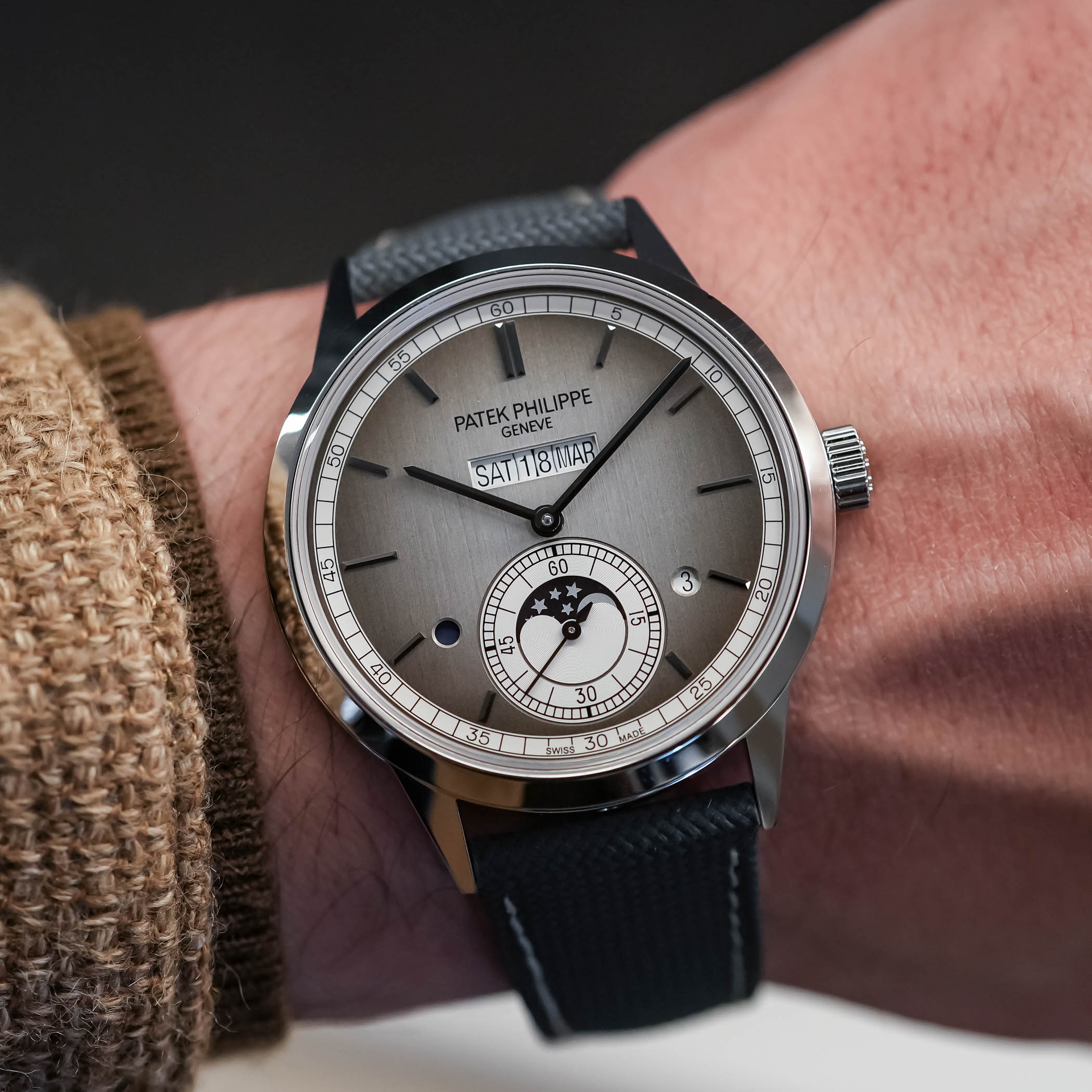
With a 41.3mm diameter and a thickness of 11.07mm, the In-Line 5236P-011 is one of Patek Philippe’s largest perpetual calendars. Crafted from 950 platinum, the case features, like all platinum models, a small diamond embedded at 6 o’clock and four seamlessly integrated corrector pushers. A contemporary classic, the case, defined by its sharp, inclined lugs, wide case middle and sloping bezel, is brightly polished.
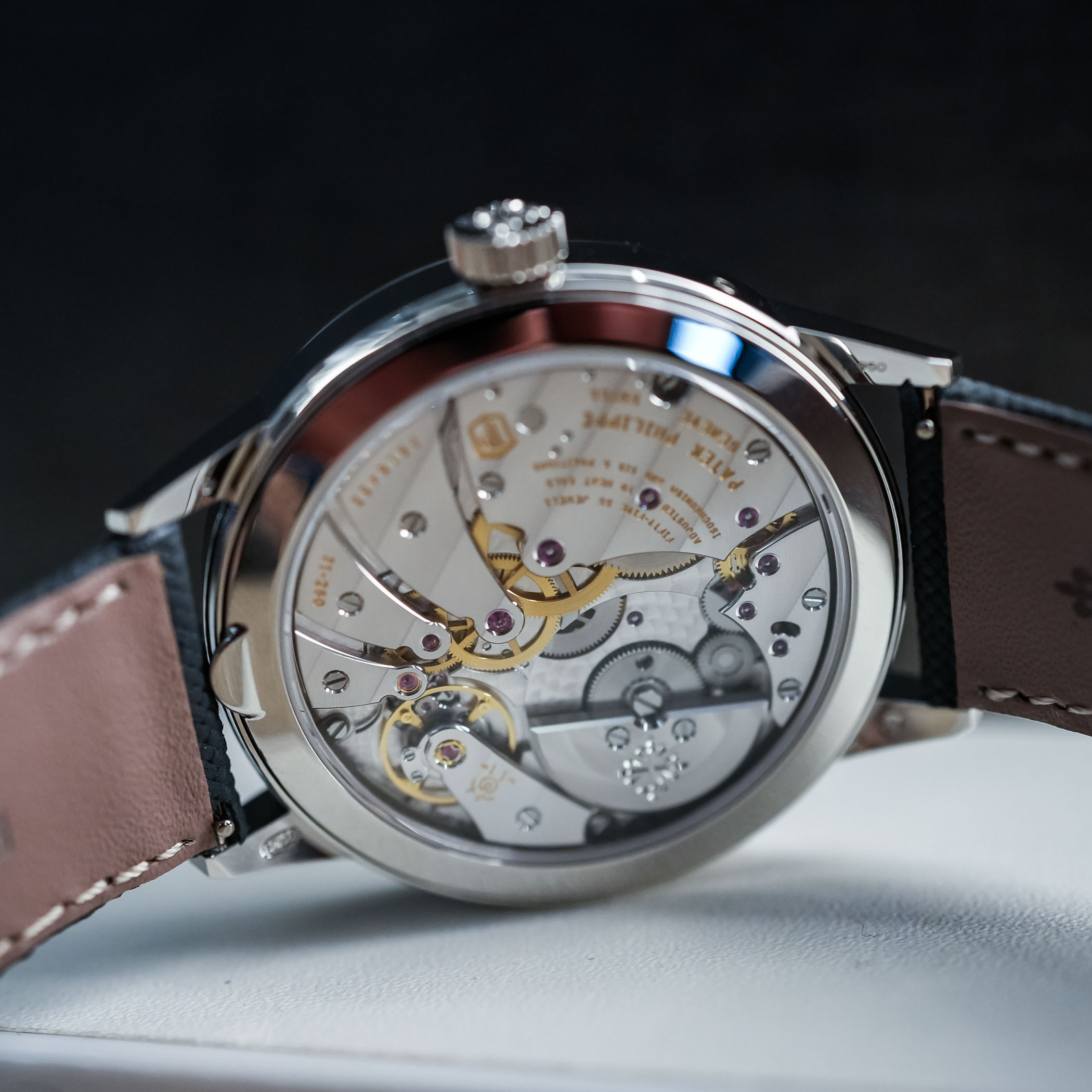
The watch is powered by the calibre 31-260 PS QL (PS = petite seconde; QL = quantième perpétuel en ligne), a modern in-house movement related to the 31-260 family used in the Ref. 5235 Annual Calendar Regulator of 2011. Reworked entirely to incorporate the PS small seconds and QL in-line perpetual calendar and protected by three patents, the torque of the spring barrel was increased by 20% to feed the energy-consuming perpetual calendar, and the frequency increased to 4Hz. As mentioned, the single-line calendar display with four rotating discs alone required 118 additional parts, bringing the total up to 503 components. Revealed on the caseback, you can see the off-centred platinum micro rotor, the elegant finger bridges decorated with Geneva stripes and polished bevels and other refined finishings like the perlage, circular graining and polished countersinks.
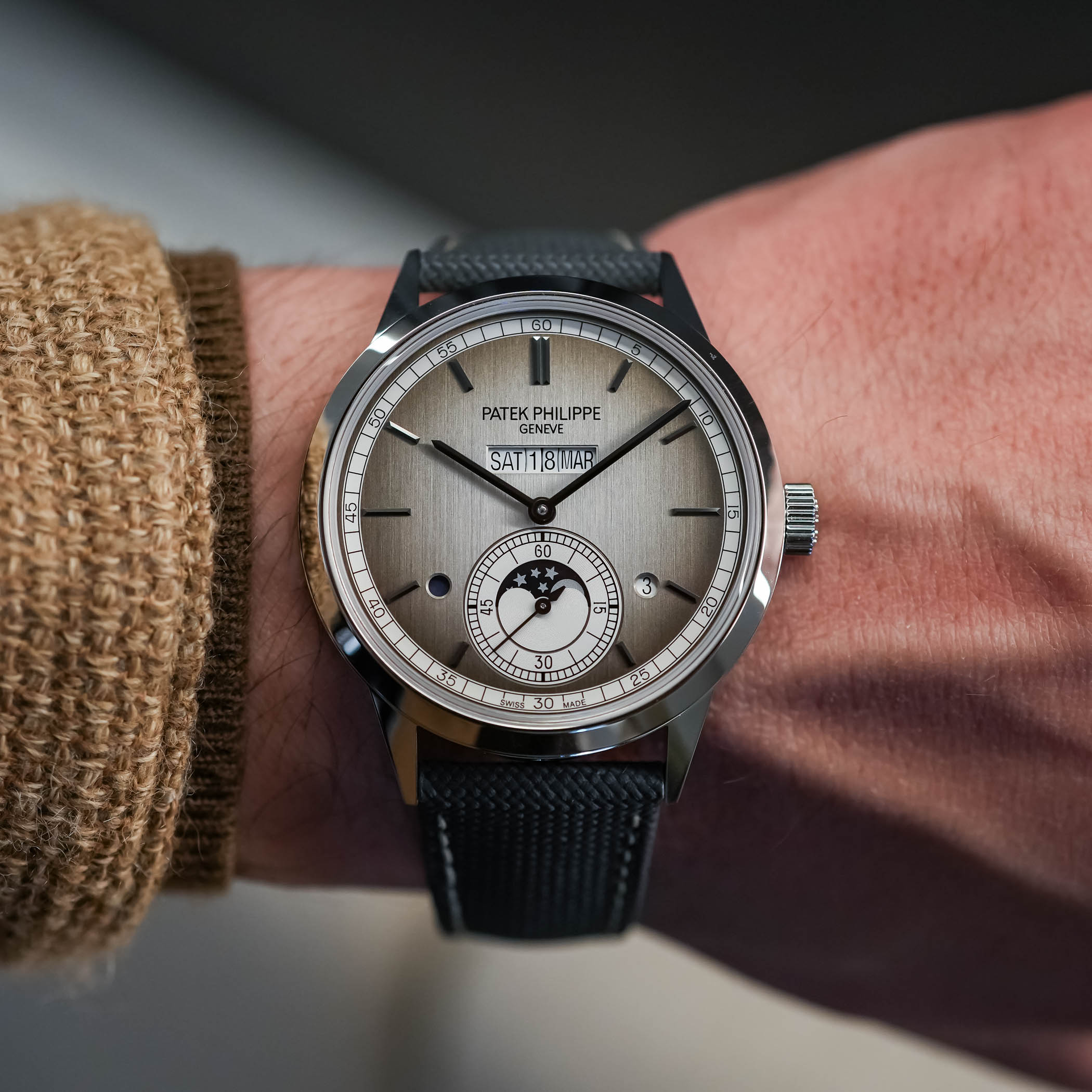
The watch is paired with a contemporary charcoal-grey composite strap with cream top stitching and a platinum triple-blade foldover clasp. It retails for CHF 124,800. More information at patekphilippe.com.
https://monochrome-watches.com/patek-philippe-in-line-perpetual-calendar-5236p-011-silver-gradient-review-price/