
The post Slow Motion Reveals What Is Invisible to the Naked Eye: Gaboon Viper’s Strike appeared first on A-Z Animals.
Watch the Video
Click here to watch on YouTube
A master of disguise lies in wait as potential prey forage for food nearby.
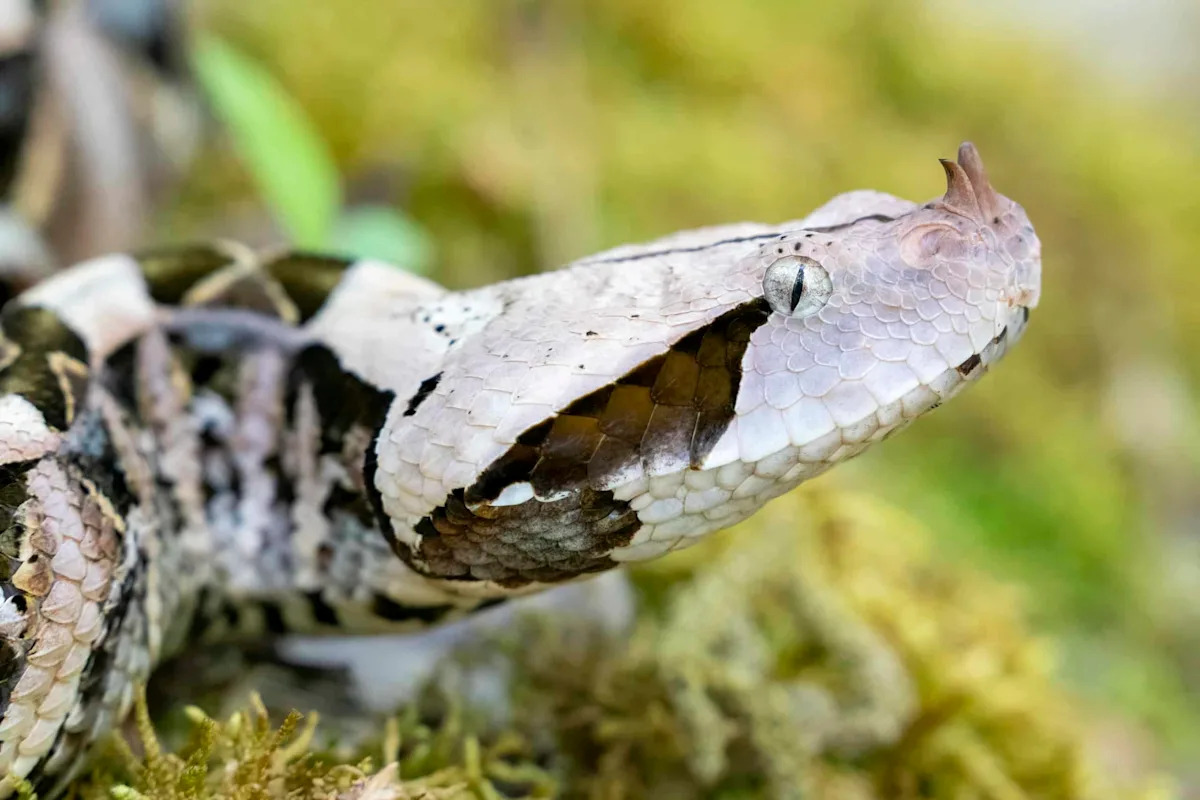
Gaboon vipers (Bitis gabonica) use camouflage to hide in plain sight. Their broad, V-shaped head mimics the fallen leaves, even their central vein, that litter these snakes’ habitat, the rainforest floor of Central, East, and West Africa. Their fangs, the longest of any venomous snake (~2 inches), retract like a switchblade.
This video, posted on Smithsonian Channel’s official YouTube page, shows Africa’s largest viper species hidden in fallen, decaying foliage as other creatures of the rainforest rummage within striking distance. The event, presented at various points in slow motion, captures the moment when a leaf-shaped head emerges from under the vegetation.
Today, a guinea fowl is unlucky. It emerges from behind a tree, but before it can fully round the tree, the snake strikes, missing. In slow motion, it seems the guinea fowl has a chance to flee. In reality, the snake’s slight miscalculation proves inconsequential. With a minor adjustment, the gaboon viper makes contact, discharging a fatal dose of its venom into the guinea fowl.
Known for their sluggish movement, gaboon vipers strike at speeds between 175 and 200 miles per hour, as fast as the top speeds reached by NASCAR cars. In fact, they move so quickly, it’s near impossible for the naked eye to register the movement. Currently, no research has determined the world’s fastest-striking snake; surely, though, gaboons are one of the quickest strikers.
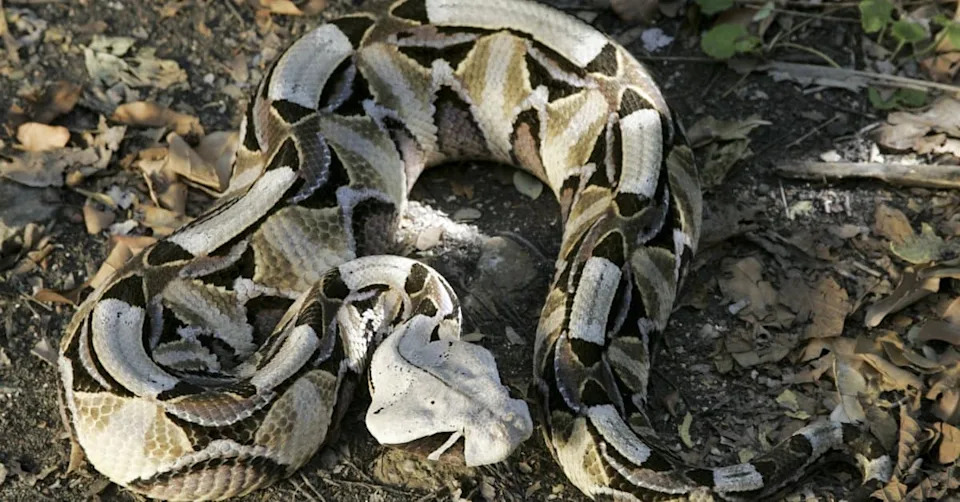
Gaboon vipers’ coloring and patterns mimic the colors of leaf litter on the forest floor of the rainforests and savannahs where they live.
©Stu Porter/Shutterstock.com
The guinea fowl stumbles a moment, stunned at its fate. Within 10 minutes, the venom has run its course, and Velvet—the name given to the snake—prepares to consume its meal.
Gaboon vipers can wait hours, even days, to ambush prey. Once the moment arrives, these snakes “unhinge” their jaws to devour prey whole, beginning with the prey’s head.
However, contrary to popular belief, snakes do not dislocate or unhinge their jaws. They increase their jaw’s width, or gape, with two principal adaptations. According to Kenneth V. Kardong, the first adaptation is “the flexibility of the mandibular symphysis”; in other words, their mandibles are connected by a stretchy ligament rather than fused as is the case in mammals.
The second, he explains, is “the ability of the snake to swing the two quadrato-mandibular joints outward while the lower jaw is depressed. The characteristic ingestion-swallowing motion of snakes is an alternating advance of first one then the opposite side of the jaws over the prey.” In layman’s terms, their jaws move independently of each other and “walk” forward in a side-to-side motion over the prey’s body.
Gaboon vipers, while capable of inflicting significant damage, are notoriously docile, even when handled by (trained) people. They are more likely to warn threats with a hiss than a bite.
Watch the Video
Click here to watch the video.
The post Slow Motion Reveals What Is Invisible to the Naked Eye: Gaboon Viper’s Strike appeared first on A-Z Animals.