
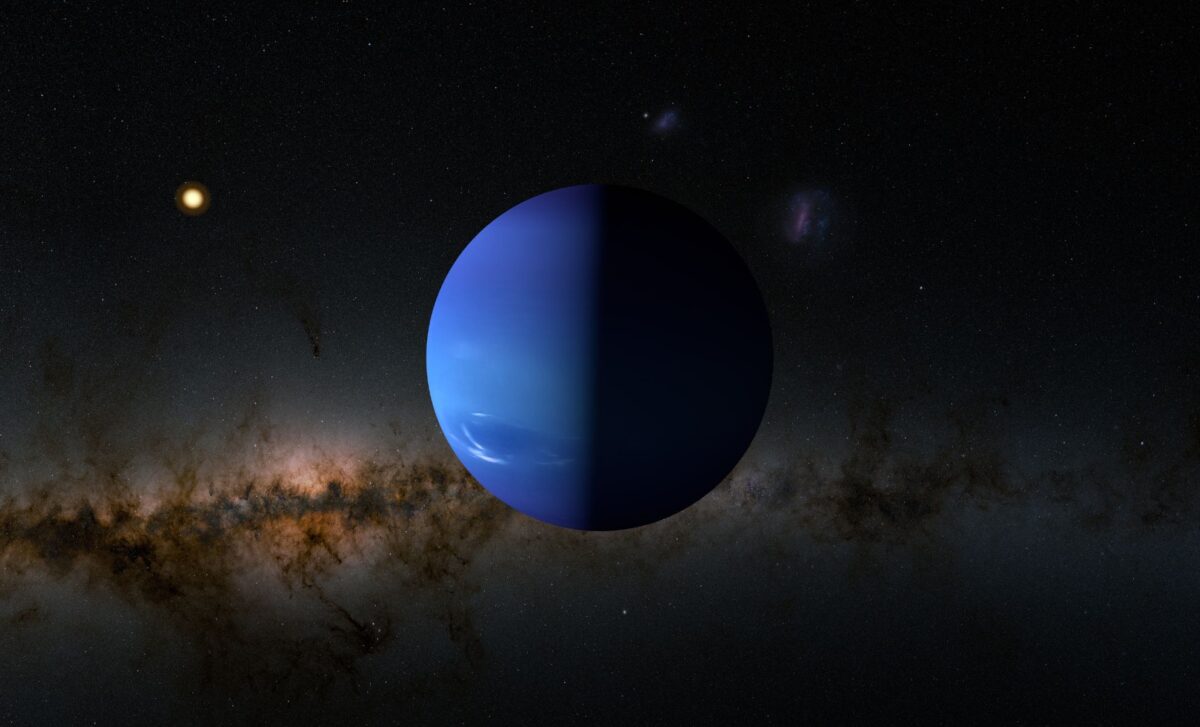
Something unusual may be happening to matter deep inside Uranus and Neptune. New simulations suggest that carbon hydride could form a strange superionic state under extreme conditions.
Interest in planetary interiors has grown as more than 6,000 exoplanets have been discovered so far. Researchers are trying to understand how planets form and evolve by combining observations, experiments, and simulations, especially when it comes to how magnetic fields are generated.
In our own Solar System, Uranus and Neptune are believed to contain layers often called “hot ices” beneath their outer atmospheres. These regions are made of water, methane, and ammonia, but under extreme pressure and heat, these familiar compounds behave in very unfamiliar ways.
Simulating Extreme Conditions Inside Ice Giants
To dig into this, Cong Liu and Ronald Cohen ran detailed quantum simulations using high-performance computing and machine learning. According to their study published in Nature Communications, they tested pressures between 500 and 3,000 gigapascals and temperatures from 4,000 to 6,000 kelvin.
They focused on carbon hydride (CH), a simple mix of two elements commonly found in planetary interiors. Under these extreme conditions, the material showed behaviors that simply don’t exist on Earth.
A Spiral Superionic State
What stood out most was the appearance of a quasi-one-dimensional superionic state of matter. In this structure, carbon atoms form a stable framework, while hydrogen atoms move through it along spiral, almost corkscrew-like paths. As Ronald Cohen explained:
“This newly predicted carbon-hydrogen phase is particularly striking because the atomic motion is not fully three-dimensional. Instead, hydrogen moves preferentially along well-defined helical pathways embedded within an ordered carbon structure.” That makes it different from other known superionic materials.
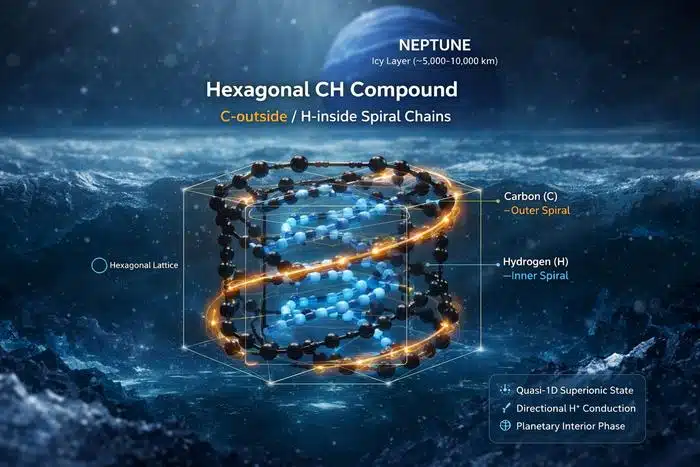 Concept of a spiral superionic carbon–hydrogen structure inside Neptune under extreme conditions. Credit: Cong Liu
Superionic states are already unusual because they act partly like solids and partly like liquids. Here, the motion is even more specific, with hydrogen moving in a more controlled, directional way.
How This Could Shape Magnetic Fields?
This kind of movement could affect how heat and electricity travel through matter inside planets. According to the researchers, that’s directly linked to how magnetic fields are generated.
Uranus and Neptune have oddly shaped magnetic fields compared to other planets. A layer of matter with this kind of directional behavior could help explain why.
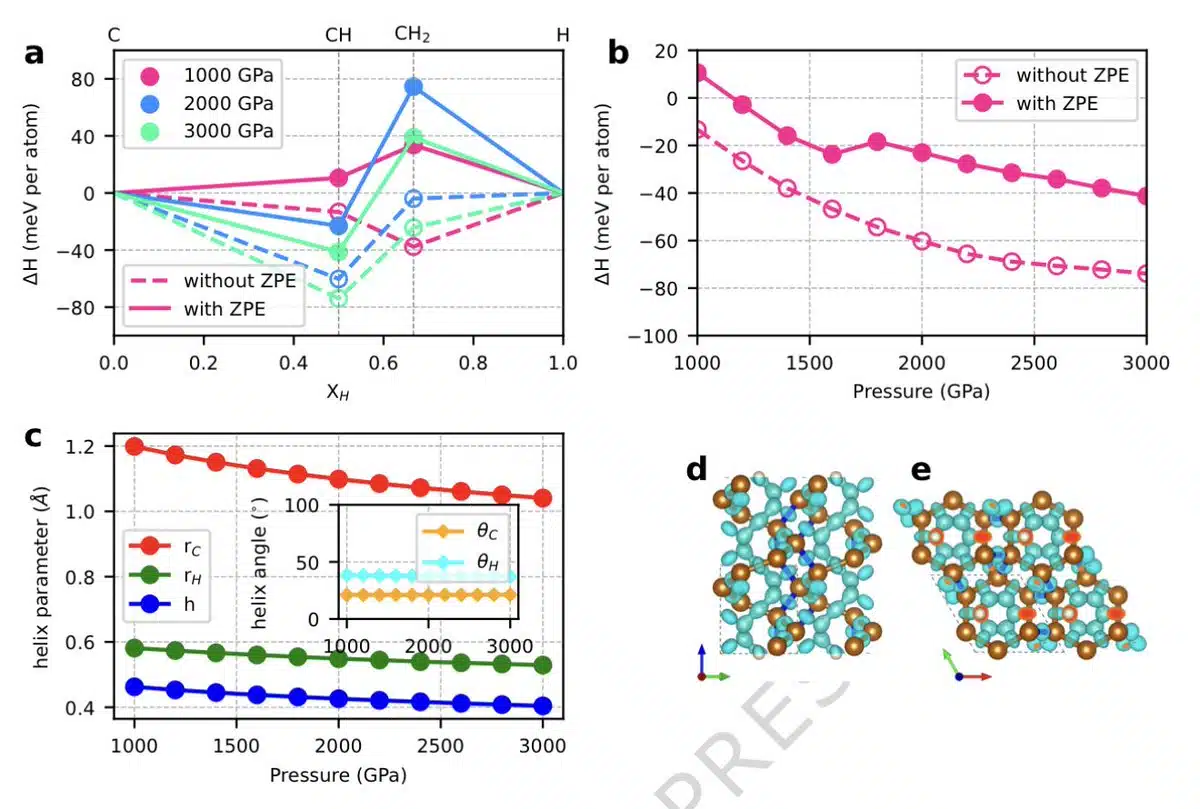 Simulated structure of carbon hydride at extreme conditions. Credit: Nature
According to Cong Liu, even though carbon and hydrogen are very common in planetary materials.
“Carbon and hydrogen are among the most abundant elements in planetary materials, yet their combined behavior at giant-planet conditions remains far from fully understood.”
Findings like this show that even the simplest elements can behave in unexpected ways when matter is pushed to its limits.