
Main pointsKey Reads
Órla Ryan – 19 minutes ago
Iran behind low-level ‘hybrid warfare’ attacks in UK, Europe, analysts say
Iranian intelligence services and Revolutionary Guards operatives are recruiting teenagers through criminal intermediaries to launch a wave of low-level “hybrid warfare” attacks in Europe and the UK, according to investigators, security officials, analysts and police documents.
A first wave of attacks was launched in early March, 10 days after the US and Israel began strikes on Iran, and targeted Jewish community sites in Belgium, the Netherlands and US banks. A second wave has focused on the UK, with a series of arson and attempted arson attacks on synagogues, a Jewish charity and the offices of an Iranian opposition TV network in London.
On Tuesday, British police said they had arrested seven people for allegedly plotting a further firebombing, and a teenager pleaded guilty to an arson attack on a synagogue in west London on Saturday.
Analysts and security officials say that although there is no direct proof of Iran’s involvement, multiple factors strongly suggest the attacks are part of a campaign of hybrid warfare launched by Tehran to destabilise US allies and warn of them potential cost of greater involvement in the conflict, while also harming Jewish communities seen as supportive of Israel. – The Guardian
Message from the Editor
 Irish Times Editor Ruadhán Mac Cormaic
Thanks for reading. If you’re interested in world news, The Irish Times has the largest network of foreign correspondents of any Irish news organisation.
Our team provides sharp reporting, in-depth analysis and thought-provoking commentary. Receive our Global Briefing newsletter in your inbox every morning to enjoy Denis Staunton’s guide to understanding world events; what’s happening, why it matters and how it affects you.
At The Irish Times, our journalism is free of any personal, political or commercial control. Unlike most publishers, we have no shareholders to satisfy, no media baron owner in the background telling us what we can and cannot publish.
We are owned by a Trust that mandates us to uphold a set of public-interest values. Those values describe a worldview that is outward-looking, tolerant, curious, interested in divergent views and attentive to the needs of minorities.
Our watchwords are fairness and accuracy. Our goal is to enable you to make informed and independent judgments. And any profit we make goes towards supporting our journalism.
Ruadhán Mac Cormaic
Editor
To join Ireland’s biggest community of news subscribers, sign up here
Órla Ryan – 47 minutes ago
European gas prices up
European gas prices are up 4.3 per cent, to €45.40 per megawatt hour.
The month-ahead UK wholesale gas contract is up 4.8 per cent at 113.7p (€1.31) per therm, its highest in over a week. Before the Iran war began at the end of February, UK gas was trading below 80p (92c) a therm, but rose as high as 180p (€2.07) /therm in March. – The Guardian
Israeli strikes kill journalist in Lebanon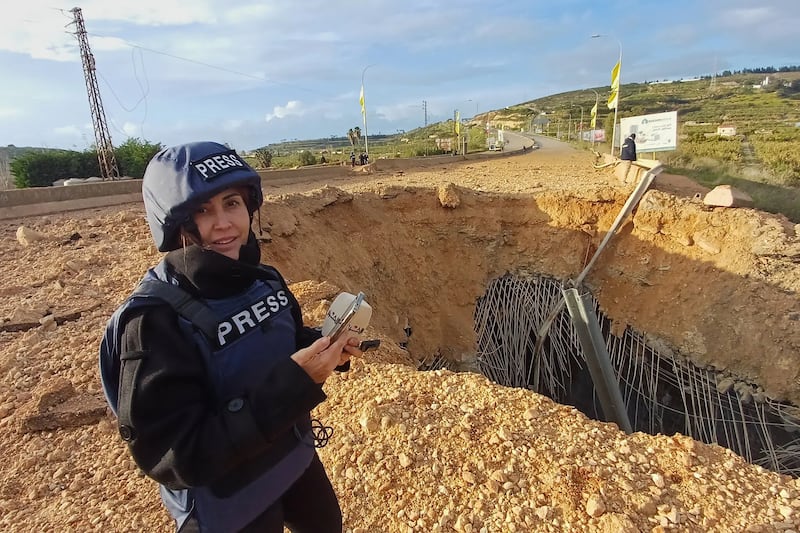 Amal Khalil, who worked for Al-Akhbar, reporting near a destroyed bridge last month. She was killed on Wednesday. Photograph by Mohammed Zaatari/Associated Press
Israeli strikes killed one journalist and wounded another in southern Lebanon on Wednesday, rattling a tenuous ceasefire between Israel and Lebanon.
The Lebanese ministry of public health said the Israeli military had targeted the journalists in the town of Tayri, where they took shelter in a nearby house after an air strike struck a vehicle in front of the car they were travelling in.
About an hour-and-a-half later, a second strike hit the house they were hiding in, according to a statement by a Lebanese newspaper Al-Akhbar, which employed the journalist who was killed.
The Lebanese Red Cross said its teams came under fire while trying to evacuate the journalists from the house, forcing them to withdraw. The rescue crews were targeted by a warning strike and machine-gun fire, the Lebanese health ministry said.
Zeinab Faraj, a photojournalist, was rescued from the house. The other journalist, Amal Khalil, who was a reporter for Al-Akhbar, remained trapped under rubble for hours before emergency medics recovered her body, according to Lebanon’s civil defence.
Euro zone yields climb for fourth day amid Iran-US stalemate
Euro zone short-dated government bond yields rose for a fourth consecutive session on Wednesday, as tensions surrounding the Strait of Hormuz bolstered expectations of further European Central Bank rate hikes later this year.
Borrowing costs have tracked gains in oil prices, which have stoked concerns about inflation and raised the prospect of a swift hawkish response from the ECB.
Investors will closely watch PMI data later in the session, especially price indices, for clues on the inflationary effects of higher energy costs.
Germany’s two-year yields, more sensitive to expectations for policy rates, rose 3 basis points (bps) at 2.57 per cent. They reached 2.771 per cent in late March, the highest since July 2024.
Germany’s 10-year government bond yield rose 4 bps to 3.04 per cent. It reached 3.13 per cent in late March, its highest level since June 2011.
Money markets priced in an ECB deposit facility rate at 2.59 per cent by year-end, implying two hikes and an about 35 per cent chance of a third move, from around 2.35 per cent late Friday.
Italy’s 10-year government bond yields rose 6 bps to 3.85 per cent. The yield gap of Italian government bonds versus Bunds was at 76 bps. It was at 63 bps before the attack against Iran and hit 103.62 during the conflict, the highest since June 2025. – Reuters
Israel buys more aerial munitions
The Israeli defence ministry said it has bought $200 million (€170 million) worth of aerial munitions from arms manufacturer Elbit Systems.
The ministry said the deal for missiles and other weaponry for strikes and interceptions was part of “improving readiness for immediate combat scenarios and preparing for a decade of strong defences”.
A similar deal was signed between the ministry and Elbit for aerial munitions in January for $183 million (€156 million). – The Guardian
Senior US navy official is reportedly fired
The Pentagon announced on Wednesday that the US navy’s top civilian official, John Phelan, the secretary of the navy, is leaving his job.
In a statement posted to social media, Sean Parnell, a Pentagon spokesperson, said Phelan was “departing the administration, effective immediately”.
Hung Cao, the navy undersecretary, would become acting secretary of the navy, Parnell said.
Reuters, citing an anonymous source, reported Phelan had been fired by the Pentagon.
The sudden departure comes just a day after Phelan addressed a large crowd of sailors and industry professionals at the navy’s annual conference in Washington, DC, and spoke with reporters about his agenda.
Phelan’s departure also comes just weeks after Pete Hegseth, the defence secretary, fired the army’s top officer, Gen Randy George. Hegseth also has fired several top generals, admirals and other defence leaders since taking office last year.
As with many of those other firings, Pentagon officials did not offer a reason for Phelan’s departure. – The Guardian
Oil prices rise as peace talks stall
Oil prices extended their gains on Thursday in the wake of stalled peace talks between Iran and the United States, and as both nations maintained restrictions on the flow of trade through the Strait of Hormuz.
Brent crude futures rose $1.37 (€1.17), or 1.3 per cent, to $103.28 (€88.22) a barrel on Thursday morning, after settling above $100 (€93.96) for the first time in more than two weeks on Wednesday. West Texas Intermediate futures were also up $1.52 (€1.29), or 1.6 per cent, at $94.48 (€80.70).
Both benchmarks closed more than $3 higher on Wednesday after larger-than-expected gasoline and distillate stock draws in the US, and over the lack of progress on Iran peace talks.
“The oil market is repricing expectations with little sign of progress in finding a resolution in the Persian Gulf,” said ING analysts in a note, adding that hopes for a resolution are fading as peace talks stall.
“In addition, Iran’s seizure of two vessels attempting to transit the Strait of Hormuz suggests disruptions to shipments are set to continue.”
While US president Donald Trump extended a ceasefire between the countries following a request by Pakistani mediators, Iran and the US are still restricting the transit of ships through the strait, which carried about 20 per cent of daily global oil supplies until the war began on February 28th. – Reuters
Iran seizes ships in Strait of Hormuz ahead of possible new talks
Iran seized two ships in the Strait of Hormuz on Wednesday, tightening its grip on the strategic waterway amid reports that peace talks could begin on Friday, Mark Weiss in Jerusalem writes.
In a statement on Wednesday, Iran’s Islamic Revolutionary Guard Corps said the ships seized, which they identified as the Panama-flagged MSC Francesca and the Liberia-flagged Epaminodes, were detained for “operating without the required authorisation and for manipulating navigation systems” and were transferred to Iranian shores.
The Greek-operated Epaminondas reported being fired upon off Oman. It said it had sustained damage to its bridge and that no one was hurt in the incident.
The ship seizures represent a serious escalation in the Strait of Hormuz, where a battle for control of the vital waterway has emerged as a major stumbling block in negotiations to end the war.